
- Is the IBM Data Science Professional Certificate Worth It?
- What Is the IBM Data Science Professional Certificate?
- Who Is This Certificate For?
- What You’ll Learn
- How Long Does It Take?
- How Much Does It Cost?
- Course Contents And Structure
- How Do You Get the Certificate?
- Where It Falls Short
- Other Data Certifications Worth Considering
- Other IBM Professional Certificates
- Frequently Asked Questions

The IBM Data Science Professional Certificate is worth it if you are a beginner who wants a structured, low-cost start in data science. It costs $49 per month on Coursera, Coursera estimates about 4 months at 10 hours a week, and it is recommended for up to 12 college credits. It is not worth it if you already work with Python or data, because the courses stay at an introductory level.
We went through the program’s lessons, labs and quizzes when we first reviewed it, and we have checked every course against Coursera again for this update. The biggest changes since then are two new courses, one on generative AI for data scientists and one on job search and interview preparation, which bring the program to 12 courses.
In this review, we explain what you learn in each course, how long it really takes, what it costs, where it falls short, and how it compares with other data certifications.
| IBM Data Science Professional Certificate | At a glance |
|---|---|
| Provider | IBM, on Coursera |
| Level | Beginner, no degree or programming experience required |
| Courses | 12 |
| Duration | 4 months at 10 hours per week (about 178 hours) |
| Cost | $49 per month after a 7-day free trial |
| College credit | ACE and FIBAA recommend up to 12 college credits and 6 ECTS credits |
| Rating | 4.6 out of 5 from 151,179 reviews |
| Enrolled | 960,823 learners |
| Registration | Enroll on Coursera |
Is the IBM Data Science Professional Certificate Worth It?
Yes, for beginners. It’s one of the most complete entry-level data science programs online, and one of the best Coursera certificates overall.
Here is why we recommend it to people starting out:
- It assumes no experience. You start with what data science is and build up to Python, SQL and machine learning step by step.
- It is practical. Most courses have hands-on labs with Python, SQL, Pandas, scikit-learn and Jupyter, and the capstone gives you a project for your portfolio.
- It is affordable. At the suggested pace of 4 months, the total cost is about $196.
- It carries college credit. ACE and FIBAA recommend up to 12 college credits, which you claim through your Credly badge.
- It prepares you for the job search. The last course covers your portfolio, resume and interviews, and you can join IBM’s Talent Network.
Is an IBM certificate recognized? Yes. IBM is a well-known name in data and AI, and the certificate carries college credit recommendations. Employers still care most about what you can do, so treat it as a strong start, not the finish line.
What Is the IBM Data Science Professional Certificate?
The IBM Data Science Professional Certificate is an online program created by IBM and delivered on Coursera. It teaches the skills you need for an entry-level data scientist job, and it is suitable for people with no prior experience or related degree.
Over 12 courses, you learn the theory of data science and how to work with data in Python and SQL, build machine learning models, and present your findings with visualizations and dashboards.
Who Is This Certificate For?
This certificate is for people who want to start a career in data science or data analysis, including career changers with no programming background.
When you finish, you’ll have the skills for entry-level roles such as:
- Business Intelligence Analyst
- Data Analyst
- Data Architect
- Data Engineer
- Data Scientist
- Machine Learning Engineer
- Marketing Analyst
- Operations Analyst
- Quantitative Analyst
You can also join IBM’s Talent Network, where you see job openings from IBM and other employers looking for data talent.
What You’ll Learn
The certificate covers both the theory and the practice of data science. Most courses are hands-on, with labs in the IBM Skills Network environment.
The most important learning outcomes are:
- What data science is and how it works
- What do data scientists/analysts do on a daily basis?
- How to use Python to perform data analysis
- How to work with SQL data sets and various visualization tools
- What is machine learning and how to use ML for data analysis
- How to use tools like Jupyter, GitHub, and RStudio
- How to work with various data libraries including Pandas, NumPy, Matplotlib, Seaborn, Folium, Scikit-learn, SciPy, etc.
- How to create dashboards and interactive reports
How Long Does It Take?
Coursera estimates 4 months at 10 hours a week, about 178 hours in total. At 5 hours a week, expect about 8 months. If you already know some Python or SQL, you can move through the early courses much faster.
There are no deadlines, so the challenge is keeping a schedule. The courses build on each other, and the programming courses take the longest, especially if you have never coded before.
How Much Does It Cost?
The certificate is part of a Coursera subscription:
| Cost | Details |
|---|---|
| Subscription | $49 per month |
| Free trial | 7 days |
| Typical total | About $196 at the suggested pace of 4 months |
| Audit option | You can audit the course material for free, but you need a subscription for graded work and the certificate |
| Financial aid | Available from Coursera |
Because you pay by the month, the faster you finish, the less it costs.
Course Contents And Structure
The certificate includes 12 courses. This is how long each one takes, according to Coursera:
| Course | Estimated Time |
|---|---|
| 1. What is Data Science? | 12 hours |
| 2. Tools for Data Science | 16 hours |
| 3. Data Science Methodology | 9 hours |
| 4. Python for Data Science, AI & Development | 24 hours |
| 5. Python Project for Data Science | 7 hours |
| 6. Databases and SQL for Data Science with Python | 18 hours |
| 7. Data Analysis with Python | 16 hours |
| 8. Data Visualization with Python | 19 hours |
| 9. Machine Learning with Python | 20 hours |
| 10. Applied Data Science Capstone | 14 hours |
| 11. Generative AI: Elevate Your Data Science Career | 14 hours |
| 12. Data Scientist Career Guide and Interview Preparation | 9 hours |
| Total | About 178 hours |
1. What is Data Science?
This is the first course in the series and an introduction to data science. In about 12 hours, you learn from data science practitioners what data science is, what the job involves, which skills you need, and how businesses use data science.

It’s an easy course to follow, and you can finish it in a few sittings. Content is delivered in short videos, and the quizzes are multiple-choice questions like this example:
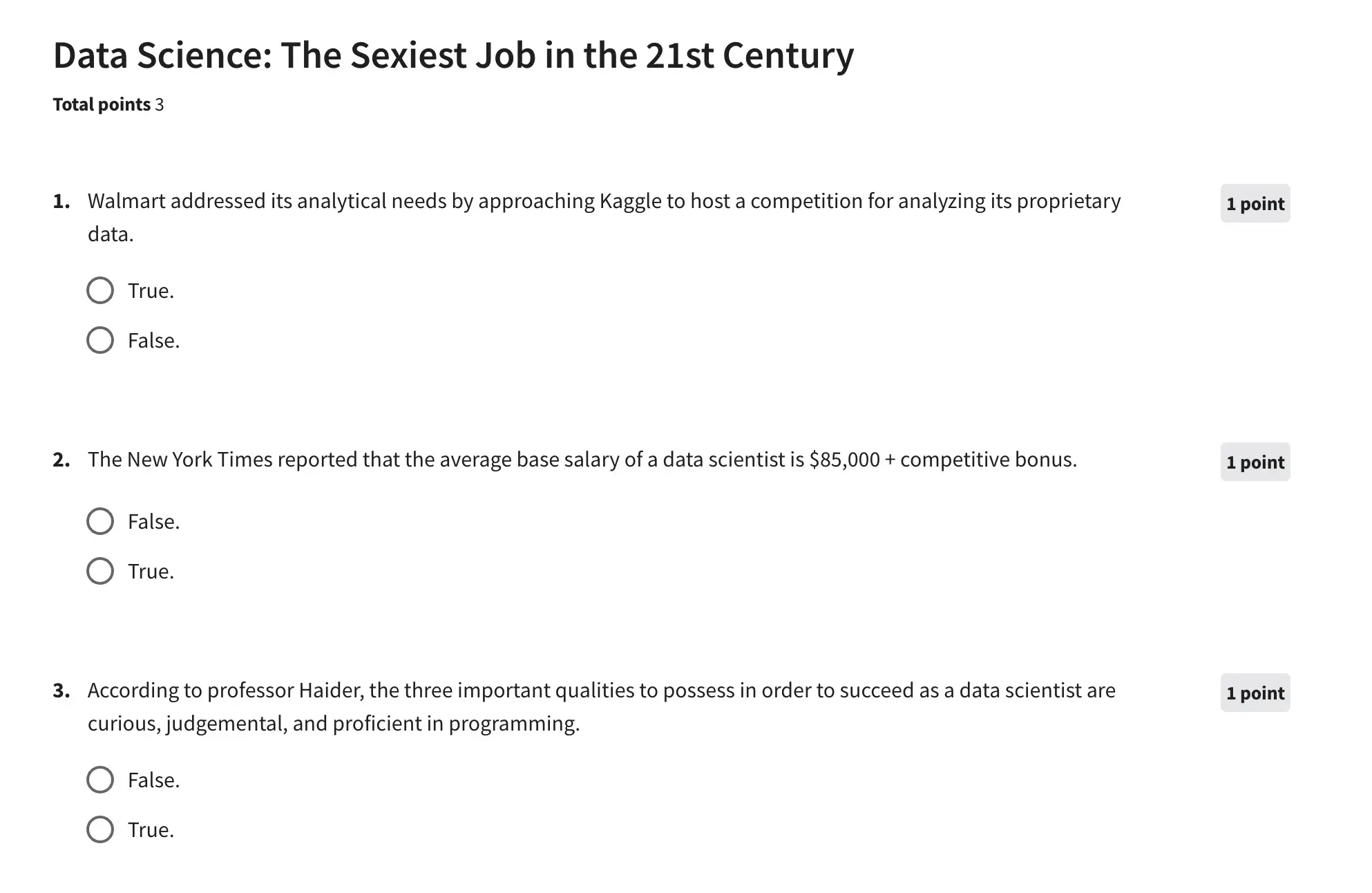
To finish the course, you submit a short written assignment and grade other students’ assignments, and you pass a multiple-choice final exam.
| Module | Topic | Time To Complete |
|---|---|---|
| Module 1 | Defining Data Science and What Data Scientists Do | 3 hours |
| Module 2 | Data Science Topics | 4 hours |
| Module 3 | Applications and Careers in Data Science | 3 hours |
| Module 4 | Data literacy for Data Science (Optional) | 2 hours |
2. Tools for Data Science
The Tools for Data Science course introduces the languages and tools data scientists use every day, including Jupyter Notebooks, JupyterLab, RStudio, Git and GitHub.
For each tool, you learn its main features through hands-on labs, and you write some simple code in Python and R.

The course takes about 16 hours and ends with a final project, where you create and share your own Jupyter Notebook.
| Module | Topic | Time To Complete |
|---|---|---|
| Module 1 | Overview of Data Science Tools | 3 hours |
| Module 2 | Languages of Data Science | 1 hour |
| Module 3 | Packages, APIs, Data Sets, and Models | 2 hours |
| Module 4 | Jupyter Notebooks and JupyterLab | 2 hours |
| Module 5 | RStudio & GitHub | 6 hours |
| Module 6 | Final Project and Submission | 3 hours |
3. Data Science Methodology
In the Data Science Methodology course, you learn how to approach a data science problem and how to think like a data scientist: from understanding the business problem and collecting data, to building a model, evaluating it and getting feedback.

The course takes about 9 hours and can easily be completed in a week.
| Module | Topic | Time To Complete |
|---|---|---|
| Module 1 | From Problem to Approach and From Requirements to Collection | 3 hours |
| Module 2 | From Understanding to Preparation and From Modeling to Evaluation | 2 hours |
| Module 3 | From Deployment to Feedback and Final Evaluation | 1 hour |
| Module 4 | Final Project and Assessment | 3 hours |
4. Python for Data Science, AI & Development
The Python for Data Science, AI & Development course is an introduction to programming with Python for people with no prior experience.
It starts with basic concepts such as expressions and variables and takes you step by step to working with data and collecting data through APIs.

The course takes about 24 hours, and it’s one of the most important in the certificate. As part of the graded work, you complete hands-on exercises in the IBM Skills Network Labs. This is what the lab environment looks like:

If you have never programmed before, you may need to redo some of the labs to gain confidence before moving on.
| Module | Topic | Time To Complete |
|---|---|---|
| Module 1 | Python Basics | 3 hours |
| Module 2 | Python Data Structures | 3 hours |
| Module 3 | Python Programming Fundamentals | 6 hours |
| Module 4 | Working with Data in Python | 6 hours |
| Module 5 | APIs and Data Collection | 7 hours |
5. Python Project for Data Science
The Python Project for Data Science course is the shortest in the certificate, with about 7 hours of material. You need to complete the Python course first.
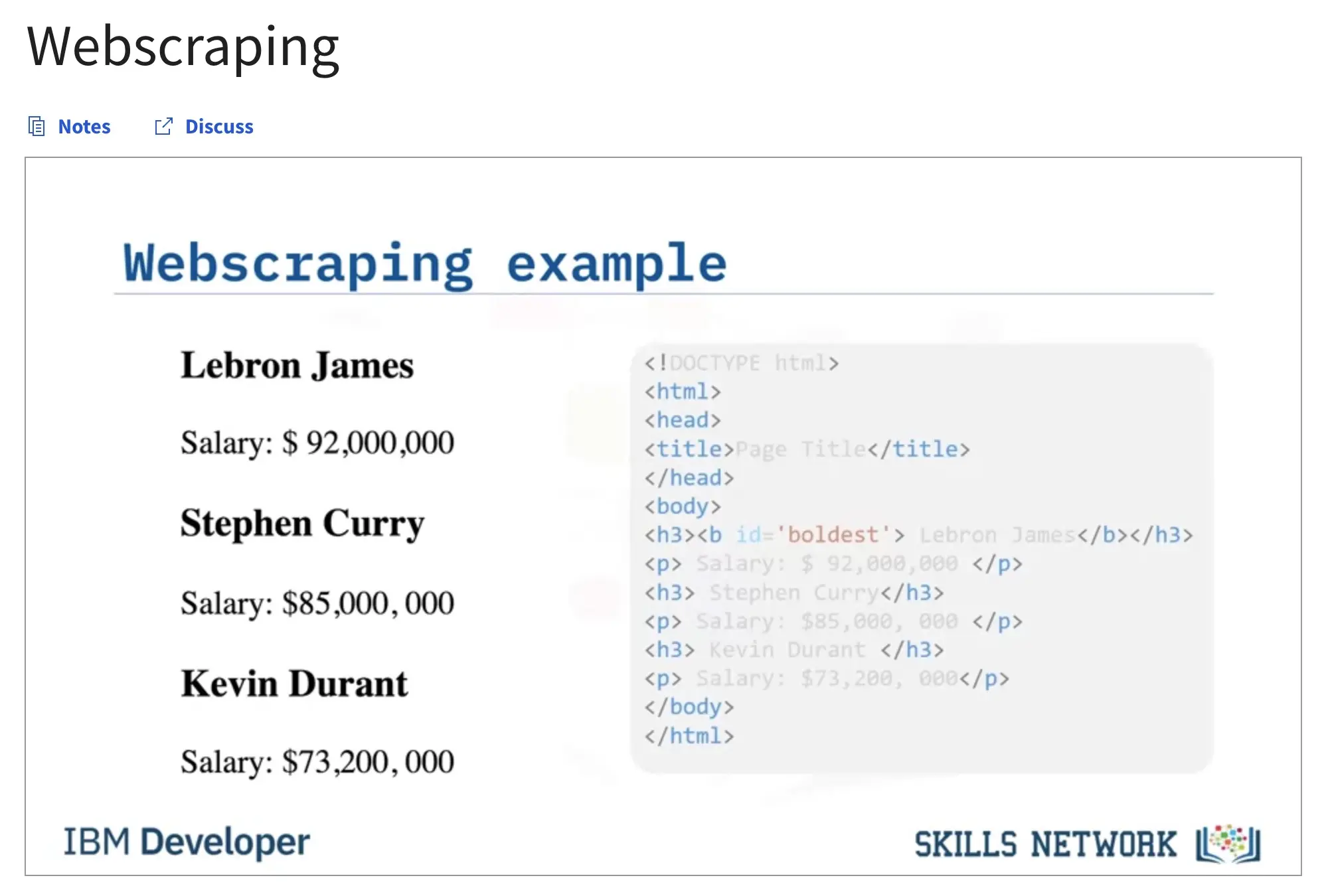
You work on a real project: collecting stock and revenue data with Python, including web scraping, analyzing it, and presenting your findings in a dashboard.
| Module | Topic | Time To Complete |
|---|---|---|
| Module 1 | Crowdsourcing Short squeeze Dashboard | 4 hours |
| Module 2 | Final Project | 3 hours |
6. Databases and SQL for Data Science with Python
The Databases and SQL for Data Science with Python course focuses on relational databases and the SQL language, one of the most important skills for a data scientist.
In about 18 hours, you learn how relational databases work, how to write basic and intermediate SQL queries, and how to access databases from Python in Jupyter notebooks. A bonus module covers advanced SQL for data engineers.
| Module | Topic | Time To Complete |
|---|---|---|
| Module 1 | Getting Started with SQL | 2 hours |
| Module 2 | Introduction to Relational Databases and Tables | 3 hours |
| Module 3 | Intermediate SQL | 3 hours |
| Module 4 | Accessing Databases using Python | 5 hours |
| Module 5 | Course Assignment | 3 hours |
| Module 6 | Bonus Module: Advanced SQL for Data Engineers | 3 hours |
7. Data Analysis with Python
This course goes deep into data analysis with Python. After building your programming and SQL skills, you learn how to import data sets, clean them, explore them, and build and evaluate models.
You work with popular libraries such as Pandas, NumPy and SciPy. It’s a highly practical course that simulates the work of a data analyst, and it ends with a final assignment.
| Module | Topic | Time To Complete |
|---|---|---|
| Module 1 | Importing Data Sets | 2 hours |
| Module 2 | Data Wrangling | 2 hours |
| Module 3 | Exploratory Data Analysis | 3 hours |
| Module 4 | Model Development | 3 hours |
| Module 5 | Model Evaluation and Refinement | 2 hours |
| Module 6 | Final Assignment | 4 hours |
8. Data Visualization with Python
The Data Visualization with Python course is about presenting your findings clearly. You learn to use Python libraries such as Matplotlib and Seaborn for charts, Folium for maps, and Plotly and Dash to build interactive dashboards.
The official estimate is about 19 hours, but it may take you longer: some lab instructions are not very clear, and you may need to rewatch the videos to get them right.
| Module | Topic | Time To Complete |
|---|---|---|
| Module 1 | Introduction to Data Visualization Tools | 2 hours |
| Module 2 | Basic and Specialized Visualization Tools | 3 hours |
| Module 3 | Advanced Visualizations and Geospatial Data | 3 hours |
| Module 4 | Creating Dashboards with Plotly and Dash | 5 hours |
| Module 5 | Final Project and Exam | 5 hours |
9. Machine Learning with Python
This course introduces machine learning for real-world data analysis. You learn linear and logistic regression, build supervised and unsupervised learning models, and evaluate and validate them.
It’s a beginner course and doesn’t go deep into the math, but it takes about 20 hours and ends with a final project you can add to your portfolio.
| Module | Topic | Time To Complete |
|---|---|---|
| Module 1 | Introduction to Machine Learning | 2 hours |
| Module 2 | Linear and Logistic Regression | 3 hours |
| Module 3 | Building Supervised Learning Models | 4 hours |
| Module 4 | Building Unsupervised Learning Models | 3 hours |
| Module 5 | Evaluating and Validating Machine Learning Models | 4 hours |
| Module 6 | Final Project and Exam | 4 hours |
10. Applied Data Science Capstone
The capstone is the final hands-on project, where you practice everything from the previous courses. You need to complete the earlier courses first.
In the scenario, you work for a company competing with SpaceX and use data to predict whether the first stage of a rocket will land successfully, which drives the cost of a launch. Along the way, you collect and wrangle data, explore it, build an interactive dashboard, train classification models and present your results. It takes about 14 hours.
| Module | Topic | Time To Complete |
|---|---|---|
| Module 1 | Introduction | 4 hours |
| Module 2 | Exploratory Data Analysis (EDA) | 2 hours |
| Module 3 | Interactive Visual Analytics and Dashboard | 3 hours |
| Module 4 | Predictive Analysis (Classification) | 1 hour |
| Module 5 | Present Your Data-Driven Insights | 4 hours |
11. Generative AI: Elevate Your Data Science Career
This course was added to the certificate as generative AI became part of data science work. In about 14 hours, it shows how data scientists can use generative AI tools in their day-to-day work, and where those tools fall short. It ends with a final project and exam.
| Module | Topic | Time To Complete |
|---|---|---|
| Module 1 | Data Science and Generative AI | 5 hours |
| Module 2 | Use of Generative AI for Data Science | 7 hours |
| Module 3 | Final Project and Exam | 2 hours |
12. Data Scientist Career Guide and Interview Preparation
The final course, about 9 hours long, helps you turn the certificate into a job. It covers preparing your portfolio and resume, applying for roles, and getting ready for data science job interviews.
| Module | Topic | Time To Complete |
|---|---|---|
| Module 1 | Building a Foundation | 4 hours |
| Module 2 | Applying and Preparing to Interview | 3 hours |
| Module 3 | Interviewing | 3 hours |
How Do You Get the Certificate?
To earn the IBM Data Science Professional Certificate, you have to complete all 12 courses and pass their graded assignments. There is no final proctored exam.
Graded work includes multiple-choice quizzes, hands-on labs, short written assignments and peer-graded projects, where you review other students’ work. If you go through the lessons and follow the lab instructions carefully, you should pass on the first attempt. If you fail a graded quiz, you can retake it, with a waiting period after several attempts.
When you finish, IBM issues a certificate and a Credly digital badge that you can share on LinkedIn and add to your resume. The badge also carries the ACE and ECTS credit recommendation.
You can see below some sample exam questions to get an idea of what the quizzes look like.


Where It Falls Short
The certificate is a good introduction, but it has clear limits:
- It stays at an introductory level. It covers the whole data science workflow, so none of it in depth. You won’t finish as a machine learning specialist.
- Some labs are heavily guided. Many exercises give you most of the code, so you learn less than if you built things from scratch.
- It doesn’t prove experience. Graded assignments are not a proctored exam, and hiring managers will still want to see your own projects.
- It takes discipline. It’s self-paced with no deadlines, and about 178 hours is a lot to fit around a job.
- The monthly fee rewards speed. If you study slowly, the cost goes up every month.
Data science still pays well once you get there: according to Indeed, the average data scientist in the US earns $130,199 a year, although entry-level roles pay less (see our list of the highest paying marketing jobs for data roles in marketing).
Other Data Certifications Worth Considering
If the IBM Data Science certificate isn’t quite right for you, these are the closest alternatives:
| Certificate | Best For | Cost | Duration |
|---|---|---|---|
| IBM Data Analyst Professional Certificate | The fastest, gentlest way into a data job | $49 per month | 4 months at 10 hours a week |
| Google Data Analytics Professional Certificate | Breaking into data analysis from any background | $49 per month (about $294) | 6 months at under 10 hours a week |
| Google Advanced Data Analytics Professional Certificate | Moving from analyst to data scientist work | $49 per month (about $294) | 6 months at under 10 hours a week |
| IBM Data Engineering Professional Certificate | Building the data pipelines that analytics and AI depend on | $49 per month | 6 months at 10 hours a week |
| IBM AI Engineering Professional Certificate | Learners who already know Python and want to build deep learning models | $49 per month | 4 months at 10 hours a week |
The Google certificates are compared in our guide to the best Google certifications.
If data isn’t the career you want, a digital marketing certification is another way into a growing field, with no programming required.
Other IBM Professional Certificates
Many of the courses in this certificate are shared with other IBM programs, so after you finish, a few extra courses can earn you another certificate, such as the IBM Data Analyst or IBM Data Engineering Professional Certificate. See our list of the best IBM courses for the full range.
Frequently Asked Questions
Is the IBM Data Science Professional Certificate recognized by employers?
Yes. IBM is a well-known name in data and AI, and the certificate is recommended for college credit by ACE and FIBAA. For most employers, it works best alongside a portfolio of your own projects rather than on its own.
Can I get a job with the IBM Data Science Professional Certificate?
You can, especially for entry-level roles such as data analyst or junior data scientist. Your chances improve if you also build your own projects and put them on GitHub, beyond the capstone that every graduate completes.
Is the IBM Data Science Professional Certificate free?
No. It costs $49 per month on Coursera after a 7-day free trial, and financial aid is available. You can audit the course material for free, but not earn the certificate.
How long does it take to get the IBM Data Science Professional Certificate?
Coursera estimates 4 months at 10 hours a week, about 178 hours in total. With some Python or SQL experience and more study time per week, you can finish faster.
Does the IBM Data Science Professional Certificate count for college credit?
Yes. ACE and FIBAA recommend up to 12 college credits and 6 ECTS credits. Whether a college accepts them is up to that college.