
Remarketing Vs. Retargeting
Remarketing and retargeting are often used interchangeably, but they have distinct differences in how they re-engage potential customers. Both marketing tactics aim to bring back people who have previously interacted with your business, but they do so in different ways.
In short, retargeting uses paid ads to reach anonymous people who visited your website or engaged with your brand, while remarketing uses direct channels like email to re-engage people whose contact details you already have, such as customers and subscribers.
| Retargeting | Remarketing | |
|---|---|---|
| Main channel | Paid ads on display networks, social media, and search | Email, SMS, and push notifications, plus ads shown to uploaded customer lists |
| Who it targets | Visitors who left without buying or sharing their contact details | Existing customers, subscribers, and leads who gave you their details |
| Data it uses | Tracking pixels and cookies (anonymous behavior) | First-party data such as email lists and CRM records |
| Funnel stage | Top and middle: bring back new visitors while their interest is fresh | Middle and bottom: repeat purchases, renewals, and cross-selling |
| Example | Showing an ad for the shoes someone viewed on your site | Emailing a customer a reorder reminder a month after purchase |

Retargeting primarily uses paid ads to reach people who have recently visited your website or engaged with your brand online. It works by tracking users through cookies or pixels and then displaying targeted ads to them as they browse other websites, social media platforms, or search engines.
Remarketing, on the other hand, typically involves email marketing to reconnect with past customers or website visitors. It often uses lists of existing contacts, such as people who signed up for a newsletter, abandoned a shopping cart, or made a previous purchase, to send personalized follow-up emails.
While email is the primary use of remarketing, it can also be done using paid ads. Popular advertising platforms like Google and Facebook allow you to upload a list of specific users to remarket with ads.
Advertising platforms don’t make a clear distinction between the two terms, which adds to the confusion. Google Ads used the word remarketing for pixel-based ads to website visitors (it now calls these audiences “your data” segments), while Meta calls both website visitors and uploaded customer lists “Custom Audiences”.
Which Is Better, Remarketing or Retargeting?
Given their similarities, you may wonder whether retargeting or remarketing is more effective for your business.
Like many things, the answer depends on what you are trying to accomplish:
- Recover abandoned carts or bring back new visitors: Use retargeting ads, because most of these people haven’t given you their email address.
- Generate repeat sales, renewals, or upsells: Use remarketing, because you already know who your customers are and what they bought.
- Build brand awareness with people who know you: Use both. Retargeting keeps you visible while they browse, and remarketing keeps you in their inbox.
The channels you already use matter too. If you have a large email list, remarketing is the cheaper place to start. If most of your traffic never signs up, retargeting is the only way to reach those visitors again.
Remarketing campaigns will likely be your ideal choice if you seek ways to engage and spark interest from an old audience.
If you want to capitalize on the fresh attention of a new user who views your site for the first time, you can create a retargeting campaign to bring them back to your site.
Most businesses can benefit from both retargeting and remarketing. In fact, the two play rather nicely together. You can use display ads and other types of retargeting to engage users at the top of the marketing funnel.
You can use email remarketing campaigns to target people at the bottom of the funnel.
What Is Remarketing And How It Works?
Remarketing is a strategy that reconnects with past visitors and customers to keep your brand top-of-mind and encourage repeat engagement. It helps nurture leads, build brand awareness, and maximize each customer’s lifetime value.
Getting started with remarketing is simple. As your business attracts website visitors, social media interactions, and customers, you can create a list of these people and use it for targeted marketing campaigns.
Once you’ve built your list, you can use various platforms to reach your audience. Some of the most effective remarketing channels include:
- Facebook Ads: You can upload email lists or phone numbers to run remarketing ads on Facebook and Instagram, allowing you to reconnect with users where they already spend time.
- Google Ads: With your data segments (formerly remarketing lists), you can reach your audience across websites in the Google Display Network, as well as Google Search and YouTube. You can also upload customer lists with Customer Match.
- Email Marketing: One of the most common forms of remarketing, email campaigns target past customers and subscribers with relevant offers, reminders, and updates.
There are several ways to structure a remarketing campaign, depending on your goals:
- Broad Remarketing Campaigns: These target your entire audience, such as showing a display ad to all past website visitors promoting a new product.
- Time-Based Campaigns: You can engage customers at strategic times, such as sending a reminder email a few weeks after a purchase to encourage reorders.
- Granular Targeting: This approach tailors campaigns based on user behavior, like showing ads for a specific product category to visitors who browsed that section of your site.
The different types of campaigns you can use in your strategy include:
1. Email Remarketing
This involves targeting previous customers and subscribers through email campaigns. Businesses use email marketing software to send relevant messages based on customer behavior, such as:
- Showcasing new products or exclusive offers.
- Reminding users about abandoned carts.
- Encouraging subscription renewals or repeat purchases.
2. Display Remarketing
With display remarketing, your ads appear on various websites within an advertising network, like Google Display Network. These ads can be:
- Static Ads: The same ad shown to all users.
- Dynamic Ads: Personalized ads based on what the user previously viewed or purchased.
3. Video Remarketing
If your brand uses video marketing (e.g., YouTube), you can run video remarketing campaigns that target viewers who have interacted with your content but haven’t taken action.
What Is Retargeting And How It Works?
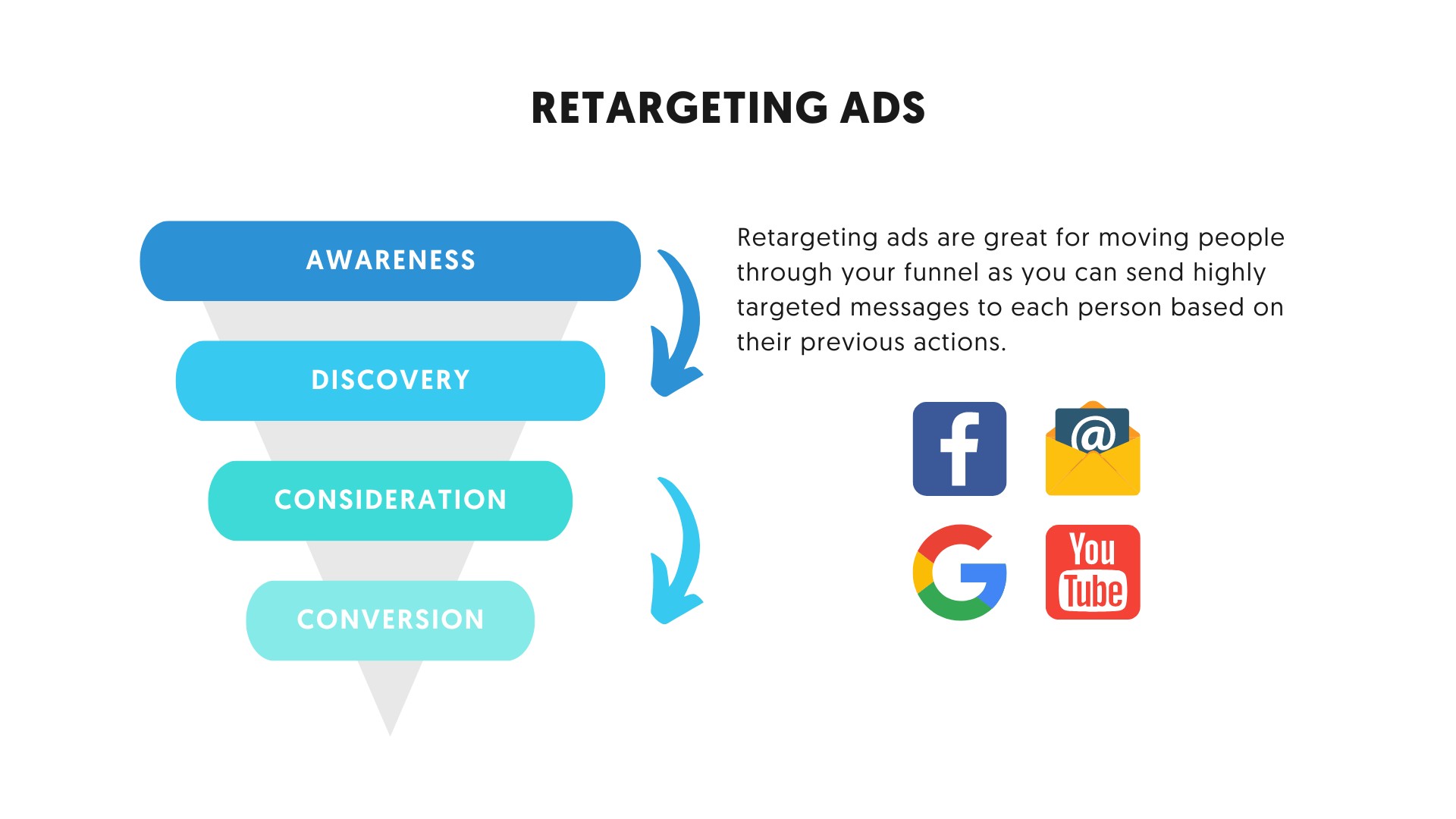
Retargeting is a marketing tactic for finding people who have interacted with your business and showing them digital advertisements to bring them back to your site.
These ads are shown to different parts of your audience based on past behavior on your site such as the pages they view.
To track the user behavior on your website, retargeting relies on tracking pixels. These small pieces of code are added to the backend of your site. They enable it to place cookies on visitors’ browsers.
Each visitor gets an anonymous ID that the ad network uses to track their behavior. With the cookies, the ad server is able to access the visitor’s ID and automatically add it to your remarketing lists.
If someone views a page or likes your post, you can quickly add them to a retargeting campaign to see if you can encourage further engagement.
Retargeting ads are usually paid per click (CPC) or per 1,000 impressions (CPM), depending on the platform and your bidding strategy.
Retargeting is an effective marketing strategy as it allows you to capitalize on your audience’s interest quickly and at scale.
Here are some of the ways you can use retargeting:
- Recovering abandoned carts: When someone leaves your site with products still in their cart you can use a retargeting ad to remind them to complete their order.
- Revisiting a specific page: When someone views a product or service page, you can create retargeting ads encouraging them to explore it further.
- Search retargeting: With this type of retargeting, you can target customers based on the keyword searches they conduct when using search engines such as Google.
- Account-based retargeting: Account-based retargeting is a strategy for acquiring new accounts by showing ads to decision-makers within your prospects’ companies.
With various ad platforms, you can filter users by position to ensure that your ads are only going to those with the authority to close the deal.
LinkedIn is one of the most popular platforms to deploy an account-based retargeting strategy.
You can use a wide variety of ad types for retargeting. This includes a mix of static and dynamic formats, as well as text and visual ads.
All of these ad types will fall into one of two categories depending on how the audience for the retargeting campaign is collected.
Pixel-based retargeting ads
This is the most common type of retargeting ad. Pixel-based ads are those that use the cookies I mentioned to gather the users to include in your campaigns.
With them, you can retarget visitors without gathering their contact information.
Pixel-based ads can be triggered instantly and automatically after someone performs an action on your site.
The ad server will track their behavior, and if their actions match the specifications of your retargeting campaign, they will be immediately added as part of the audience and eligible to receive ads when they visit the respective web properties.
List-based retargeting ads
This is a less common type of retargeting and more along the lines of a remarketing methodology.
With list-based ads, you upload a list of target audience members to your ad platform. The network then identifies the people who match the contact information you provided and shows them your ads.
While this type of ad can be highly personalized, it is far less timely. Instead of having users automatically added to a campaign, you need to take the time to upload the list.
Not once, but each time you want to expand an audience or add a new one.
Remarketing And Retargeting Examples
Retargeting examples:
- An online store shows Instagram ads featuring the exact products a visitor viewed but didn’t buy.
- A software company shows display ads offering a free trial to people who visited its pricing page.
- A B2B company runs LinkedIn ads with a case study for people who read its blog posts.
Remarketing examples:
- An abandoned cart email reminds a logged-in shopper of the items they left behind.
- A pet food brand emails customers a reorder reminder when their last bag is likely to run out.
- A course provider uploads its list of past students to Facebook and Google Ads to promote an advanced course.
Is Retargeting Still Effective?
Yes, but it has become harder. Safari blocks third-party cookies by default, Firefox isolates them, and Apple’s App Tracking Transparency lets iPhone users opt out of tracking in apps. Privacy laws in the EU and elsewhere also require consent before tracking visitors. As a result, retargeting audiences are smaller than they used to be.
This is one reason remarketing has become more important. Email lists and customer data are first-party data you own, so they aren’t affected by browser changes. The most reliable approach is to use retargeting to bring visitors back, give them a reason to share their email address, and then continue the conversation with remarketing.