

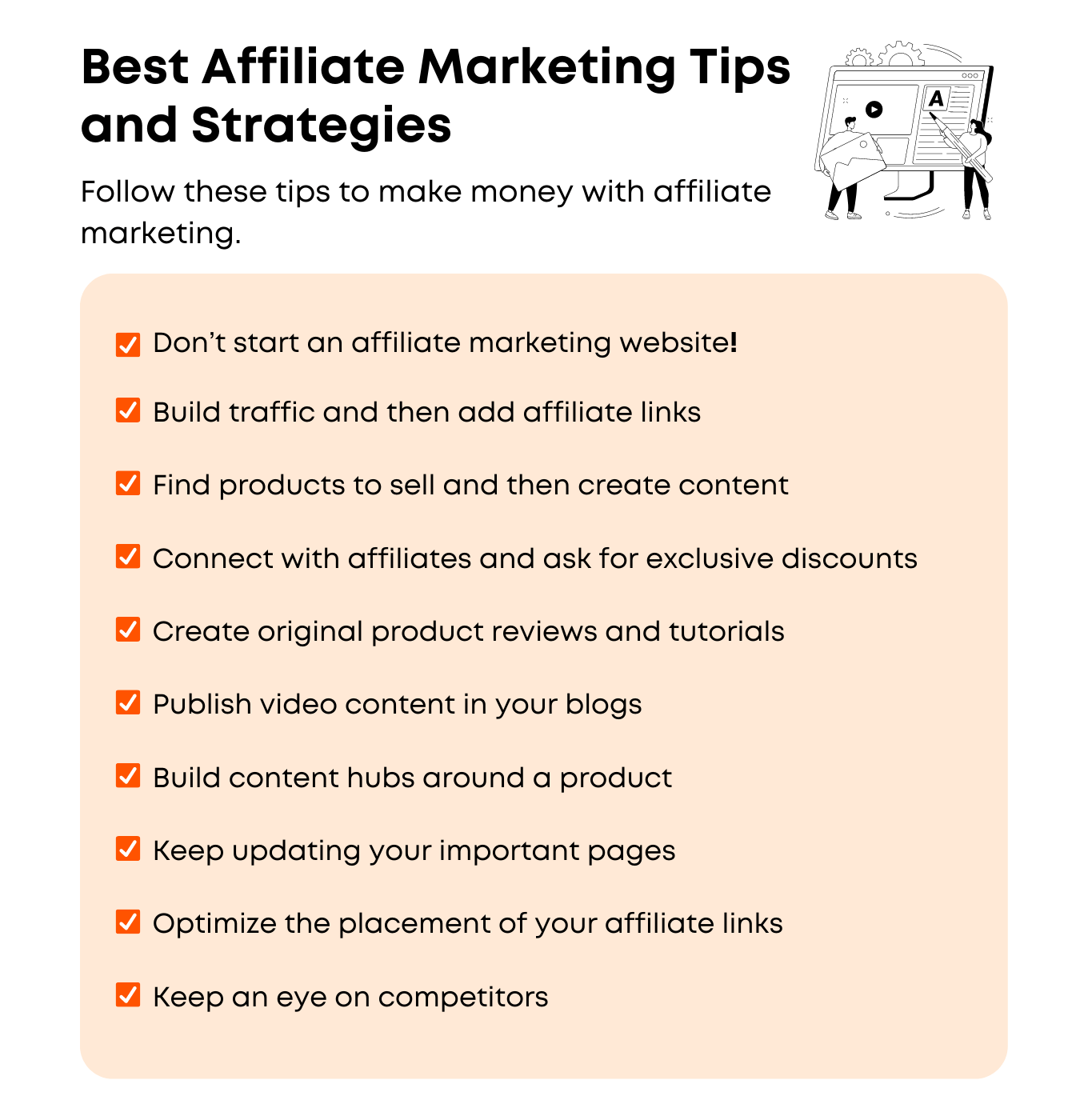
- 1. Don't Build a Website Just for Affiliate Links
- 2. Build Traffic And Then Add Affiliate Links
- 3. Find Products To Sell And Then Create Content
- 4. Connect With Affiliates And Ask For Exclusive Discounts
- 5. Create Original Product Reviews And Tutorials
- 6. Publish Video Content In Your Blogs
- 7. Build Content Hubs Around a Product
- 8. Keep Updating Your Important Pages
- 9. Optimize The Placement of Your Affiliate Links
- 10. Keep An Eye on Competitors
- 11. Always Disclose Your Affiliate Links
- 12. Grow Traffic Beyond Google and Build an Email List
- Conclusion
- Affiliate Marketing Tips FAQ


Affiliate marketing is one of the easiest ways to make money online, but that doesn’t mean it’s effortless. Many beginners jump in expecting quick results, only to get frustrated when they don’t see commissions rolling in.
Success in affiliate marketing requires strategy, consistency, and the right approach. Whether you’re just starting out or struggling to get your first $100, these 12 tips will help you avoid the most common mistakes and build a sustainable income.
1. Don't Build a Website Just for Affiliate Links
Our first tip is NOT to start a website whose only purpose is affiliate links. On the surface, this may sound counter-intuitive, but let me explain.
You should not start a website solely to promote affiliate products. There are several reasons for this.
The most important reason is that it is not a good affiliate marketing strategy. In fact, it will likely result in you having little or no success.
At its core, affiliate marketing is based on trust. People buy the products promoted by affiliates because they trust they will meet their needs. Simply promoting something doesn’t establish trust.
Despite this, many people think of affiliate marketing as a get-rich-quick scheme. This leads to many people picking up affiliate marketing, hoping to make some quick cash without actually helping their audience.
Naturally, these people don’t last long as they soon find out that affiliate marketing involves more than simply adding promotional links and banners to a website.
So, instead of making the same mistake, you should start your affiliate marketing endeavors by establishing trust, providing value, and showing your expertise.
The way to do this is by creating useful content. Once you’ve built out a solid amount of valuable content, you can then start affiliate promotions.
Start by choosing a specific niche you know or want to learn, such as home coffee equipment or project management software, instead of a broad industry. A narrow niche makes it easier to stand out as an expert. Then choose one main channel to build your audience on: a website, a YouTube channel, or a social media account. You can add more channels later, but focusing on one at the start gets you results faster.
Think of it like a business creating a product. While you may intend to make money from selling your product, it ultimately needs to serve some purpose if people are going to buy it.
We’ll discuss the best type of content to create later, but as a primer, you should plan on making most of your site’s content evergreen.
Evergreen content stays relevant over time as people continually search for it. This type of content is great for driving consistent traffic to your site. It also helps you to establish trust and authority.
Plus, many other sites will link to this type of content, further boosting your site’s performance in search engines.
2. Build Traffic And Then Add Affiliate Links
In line with tip one, our next tip is to allow your site to grow before promoting any affiliate products.
Again, the early focus of your site should be creating great content.
Having content will allow you to begin promoting products by adding affiliate links throughout the pages, but you don’t want to do so at the beginning.
Why? Because it is essentially a waste of your time and effort at this point in your business.
For one, finding the most effective way to incorporate these promotions into your site takes time. Yes, you will have to do this at some point, but it has no value in the early stages of your site.
This is because your site won’t have many (if any) visitors. Content takes time to gain traction, so you will have to wait a little while before you start getting visitors to your site.
Signing up for programs and adding links at the beginning takes effort that could be spent enhancing your content and focusing on search engine optimization (SEO).
SEO is how you get your pages to rank at the top of Google search results. It is necessary to ensure that your site receives the traffic needed to generate money from affiliate referrals.
So, the best approach is to wait until your website attracts a substantial number of visitors before registering for programs and adding links.
You’ll often have no choice but to do it in this order anyway. Many of the best affiliate programs won’t approve affiliates until they have an established website.
3. Find Products To Sell And Then Create Content
While waiting until your site is established before adding affiliate offers to your pages is best, you still want to know exactly which products you intend to promote before creating content.
Doing so will allow you to create an effective affiliate marketing strategy in which the content is centered around specific programs.
For example, let’s say you choose to become an affiliate for web hosting platforms. You start researching different affiliate programs from web hosting companies and find that Bluehost and Kinsta each have great products and programs you want to join.
With this information, you can prioritize your content by creating dedicated product reviews for each platform.
What to look for in affiliate programs
There are several important characteristics to look for in an affiliate program.
First, you should look for products relevant to the theme of your website and content. For example, if you want to create a site with cooking content, you shouldn’t look for affiliate programs for clothing companies.
Next comes the product itself. You won’t get many sales if you promote a product nobody wants. So, finding a great, easy product to sell is a crucial part of finding a good affiliate program.
After that, you can begin looking at the program itself. Naturally, you’ll first want to consider the program’s commission structure. Ideally, you want something with high commission rates to help you make more money.
The best programs offer recurring commissions. These allow you to profit the entire duration of a customer's relationship rather than just receiving a one-time payout.
Finally, check the cookie duration: how long after someone clicks your link you still get credit for their purchase. Many buyers don’t purchase on their first visit, so look for programs with cookies that last at least 30 days.
4. Connect With Affiliates And Ask For Exclusive Discounts
Our next recommendation is to work directly with affiliate partners to get access to unique promotional offers. This is one of the most overlooked affiliate marketing tactics.
It’s much easier to sell when you offer users a discount.
Many affiliate programs offer promotional offers to all affiliates who join the program. While useful, these discounts are generic, as they are offered to all affiliates.
You can take your affiliate marketing to the next level by connecting with your affiliate partner to get an exclusive discount just for you.
This will not only increase customers' incentives but also help you stand out from other affiliates competing for the same sales.
For example, readers who sign up for Semrush through our partner link get a 14-day free Pro trial, while Semrush’s public trial is 7 days.
As a buyer, that extra 7 days to test out the platform can be extremely valuable, given the cost of the subscription.
How to connect with affiliates
Before you reach out for exclusive discounts, you should follow the earlier steps in this guide. Namely, you should allow your site to grow both in authority and traffic.
Once you’ve become a successful affiliate with an established site that drives consistent revenue, you can contact your affiliate program to work on exclusive partnerships.
In some cases, affiliate partners will contact you directly. Program managers track affiliate sales, and some are proactive about rewarding and further incentivizing their best affiliates.
5. Create Original Product Reviews And Tutorials
Two types of content are particularly effective for affiliate marketing: product reviews and tutorials.
With a tutorial, you provide detailed step-by-step instructions on how to use a specific product. Tutorials can also focus on more generic knowledge rather than showcasing a particular solution.
For example, you can write a how-to tutorial on building a website.
Tutorials and similar guides focus more on providing value and generating traffic rather than turning visitors into customers.
Product reviews, on the other hand, are focused on driving sales.
With a product review, you provide a detailed description of the product, listing its key details and pros and cons.
People searching for a product review have a purchase intent; this type of content helps them finalize their decision.
Quality content is essential when creating product reviews. Potential buyers want an honest and thorough analysis of the product they are considering.
Unfortunately, many new affiliates make the mistake of repeating the main points found in existing reviews.
This lack of unique insight not only limits the SEO potential of your posts but can also leave readers questioning whether you really know anything about the product.
The best way to write a product review is to try it yourself and create completely original content with your own images and opinions.
You should provide detailed insight into the product’s strengths and weaknesses, with supporting evidence to support your points. It’s also helpful to explain how the product stands out from its competitors.
Comparison reviews
A review article doesn’t have to focus on a single product. It is common for affiliates to write reviews that compare multiple solutions.
These kinds of posts are useful for shoppers needing to evaluate competing products.
For you, comparisons are ideal for targeting non-product-specific keywords like “eCommerce platform.” They are also good for ranking keywords that contain the words “best” or “top.”
When you write a roundup review, consider including a comparison table. Comparison tables make it easy for viewers to compare different options and decide which is best for them.
For example, our list of the best affiliate marketing courses opens with a comparison table, so readers can compare the options at a glance before reading the details of each course.
6. Publish Video Content In Your Blogs
Videos are a great way to increase engagement for your affiliate blog posts while providing additional value to your viewers.
Many users prefer watching informative video content rather than reading a lengthy post.
Videos can also bring you extra visibility, because Google often shows video results for product reviews and tutorials, and YouTube is a search engine in its own right.
The best way to publish affiliate marketing videos
When it comes to adding videos to your site, there are two common approaches you can take. The first is to host the video on your site and then embed them in specific posts.
The other is to post the video on YouTube and then embed the YouTube video onto your site.
We recommend the second option. By publishing your videos on YouTube and then embedding them onto your site, you can benefit from traffic from both channels.
As more people view your YouTube videos, your following will grow, resulting in better YouTube rankings and more organic YouTube traffic.
Types of videos to create
When it comes to the details of your videos, the same subjects covered in your affiliate blogs generally work the best. Specifically, product reviews, comparisons, and how-to guides.
Like Google, these topics have strong search interest on YouTube. Naturally, they will also complement your existing content.
For example, if you have a product comparison, you can use a video to provide visual insights that aren't as easy to include as images in a blog post.
You can see this in our comparison of the best digital marketing courses. In the video, we provide a visual walk-through of each course. This helps summarize the main points of each so that viewers can better understand what the program is like.
7. Build Content Hubs Around a Product
The best way to approach your affiliate marketing content strategy is to identify all the topics and keywords around target products and then create content hubs (or topic clusters) for these subjects.
A content hub is simply a page organized around a specific topic. It serves as a hub in two ways: first, it provides detailed information on a topic, and second, it links to more thorough content pages about specific areas of the topic.
You can see this at work with our hub for the best Google career certificates. The page provides a detailed list of the best certificates and links to comprehensive reviews for each certificate on the list.
Creating content hubs strengthens your authority in your niche. It shows that your content has a connected purpose and that you’re not writing about topics that are irrelevant to your audience.
Content hubs have a similar effect to search engines. Strategically publishing and interlinking connected posts signals to Google that your site is focused on a specific topic.
8. Keep Updating Your Important Pages
Affiliate marketing content is similar to a product in that it has a life cycle. Over time, it will decay and lose value for your business.
You can keep your content fresh for users and search engines by regularly updating your pages.
Even evergreen content needs to be updated regularly as information changes and competitors find new innovative ways to cover essential topics.
Now, updating your content doesn’t mean you’ll need to rewrite each blog post from scratch. Instead, you should focus on adding new relevant paragraphs and deleting those that are outdated.
You should also check that prices, product features, and affiliate offers are still correct, and replace screenshots that show an old version of a product.
Only change the date on a post when you have made a substantial update. Google specifically warns against changing the date of pages to make them seem fresh when the content hasn’t substantially changed.
Review your most important pages, the ones that earn most of your commissions, regularly, and update them whenever products or prices change.
9. Optimize The Placement of Your Affiliate Links
Great content and affiliate products won’t do much good if you can’t get many people from your pages to the affiliate’s site. This is why link placement is a crucial part of affiliate marketing.
Good link placement leads directly to more people viewing the product page for your affiliate offers. Understandably, more viewers tend to result in more affiliate sales.
A good strategy is to include links in different places throughout your pages.
For example, in a product review, add a link near the top for readers who have already decided, a link after the section that explains the product’s main benefit, and a clear call to action at the end. In a comparison post, link each product in the comparison table as well as in its own section.
Another common tactic is to use affiliate banners. These visual assets are easy to implement as many programs offer them as promotional material for their affiliates.
However, banners tend to be less effective than contextual links.
10. Keep An Eye on Competitors
Like any type of business, analyzing the competition can be very beneficial. By actively monitoring other affiliates promoting the same products, you can ensure that you always implement the best strategies to drive results.
Start by checking what kind of content they’re publishing. If you notice they are creating styles of posts that you are not, you want to take a closer look and see if you can benefit from creating the same.
You also want to monitor how often the competition posts. A regular publishing cadence is good for attracting an engaged audience. As such, you don’t want to be too far behind your competitors in publishing frequency.
With affiliate marketing, tracking the types of offers promoted by your competitors is also important. You may discover new high-quality products that you have yet to discover.
You may also notice that they have better promotional discounts than you do. If this is the case, you will want to take action and talk to your affiliate program to see if you can get a similar offer.
Checking where competitors place their links can also be beneficial. By doing so, you may find effective placement ideas for generating many clicks.
Overall, you don’t want to copy the competition blindly. Monitoring them should serve as another form of research for developing your own affiliate marketing strategy.
11. Always Disclose Your Affiliate Links
Readers need to know when you earn a commission from a recommendation. Disclosing it builds trust, and in the United States it’s also a legal requirement.
The FTC’s guidance says a disclosure should be hard to miss and placed with the recommendation itself, not only on a separate disclosure page or at the bottom of the post. Use plain language, such as “I earn a commission if you buy through this link.”
Also mark your affiliate links for search engines. Google asks site owners to qualify affiliate links with the rel="sponsored" attribute, and still accepts rel="nofollow".
12. Grow Traffic Beyond Google and Build an Email List
Relying on one traffic source is risky. A Google update or an AI Overview can reduce your clicks overnight.
Spread your content across the platforms where people search for product advice. YouTube works well for reviews and tutorials, and Pinterest works well for visual niches like home, food, and fashion. You can also turn your content into short videos for Instagram Reels, TikTok, and YouTube Shorts.
Most importantly, build an email list. Offer a free checklist, guide, or discount in exchange for an email address, then send your subscribers useful content and relevant recommendations. Unlike search or social media traffic, your email list is an audience you own.
Conclusion
Affiliate marketing can be a powerful way to generate an online income, but it requires thought and effort. These affiliate marketing tips and tricks will help you start generating more commissions.
Affiliate Marketing Tips FAQ
How do beginners get into affiliate marketing?
Choose a niche, pick one main channel (a website, YouTube, or social media), and create helpful content for that audience. Once you have some traffic, join affiliate programs for products that fit your content and add your links. Our guide on how to start affiliate marketing walks through each step.
Which affiliate program is best for beginners?
Large programs like Amazon Associates are easy to join and have products for almost every niche, but their commission rates are low. Once your content gets traffic, look for programs in your niche with higher or recurring commissions, such as software and online courses. See our list of high-ticket affiliate programs.
What is the 80/20 rule in affiliate marketing?
It’s the idea that a small share of your content and products brings in most of your commissions. In practice, it means finding the pages and products that earn the most and spending most of your time improving and promoting them.
Can I use ChatGPT for affiliate marketing?
Yes, for research, outlines, and first drafts. But affiliate content only works if readers trust it, so add your own experience with the product, your own photos or screenshots, and honest pros and cons. Content that only repeats what’s already online won’t stand out in search or convince readers to buy.