
To add your website to Google Search Console, sign in to Search Console, add a property (a Domain property for your whole site or a URL-prefix property for one address), and verify that you own the site with a DNS record, an HTML tag, an HTML file, Google Analytics, or Google Tag Manager. Once verified, submit your sitemap so Google can find your pages.
Google Search Console is one of the most useful SEO tools, and it's free. In this guide, you'll learn how to add and verify your website step by step, which property type to choose, and what to do next to get your site on Google.
What Is Google Search Console?
Google Search Console (formerly Google Webmaster Tools) is a free tool from Google with reports you can use to see what Google knows about your website, measure your traffic and rankings in Google Search, and find and fix problems.
Before you can use it, you need to add your website and prove that you own it. Google calls each website you add a "property".
How To Add Your Website To Google Search Console
- Sign in to Google Search Console
- Add a property and choose Domain or URL-prefix
- Verify ownership of your website
- Add your website variations (URL-prefix properties only)
Step 1: Sign in to Google Search Console
Go to Google Search Console and click Start now.
Sign in with your Google account. If you don't have one, create a free Google account first.
Note: If you already use Google Analytics, sign in with the same Google account. It makes verification easier, and it's good practice to have Search Console and Analytics on the same account.

Step 2: Add a property and choose Domain or URL-prefix

Open the property selector dropdown at the top left and click Add property. Google asks you to choose between two types of website property:
| Property type | What it includes | How you verify it | Best for |
|---|---|---|---|
| Domain | Your whole domain: http and https, www and non-www, and all subdomains (for example, example.com, www.example.com, m.example.com) | DNS record only | Most websites, if you can edit your domain's DNS settings |
| URL-prefix | Only URLs that start with the exact address you enter, including the protocol (for example, https://www.example.com) | HTML file, HTML tag, Google Analytics, Google Tag Manager, or DNS | When you can't edit DNS, or you only want data for one section of a site |
I recommend a Domain property whenever you can edit your DNS settings, because it covers every version of your site in one place.
Enter your domain (for a Domain property) or your full website address (for a URL-prefix property) and click Continue.
Note: Google treats http:// and https://, as well as www and non-www, as different addresses. That matters for URL-prefix properties, but not for Domain properties. Read our guide on www or non-www to decide which version your site should use.
Step 3: Verify ownership of your website
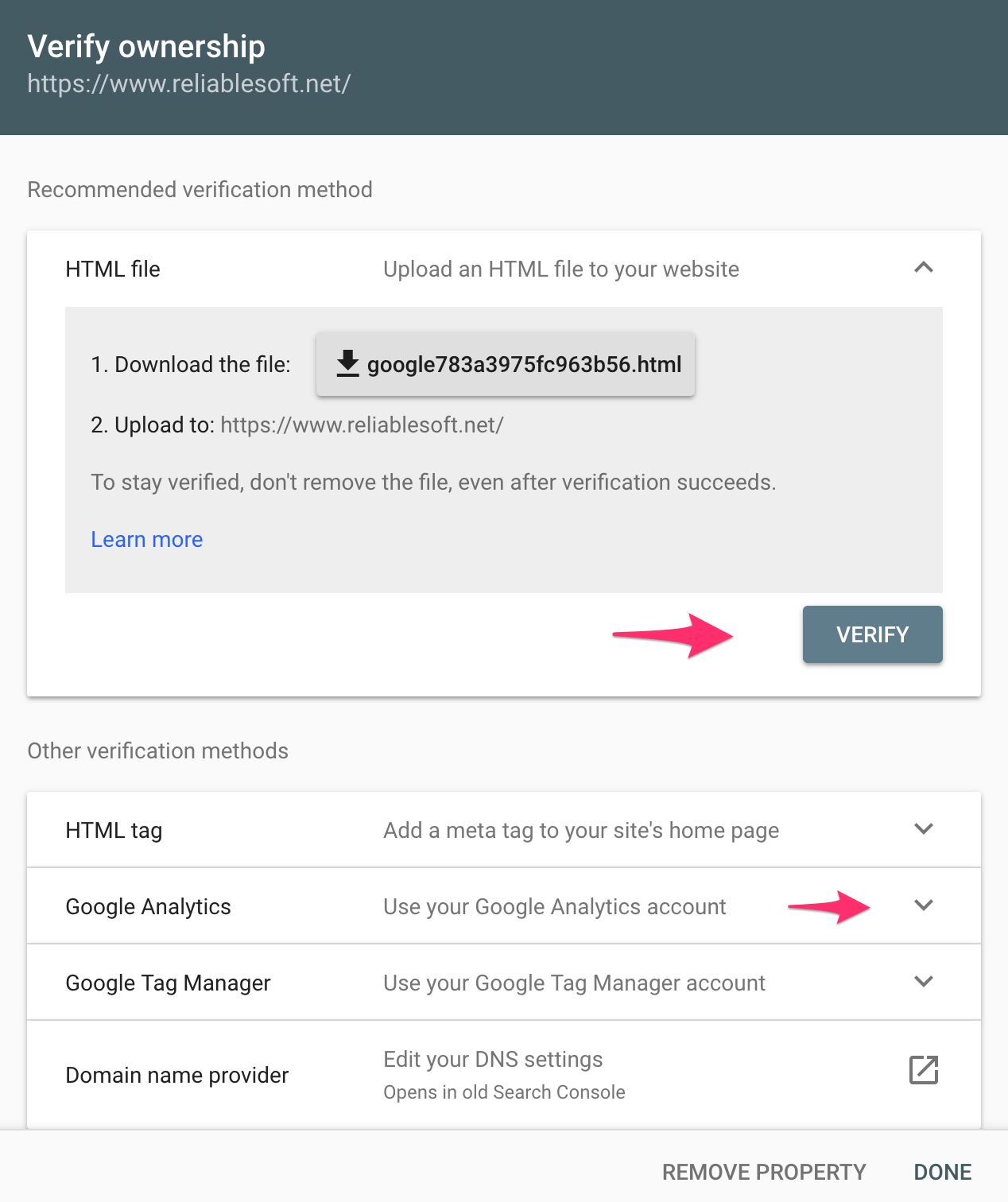
Next, you need to prove that you own the website. Google offers several verification methods.
Domain name provider (DNS record)
This is the only method for a Domain property. Google gives you a TXT record to add to your domain's DNS settings at your domain registrar or hosting provider. Once it's added, click Verify. DNS changes can take a while to take effect, so if verification fails, wait and try again. If you're not comfortable editing DNS, ask your domain provider's support team to add the record for you.
The methods below are available for URL-prefix properties.
HTML file upload
Download the HTML file Google gives you and upload it to the root folder of your website. In most cases, this is the public_html folder. Once uploaded, click the Verify button.
Note: Keep the file on your website at all times. Verification lasts only as long as the file is there, so removing it will also remove your ownership.
HTML tag

Copy the meta tag Google gives you and add it to thesection of your homepage.
If you use the Yoast SEO plugin on WordPress, go to Yoast SEO > Settings > Site connections, paste the meta tag in the Google field, and click Save changes. The screenshot below shows an older version of the Yoast settings screen.

Google Analytics
If your website already has a Google Analytics tag and you use the same Google account for Analytics and Search Console, select this method and click Verify. It's the quickest option if Analytics is already set up.

Google Tag Manager
This works the same way as Google Analytics. If your website already has the Google Tag Manager snippet and you can access that Tag Manager account, you can verify with one click.
Tip: Google recommends adding a second verification method as a backup. For example, if you verified with Google Analytics and someone removes the tag during a redesign, a second method keeps your access.
Step 4: Add your website variations (URL-prefix properties only)
If you added a Domain property, you can skip this step. A Domain property already includes every version of your site: http and https, www and non-www, and all subdomains.
If you added a URL-prefix property, it only includes the exact address you entered. To see data for the other versions of your site, repeat steps 2 and 3 for each one. For a site with HTTPS, that means up to four properties:
- http://www.example.com
- http://example.com
- https://www.example.com
- https://example.com
In practice, your main data will be in the version your site redirects to (usually one of the https addresses), but adding the others lets you spot problems with redirects and old links.
Check your settings

Go to Settings to check your ownership status and verification method, and to add, remove, or change the users who can access your property.
That's it. You can now use Search Console's reports to measure and improve your site's performance in Google.
Adding a WordPress or Website Builder Site
The steps are the same for every website, but the easiest verification method depends on your platform:
- WordPress: use the HTML tag method with an SEO plugin such as Yoast SEO or Rank Math, or connect Search Console through Google's Site Kit plugin.
- Wix, Squarespace, Shopify, and other website builders: most have a built-in field or integration for Google Search Console in their SEO or domain settings. If you bought your domain through the builder, you can usually add the DNS record there to create a Domain property.
- Blogger and Google Sites: Google can verify these automatically when you sign in with the account that owns the site.
How to Get Your Website on Google After Adding It
Adding your site to Search Console doesn't put it on Google by itself. It gives you the tools to help Google find your pages and to see how they perform. After verifying your site:
- Submit your sitemap. Go to Sitemaps and add your sitemap URL so Google can discover all your pages. See how to submit a sitemap to Google.
- Request indexing for important pages. Use the URL Inspection tool to ask Google to crawl a new or updated page. Learn how to ask Google to recrawl your site.
- Check for problems. The Pages report shows which pages are indexed and why others aren't. Here's how to fix errors in Google Search Console.
- Be patient. Google decides when and whether to index a page. New sites can take anywhere from a few days to a few weeks to appear.
To appear in other search engines as well, add your site to Bing Webmaster Tools, which also helps with search engines that use Bing's results, such as DuckDuckGo. Our guide to webmaster tools covers every major search engine.
FAQ
Is Google Search Console free?
Yes. Google Search Console is completely free, and you can add up to 1,000 properties to one account.
Should I choose a Domain or a URL-prefix property?
Choose a Domain property if you can edit your domain's DNS settings, because it covers every version of your site in one property. Choose a URL-prefix property if you can't edit DNS, or if you only want data for one section of a website.
Do I need to keep the verification code on my site?
Yes. Verification lasts only as long as your verification token (the DNS record, HTML file, or HTML tag) stays in place. If you remove it, you lose access to the property.
How long does it take for my website to show up on Google?
After you add your site and submit a sitemap, it can take from a few days to a few weeks for Google to crawl and index your pages. Adding your site doesn't guarantee that every page will be indexed.
Can I add my social media profiles to Search Console?
Yes. Besides websites, Search Console supports platform properties for your presence on supported platforms such as Instagram, TikTok, and X.
To learn how to use Search Console and the rest of SEO step by step, take our SEO course.