


Only three major search engines still offer webmaster tools: Google, Bing and Yandex. Baidu offers them too if you are targeting China. Yahoo, DuckDuckGo and Ask.com do not have tools of their own, because their web results come from other engines, and the practical answer for all three is to use Bing Webmaster Tools.
Through webmaster tools you can verify ownership of your site, submit a sitemap, ask for pages to be indexed, and see how your site performs in that engine's results.
In this guide you'll learn which search engines actually have webmaster tools in 2026, which ones don't and why, and what to use instead.
Webmaster Tools
Click one of the options below to go to the tools of the particular search engine.
- Google Webmaster Tools (Search Console)
- Bing Webmaster Tools
- IndexNow (submit to several engines at once)
- Yandex Webmaster Tools
- Yahoo Webmaster Tools
- DuckDuckGo Webmaster Tools
- Ask Webmaster Tools
- Baidu Webmaster Tools
Which Search Engines Have Webmaster Tools?
| Search engine | Has its own tools? | Where its web results come from | What to use |
|---|---|---|---|
| Yes | Its own index | Google Search Console | |
| Bing | Yes | Its own index | Bing Webmaster Tools |
| Yandex | Yes | Its own index | Yandex Webmaster |
| Baidu | Yes | Its own index | Baidu Search Resource Platform |
| Yahoo | No | Bing, exclusively since October 2019 | Bing Webmaster Tools |
| DuckDuckGo | No | Largely Bing for traditional links, plus its own crawler and partner sources | Bing Webmaster Tools |
| Ask.com | No | Partner feeds | Nothing to submit |
The short version: set up Google Search Console and Bing Webmaster Tools, and you have covered Google, Bing, Yahoo and DuckDuckGo. Add Yandex if you care about Russia and Baidu if you care about China.
What Can You Do With Webmaster Tools?
The features below are common to all webmaster tools:
- They are free to use
- They allow you to create an account and verify ownership of your website using different methods.
- They allow you to submit an XML sitemap
- They have reports for analyzing the performance of your website in their search results
- They notify you of problems related to crawling and indexing
- They allow you to manually submit pages to their index (either new or existing pages)
- They have reports for analyzing your link profile
Google Webmaster Tools
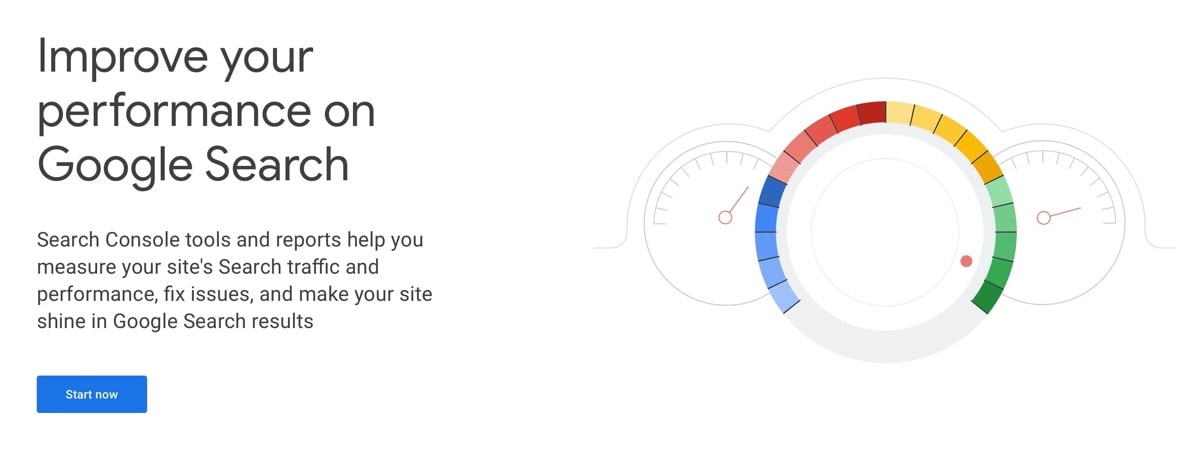
Google webmaster tools are by far the most popular tools available, due to the popularity of Google.

Google renamed the product from Google Webmaster Tools to Google Search Console in 2015, so the two names refer to the same thing. You will still see the old name used widely, including in searches.
You can use it to optimize the performance of your website on Google search and get more organic traffic.
One limit worth knowing: the URL Inspection tool lets you request indexing for roughly 10 to 12 URLs per day per property. For anything larger, an XML sitemap is the route, not manual submission.
Use the guides below, in this order, to learn how to use Google Search Console:
- How to add and verify your website with Google Search Console - how to create an account and verify your website with Google.
- How to submit a sitemap to Google - once you have an XML sitemap, this explains the three available methods for submitting it.
- How to find and fix crawl errors using Google Search Console - if a page is not in the index it cannot appear for any search, so this is one of the most valuable reports in the tool.
- How to force Google to recrawl your website - there are cases where asking Google to re-index is better than waiting for the normal crawl cycle.
Bing Webmaster Tools

Bing is smaller than Google, but Bing Webmaster Tools is the most important account on this list after Search Console, because Bing's index also powers Yahoo and most of DuckDuckGo's web results.
Set up this one account and you are effectively managing three search engines.
One of the major differences between Google and Bing is that Bing encourages you to submit content directly. Established sites can submit up to 10,000 URLs per day, against roughly 10 to 12 per day through Google's URL Inspection tool.
Bing Webmaster Tools also lets you import your site directly from Google Search Console, which makes setup a two-minute job if you already have Search Console configured.
How to use Bing Webmaster Tools for Beginners - a step-by-step guide on creating an account, adding your website, submitting a sitemap and using the most common functions.
IndexNow
IndexNow is not a webmaster tools account. It is an open protocol that lets you notify several search engines the moment a page is added, updated or deleted, instead of waiting for them to crawl it.
The engines currently accepting IndexNow submissions are Bing, Yandex, Naver, Seznam.cz, Yep and Amazon. Submit a URL to any one endpoint and it is shared with all of them. Google does not participate.
Setting it up takes a few minutes:
- Generate a key of 8 to 128 characters using letters, numbers and hyphens.
- Create a text file named after the key, for example yourkey.txt, containing only that key.
- Upload it to the root of your domain so it is publicly reachable at yourdomain.com/yourkey.txt.
- Submit URLs through the API, or let your CMS do it.
Most SEO plugins for WordPress and most major CMS platforms support IndexNow directly, so in practice you enable a setting rather than write any code. You can submit up to 10,000 URLs in a single request.
This is the fastest way to get new content into Bing, and by extension into Yahoo and DuckDuckGo.
Yandex Webmaster Tools
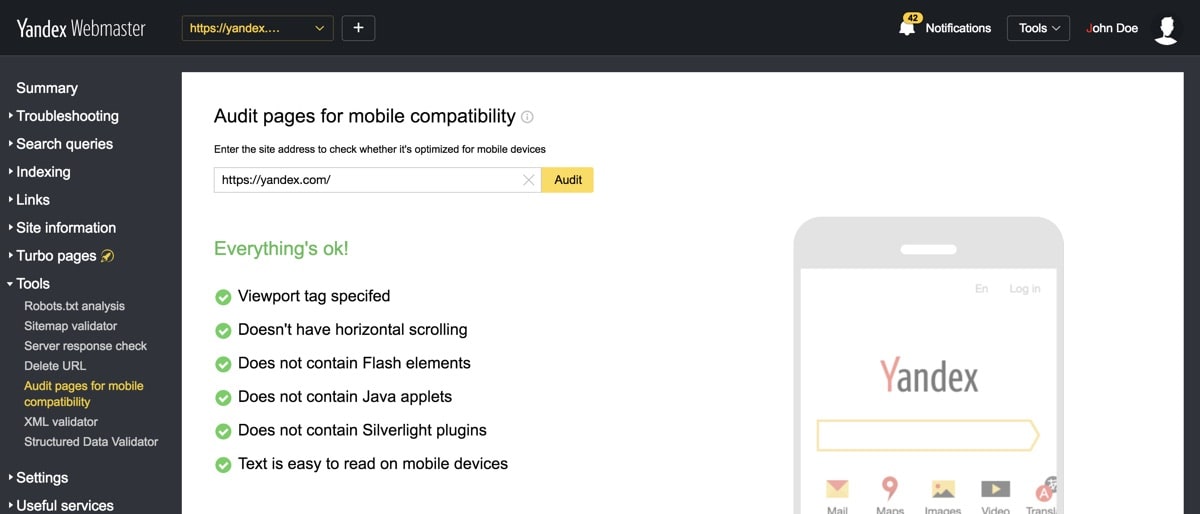
Yandex is the dominant search engine in Russia, holding roughly 70% of the market against Google's 28%.
Even if you are not targeting Russia, Yandex Webmaster is worth an hour of setup. With the exception of Search Console, its reports are the most complete of any free tool here, and several of them are useful for general SEO rather than Yandex specifically.
How to get started with Yandex Webmaster
- Create an account. You need a Yandex account. The interface is available in English, though the English version exposes fewer features than the Russian one.
- Add your site. Enter your domain in the "Add site" field from the dashboard.
- Verify ownership. Three methods are offered: a meta tag in your homepage head, an HTML file uploaded to your root directory, or a DNS TXT record. The meta tag is the quickest if you use an SEO plugin.
- Submit your sitemap. Go to Indexing, then Sitemap files, and add the full URL of your XML sitemap.
- Set geotargeting. Under Site information, specify the region your site serves. This matters more in Yandex than in most engines.
- Check the reports. The Search queries and Site quality reports are where the useful data sits, including the Site Quality Index, which has no equivalent in other tools.
Yandex also accepts IndexNow submissions, so once you have that configured your new pages reach Yandex without any manual work.
Yahoo Webmaster Tools
Yahoo does not have webmaster tools, and has not had them since Yahoo Site Explorer was retired. Use Bing Webmaster Tools instead.
The reason is that Yahoo Search results have been provided exclusively by Microsoft Bing since October 2019. Yahoo runs the front end, Bing supplies the index. There is nothing separate to submit to, verify with, or optimize for.
In practice this means:
- Anything you do in Bing Webmaster Tools applies to Yahoo.
- Submitting a sitemap to Bing submits it for Yahoo.
- If your pages rank in Bing, they rank in Yahoo, with only minor differences in presentation.
- There is no Yahoo-specific ranking factor to chase.
If you arrived here looking for a Yahoo Search Console, set up Bing Webmaster Tools and you are done.
DuckduckGo Webmaster Tools
DuckDuckGo does not offer webmaster tools either, and the reason is more interesting than a simple redirect to Bing.
DuckDuckGo builds its results from several places at once. According to DuckDuckGo's own documentation, instant answers come from specialist partners such as Wikipedia, Sportradar, Tripadvisor and Musixmatch, and the company maintains its own crawler, DuckDuckBot, along with its own indexes. For ordinary web results, though, they state plainly that they "largely source" traditional links and images from Bing.
That distinction is what matters for a website owner:
- For your pages to appear in DuckDuckGo's web results, rank in Bing. That is the lever, and Bing Webmaster Tools is the tool.
- Let DuckDuckBot crawl you. It respects robots.txt, and changes to those directives can take up to 72 hours to register.
- For instant answer boxes, the source is the source. If your business appears in a Tripadvisor or Wikipedia result, corrections have to be made there, not with DuckDuckGo.
So there is no DuckDuckGo Search Console to sign up for, and no submission form. Optimizing for Bing is optimizing for DuckDuckGo.
Ask.com Webmaster Tools
Ask.com used to be a well-known search engine, originally Ask Jeeves, but that is no longer the case. Ask now assembles its content from partner feeds and large third-party websites rather than running a general web index, so it offers no webmaster tools and there is nothing to submit.
Its search share is now negligible, so this is not a gap worth worrying about.
Baidu Webmaster Tools
Baidu is China's most popular search engine, and Baidu Search Resource Platform (百度搜索资源平台, often called Baidu Ziyuan) is its equivalent of Search Console.
You can use it to submit new content, check traffic and keywords, review your link profile and control how your site appears in Baidu results.
What to know before you start
- The interface is Chinese only. There is no English version, so browser translation is the only option for non-Chinese speakers.
- Registration needs a Chinese mobile number, because verification codes are sent by SMS.
- Full features require an ICP licence. Without one, functions such as sitemap submission and logo customization are restricted. An ICP licence requires a Chinese business entity, so foreign companies generally need a local partner or a wholly foreign-owned enterprise.
- Hosting matters. Sites hosted outside mainland China load slowly through the Great Firewall, and Baidu weighs site speed heavily.
If you are seriously targeting the Chinese market, Baidu webmaster tools should be an early step, but the licensing and hosting requirements are the real work, not the tool itself.
Frequently Asked Questions
Is Google Webmaster Tools the same as Google Search Console?
Yes. Google renamed Google Webmaster Tools to Google Search Console in 2015. The old name is still widely used in articles and searches, but there is only one product and it is free.
Does DuckDuckGo have webmaster tools?
No. DuckDuckGo has no webmaster tools account, submission form or search console. Its own documentation states that it largely sources traditional links and images from Bing, so ranking in Bing is what gets you into DuckDuckGo. Use Bing Webmaster Tools.
Does Yahoo have webmaster tools?
No, not since Yahoo Site Explorer was retired. Yahoo Search has been powered exclusively by Bing since October 2019, so Bing Webmaster Tools covers Yahoo completely. There is nothing Yahoo-specific to configure.
Which webmaster tools should I set up first?
Google Search Console, then Bing Webmaster Tools. Those two cover Google, Bing, Yahoo and DuckDuckGo, which is the overwhelming majority of search traffic in most markets. Add Yandex if Russia matters to you and Baidu if China does. Bing can import your site directly from Search Console, so the second account takes a couple of minutes.
Are webmaster tools free?
Yes, all of them. Google, Bing, Yandex and Baidu all provide their tools at no cost. There is no paid tier, and none of them affect your rankings by themselves. They report on and diagnose performance rather than improve it.
Do I still need to submit my site to search engines?
Not in the old sense of submitting to a directory. Search engines find sites by following links. What is still worth doing is submitting an XML sitemap through Search Console and Bing Webmaster Tools, and enabling IndexNow so new pages reach Bing, Yandex and the other participating engines immediately rather than waiting for a crawl.
Key Learnings
Only four search engines run their own webmaster tools: Google, Bing, Yandex and Baidu. Yahoo, DuckDuckGo and Ask.com do not, because they source their web results elsewhere, and Bing Webmaster Tools is the answer for the first two.
The concept behind all of them is the same: create an account, verify ownership, submit an XML sitemap, then use the reports to analyze traffic and troubleshoot errors.
For most websites the entire job is two accounts. Set up Google Search Console and Bing Webmaster Tools, enable IndexNow, and you have covered Google, Bing, Yahoo and DuckDuckGo between them.
It is normal to spend most of your time on Google, but do not ignore the others. They can generate extra traffic from content you have already published.