
Until recently, Google was the most popular search engine and the go-to source for all things search, but that is no longer the case. Google may not have lost significant market share for traditional searches, but when it comes to AI search engines, there is a new king in town.
To determine which AI search engines are gaining the most traction, we analyzed monthly active users as a measure of popularity. This metric better reflects how many people rely on these tools for AI‑driven search and assistance.
The most popular AI search engine to date is ChatGPT, with 800 million monthly active users, followed by Google Gemini, with 650 million monthly active users, and ByteDance’s Doubao, with 159 million active users.
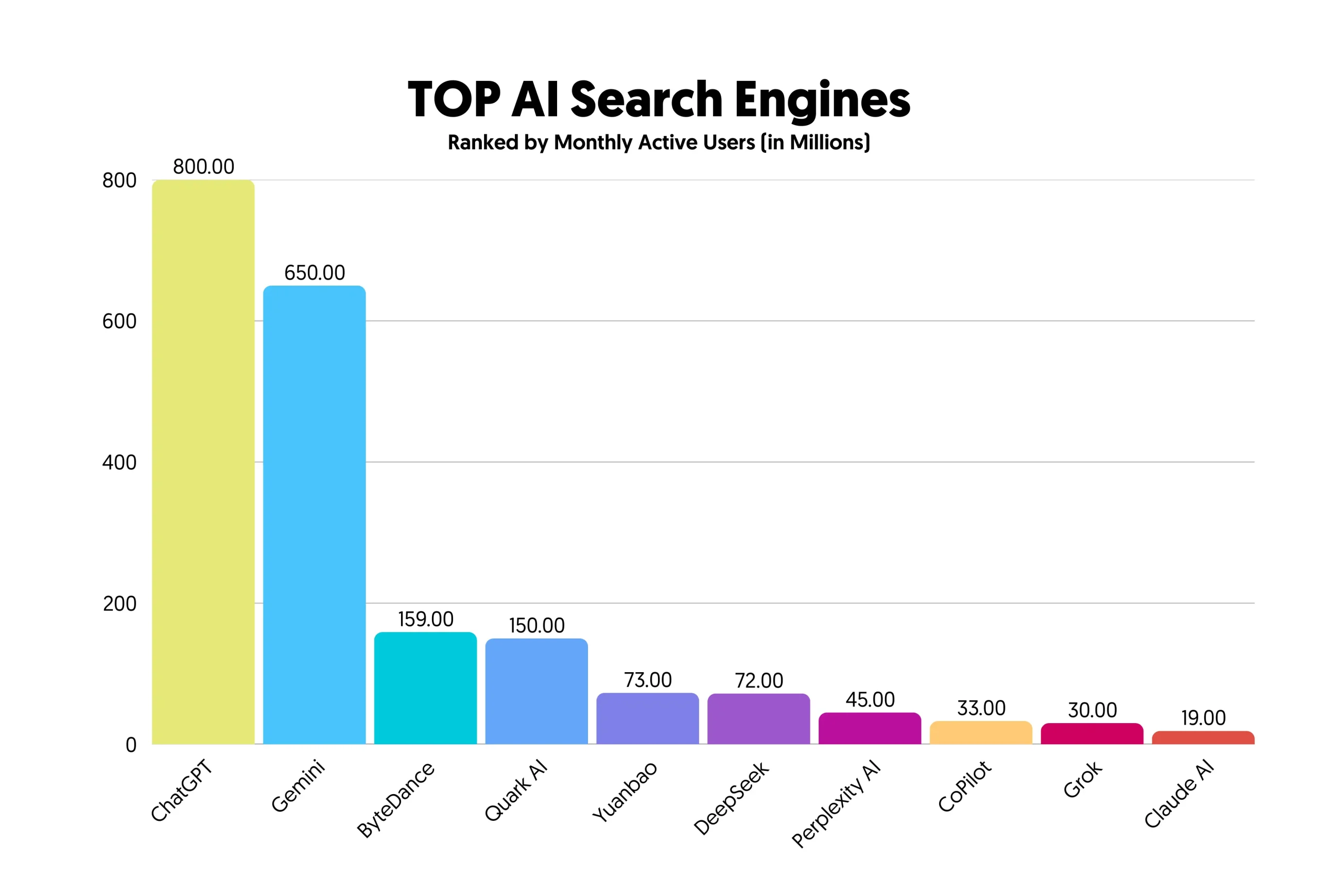
Top Search Engines By Monthly Active Users (Millions)
| Rank | AI search engine | Monthly active users (millions) |
|---|---|---|
| 1 | ChatGPT (OpenAI) | 800 |
| 2 | Google Gemini | 650 |
| 3 | Doubao (ByteDance) | 159 |
| 4 | Quark AI (Alibaba) | 150 |
| 5 | Yuanbao (Tencent) | 73 |
| 6 | DeepSeek | 72 |
| 7 | Perplexity AI | 45 |
| 8 | Microsoft Copilot | 33 |
| 9 | Grok (xAI) | 30 |
| 10 | Claude AI (Anthropic) | 19 |
Looking at the actual numbers, it's clear that ChatGPT is the leader in the AI space. Google’s Gemini has also grown rapidly to hundreds of millions of active users despite being far younger than ChatGPT.
Other notable AI search engines include the Chinese‑language platforms Doubao, Quark AI and Yuanbao, which have captured tens of millions of users each in a short time.

Perplexity AI has gained popularity for providing real‑time citations and concise answers, while Claude AI focuses on safe and helpful generative responses rather than real‑time web search.
10 Best AI Search Engines For 2026
1. ChatGPT
ChatGPT, developed by OpenAI, was launched in November 2022. It quickly gained popularity, reaching 100 million users within two months, making it the fastest-growing consumer application in history. By late 2025 ChatGPT had roughly 800 million monthly active users and processed billions of prompts daily.
ChatGPT offers a range of features, including writing content, developing code, generating images, performing deep research, and much more.
ChatGPT app has more than 1.36 billion downloads on Google Play and Apple App Store and is one of the most popular apps worldwide.
2. Google Gemini
Google Gemini, formerly known as Bard, is Google’s flagship AI assistant built on its LaMDA and PaLM large language models. Gemini debuted in March 2023 as a conversational search engine and has gradually integrated into Google’s ecosystem.
Google reported that Gemini had about 350 million active users by June 2025 and approximately 650 million active users by November 2025, making it the second‑most‑used AI search tool after ChatGPT.
It should be noted that Gemini is not the same as Google AI Overviews shown in Google search. Gemini functions as an interactive AI assistant and chatbot, similar to ChatGPT, while Google AI Overviews are AI-generated summaries that appear within Google Search results.
3. Doubao (ByteDance)
Doubao is ByteDance’s Chinese‑language AI assistant and search engine.
Integrated into the Douyin ecosystem, it offers chat‑based search, content creation and translation.
According to Reuters, Doubao had about 159 million monthly active users in October 2025, making it one of the most widely used AI search tools.
4. Quark AI (Alibaba)
Quark AI, developed by Alibaba’s Quark unit, is a mobile‑first AI search engine popular in China.
It provides generative search results, document summarisation and other productivity tools.
DataReportal’s Digital 2026 report noted that Quark had around 150 million monthly active users worldwide in April 2025.
5. Yuanbao (Tencent)
Yuanbao is Tencent’s AI assistant built on its Hunyuan large language model and integrated across services such as WeChat.
It delivers conversational search, content generation and translation.
Reuters reported that Yuanbao recorded roughly 73 million monthly active users in October 2025.
6. DeepSeek
DeepSeek was founded in China in 2023 and released its generative AI assistant publicly in early 2025. The service rapidly climbed app store charts thanks to strong performance in mathematics and reasoning.
By October 2025 DeepSeek had around 72 million monthly active users, a huge leap from its launch earlier that year. Analysts noted that DeepSeek’s aggressive pricing and open‑source approach helped it win users against bigger rivals.
Upon its release, DeepSeek became the top-rated free application on Apple’s App Store, and as of February 2025, it has been downloaded over 21.66 million times worldwide across Google Play and the App Store.
7. Perplexity AI
Perplexity AI was founded in August 2022 by Aravind Srinivas (former AI researcher at Open AI), Denis Yarats (former AI research scientist at Meta), Johnny Ho, and Andy Konwinski.
Perplexity AI is a conversational search engine that uses AI to provide answers to user queries with cited sources. The main difference between Perplexity AI and traditional search engines is how the results are presented. Instead of giving a list of links, it summarizes answers with inline citations.
According to industry data, Perplexity AI had about 45 million monthly active users in the second half of 2025, a jump from just 20 million the year before. The company is backed by investors including Jeff Bezos and Nvidia.
8. Microsoft Copilot
Microsoft Copilot is Microsoft's AI agent, available as a standalone product through Bing Search and integrated across various Microsoft products, including Microsoft 365, Windows, and GitHub.
By mid‑2025 Copilot had roughly 33 million monthly active users, reflecting uptake across Microsoft's ecosystem. Copilot is also part of paid Microsoft 365 plans and is marketed as a productivity‑enhancing AI tool for businesses and developers.
9. Grok AI
Grok is the AI assistant created by xAI for the social network X (formerly Twitter).
Designed with a playful personality inspired by The Hitchhiker’s Guide to the Galaxy, Grok can answer questions, summarise news and generate creative content.
Business of Apps estimated Grok had about 30 million monthly active users in Q3 2025.
10. Claude AI
Claude AI is part of Anthropic, an AI and research company founded in 2021 by former OpenAI executives, including Dario Amodei and Daniela Amodei.
Claude AI is a generative AI assistant introduced in March 2023.
Anthropic emphasizes safety and ethical considerations in AI development, implementing a framework called Constitutional AI to align Claude’s outputs with human values and ensure helpfulness, honesty, and harmlessness.
By the second half of 2025 Claude had about 19 million active users. Compared to other AI search engines, Claude does not have real‑time web search; instead it focuses on safe and helpful generative responses.
Other AI Chatbots Worth Considering
Meta AI was officially launched in April 2024, and it's Meta's AI assistant. It is integrated across Meta’s suite of applications, including Facebook, Instagram, WhatsApp, and Messenger.
According to Mack Zuckerberg, it has over 500 million active users. It should be noted that Meta AI is not yet available worldwide.
Conclusion
The AI search engine landscape is changing rapidly. New AI models are released, pushing the capabilities of search engines into ways we have not seen before. While no one can predict the future, ChatGPT currently leads the way, setting the standards for AI-powered search.
Besides Google and Bing, which already have a large user base, it remains to be seen if other competitors like Perplexity, Claude and Grok are here to stay or just a part of the AI bubble.