
- The 7 Digital Marketing Courses For Beginners
- What You'll Learn First
- The Courses, Reviewed
- How to Choose the Right Digital Marketing Course
- Free vs Paid Digital Marketing Courses
- Do You Need a Certificate to Get Hired?
- Are Digital Marketing Courses Worth It?
- Tips for Beginners Starting Digital Marketing
- Frequently Asked Questions
- How We Chose These Courses
- Final Thoughts
Most beginner digital marketing courses are free, and you can cover the fundamentals in a weekend. The five free courses below take between three and six hours each. The two paid ones are worth it only once you know which channel you want to go deep on.
I have ordered them free first, shortest to longest, then paid, not by which I like most, so you can start today without spending anything.
The 7 Digital Marketing Courses For Beginners
Best overall: The Complete Digital Marketing Course by Reliablesoft. Best free option: HubSpot Digital Marketing Certification. Fastest: HubSpot, at 3 hours 24 minutes.
| # | Course | Provider | Cost | Length | Certificate |
|---|---|---|---|---|---|
| 1 | Digital Marketing Certification Course | HubSpot Academy | Free | 3 hr 24 min | Yes |
| 2 | Introduction to Digital Marketing | Great Learning | Free | 3.75 hours | Yes |
| 3 | Free Digital Marketing Basics Course | Udemy | Free | 5 hr 45 min | No |
| 4 | Fundamentals of Digital Marketing | Google Skillshop | Free | 17 modules, self-paced | Yes |
| 5 | Introduction to Digital Marketing | IBM on Coursera | Free to audit | 4 modules (~2 weeks) | Paid only |
| 6 | Digital Marketing & E-commerce Certificate | Google on Coursera | $49/mo subscription | 3–6 months | Yes |
| 7 | The Complete Digital Marketing Course | Reliablesoft Academy | $127 | Self-paced (2–4 weeks) | Yes |
Prices and course lengths checked September 2026 against each provider's own page.
What You'll Learn First
Every beginner course covers the same five areas. If a course leaves one out, it is an introduction to a channel rather than to digital marketing.
- Search engine optimization (SEO) - how to get web pages ranking in search results without paying for the traffic. This is the slowest channel to show results and the one that keeps working after you stop.
- Social media marketing - building an audience and running ads on platforms like Instagram, TikTok and LinkedIn.
- Content and email marketing - writing pages people actually search for, and following up with the visitors who did not buy the first time.
- Paid advertising (PPC) - buying traffic on Google Ads or Meta Ads Manager, where you pay per click.
- Analytics - reading Google Analytics well enough to say which of the four above is working.
Start with SEO and content marketing. They are free to practice on your own site, they teach you how people search, and the skills carry into every other channel. For the full order to learn them in, see our digital marketing roadmap for beginners.
The Courses, Reviewed
1. Digital Marketing Certification Course by HubSpot Academy
- Cost: Free
- Duration: 3 hours 24 minutes (10 lessons, 30 videos, 8 quizzes)
- Certificate: Yes, free
This is the fastest way to get a complete overview of digital marketing, and the one I would start with if you have an afternoon. It covers inbound strategy, content marketing, SEO basics, social media and email, and the certificate is genuinely free rather than free-to-learn-and-pay-to-certify.
HubSpot's teaching style is short videos with a quiz after each one, which suits people who want to finish something rather than browse it.
Where it falls short: it is built around HubSpot's inbound methodology, so it is light on paid advertising and gives you no hands-on practice with the tools. You will finish understanding the vocabulary, not knowing how to run a campaign.
Take the HubSpot Digital Marketing course
2. Introduction to Digital Marketing by Great Learning
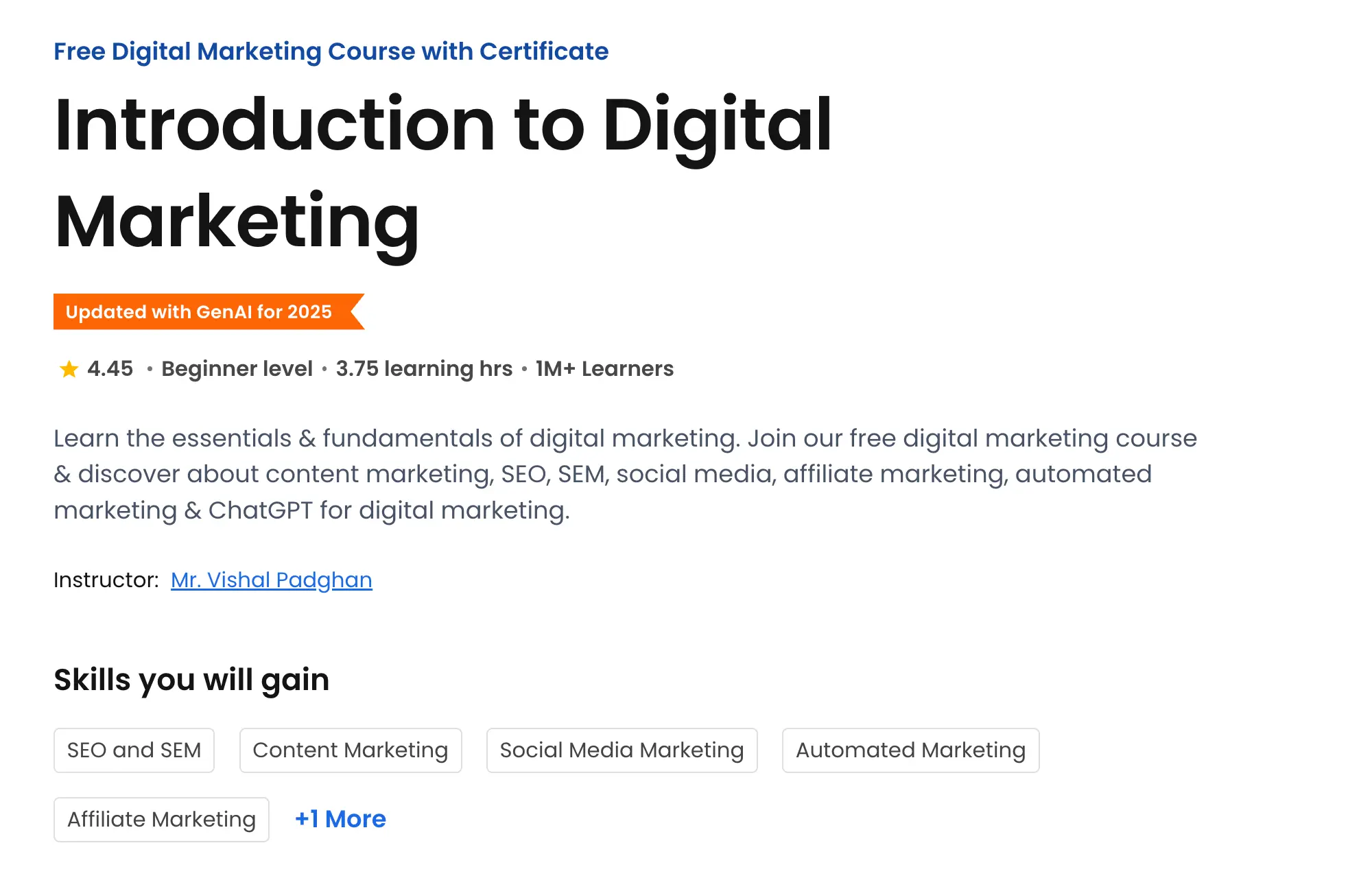
- Cost: Free
- Duration: 3.75 hours
- Certificate: Yes, free
A short, structured introduction to SEO, social media, paid ads and analytics, recently updated with a GenAI section for 2026. Over 1.1 million people have enrolled, and it holds a 4.45 rating.
It suits you if you want a quick overview before committing time or money to something longer.
Where it falls short: it is broad and shallow by design, with minimal practical activity. Treat it as a map of the territory, not training.
Take the Great Learning course
3. Free Digital Marketing Basics Course by Udemy
- Cost: Free
- Duration: 5 hours 45 minutes (3 sections, 22 lectures)
- Certificate: No
Taught by Sorav Jain, this is the longest of the free courses and the most hands-on of them, with live tool demonstrations rather than slides. It covers digital marketing basics, running paid ads, email marketing and landing pages. It has 254,489 students and a 4.5 rating from 7,809 ratings.
Where it falls short: it was last updated in July 2019. The strategy still holds, but every interface you see on screen has changed, and there is nothing on AI. Udemy also issues no certificate for free courses. Use it for the concepts, not for the click-by-click.
4. Fundamentals of Digital Marketing by Google Skillshop
- Cost: Free
- Duration: 17 modules, self-paced
- Certificate: Free completion award
Google's own introduction, formerly on Google Digital Garage and now on Skillshop. It teaches SEO, search advertising, analytics and online strategy through short videos with practical exercises, and the award comes from Google, which is worth something on a CV.
Where it falls short: it is high level and stays close to Google's own products. You will learn the concepts and very little about anything outside the Google ecosystem.
Take the Google Skillshop course
5. Introduction to Digital Marketing by IBM
- Cost: Free to audit, paid for the certificate
- Duration: 4 modules (about 2 weeks at 10 hours a week)
- Certificate: With a Coursera subscription
IBM's beginner course on Coursera, and the first module of its Digital Marketing and Growth Hacking with GenAI Professional Certificate. It has no prerequisites and around 25,900 enrolled. It is the most current of the free options on AI in marketing, which is where the other short courses are thinnest.
Where it falls short: auditing gets you the videos but not the graded work or the certificate, and as the opening module of a longer certificate it is designed to lead you into the paid track.
6. Google Digital Marketing & E-commerce Professional Certificate
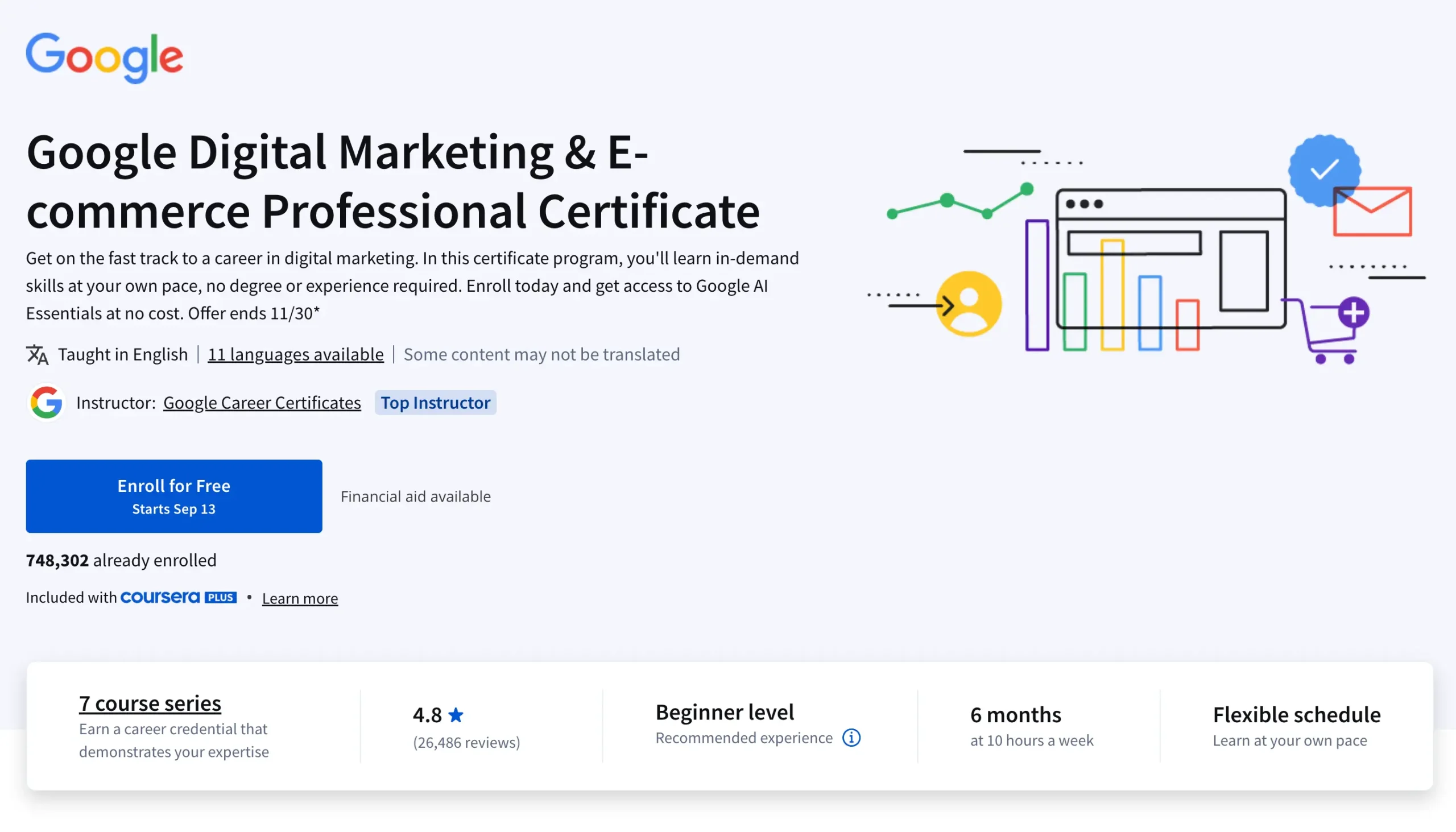
- Cost: Coursera subscription, $49 per month
- Duration: 3–6 months
- Certificate: Yes, from Google
The most substantial of the structured programs, covering digital marketing fundamentals, analytics, SEO, Google Ads and e-commerce, with graded assignments and workplace-style projects. It suits people who want an academic pace and an employer-recognised credential at the end.
Because it is billed monthly, finishing faster costs you less. Most people who treat it as a part-time commitment pay for three to six months.
Where it falls short: it is heavier on theory than on running real campaigns, and the subscription keeps charging whether you study that month or not.
You can read our comprehensive review for what is included and how to pass the exams first time.
Take the Google Digital Marketing Certificate
7. The Complete Digital Marketing Course by Reliablesoft Academy
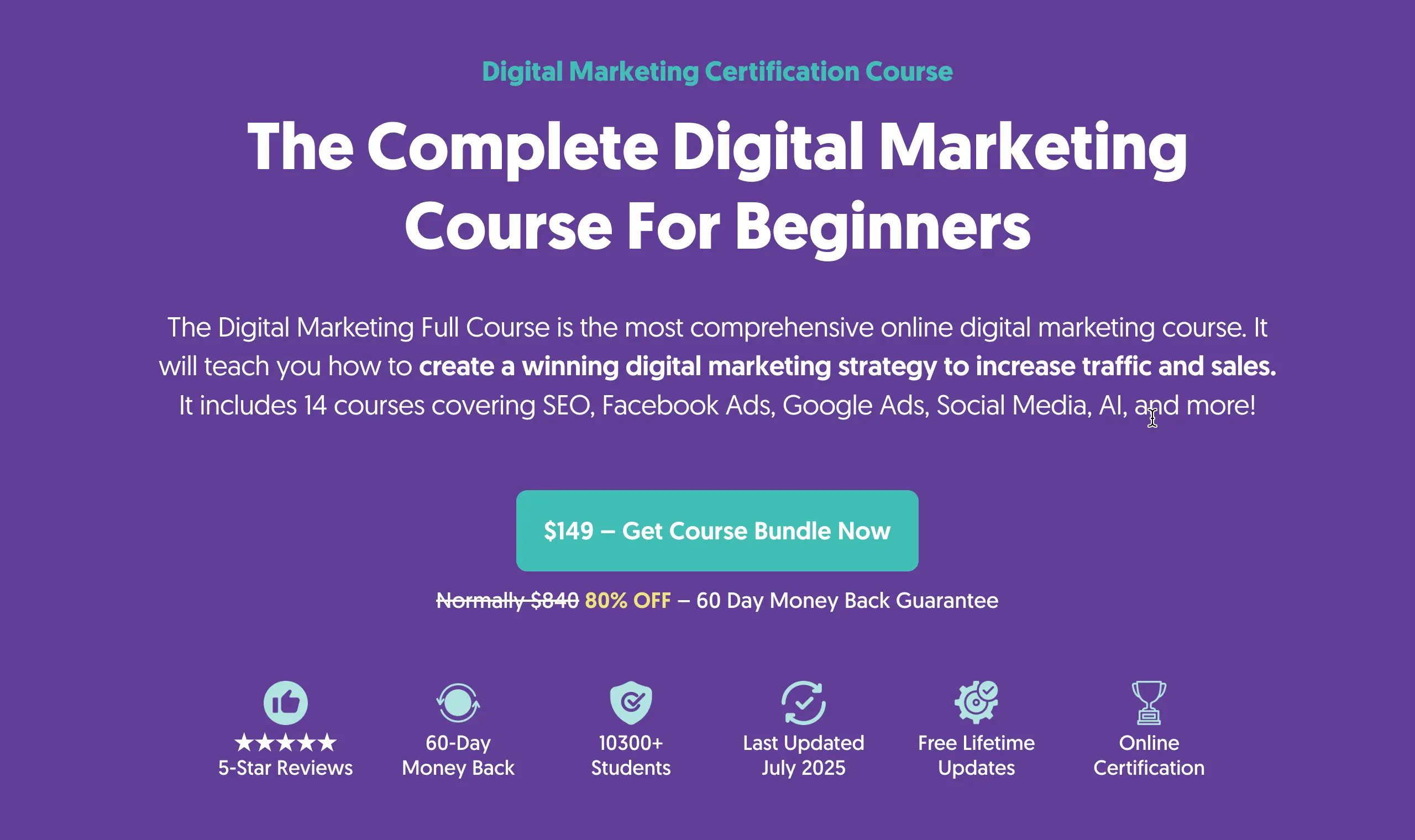
- Cost: $127 (normally $1,260)
- Duration: Self-paced (typically 2–4 weeks)
- Certificate: Yes
This is our own course, so treat the recommendation accordingly. But it is the one I would move to after the free courses above. It is 21 courses covering SEO, Google Ads, AI, Facebook Ads, affiliate marketing, email, content marketing and analytics, with checklists and step-by-step workflows rather than lectures.
It is taught by marketers who run campaigns for clients, includes SEO and digital marketing certifications, and comes with a 60-day money-back guarantee and lifetime access.
Where it falls short: it is not free, and it is fully self-paced with no cohort or deadlines, so it asks more discipline than a structured program like Google's. If you have not finished one of the free courses above, start there instead.
Take The Complete Digital Marketing Course
How to Choose the Right Digital Marketing Course
Choose on how recently the course was updated and how much of it you actually do, rather than on how much it covers.
Digital marketing changes fast (AI tools and chatbots, new content formats, shifting search behaviour), so a course recorded three years ago will teach you interfaces that no longer exist. Check the last-updated date before anything else.
Beyond that:
- Full channel coverage. SEO, PPC, email, content, social media, AI and analytics. Anything missing is a gap you will have to fill yourself.
- Practical work. Case studies, templates and exercises you can apply to a site of your own. Marketing is a skill, not a subject.
- Who teaches it. Courses built by people running live campaigns give advice that survives contact with a real budget.
- A certificate you can name. Google, HubSpot and IBM mean something to a hiring manager. An unknown provider's certificate does not.
- Your learning style. Some people finish video courses; others only finish text. Pick the format you will actually complete.
Free vs Paid Digital Marketing Courses
Start free. Five of the seven courses above cost nothing, and between them they cover every fundamental a beginner needs. There is no reason to pay before you know which part of digital marketing you want to do.
Free courses are shorter and shallower by design. They introduce concepts, they rarely give you practice, and most are built to lead you toward the provider's paid product or platform.
Paid courses earn their price on three things: they are kept up to date, they go deep enough to actually execute, and they usually include real examples with real numbers. If you are learning digital marketing for work, a client or your own business, that depth is the difference between understanding a channel and running it.
If you want more free options than the five here, see our list of free digital marketing courses. For paid programs beyond beginner level, see the best digital marketing courses. We also run a free digital marketing course of our own.
Do You Need a Certificate to Get Hired?
No. A certificate gets your application read; a portfolio gets you hired.
Certificates from Google, HubSpot and IBM are recognised and free or cheap, so there is no reason not to have one. But every applicant for an entry-level role has the same ones, which means they no longer distinguish you.
What does: evidence you have run something. A site you ranked, a campaign you managed, an email sequence that converted, with the before and after numbers. Build that while you take the courses, not after.
- Entry-Level Digital Marketing Jobs: What You Need
- How to Get Into Digital Marketing Without Experience
- Best Digital Marketing Certificate Programs
Are Digital Marketing Courses Worth It?
Digital marketing courses are worth it if you want a structured path instead of assembling one from blog posts and YouTube videos. What you are paying for is the order to learn things in, and the mistakes you skip.
They are not worth it if you take them passively. A course you watch and do not apply teaches you vocabulary, which is why people finish three of them and still cannot run a campaign.
The people who get the most out of a course are the ones who apply each lesson to something of their own while they go: a blog, a shop, a social account, anything with real traffic and real numbers.
Digital marketing courses are worth it when you use them to build a career, start freelancing, or promote your own business.
Tips for Beginners Starting Digital Marketing
Start with the basics. SEO, content marketing and how search engines work shape everything else. Learn them before paid ads.
Practice while you learn. Apply every new concept to a small project: a blog, a landing page, a social account. You learn digital marketing by doing it badly first.
Use the free tools. Google Analytics, Google Search Console and Google Keyword Planner are free and are what the industry actually uses. Reading data is the skill employers test for.
Build small projects. A landing page, an SEO article, a sample email campaign. These become your portfolio.
Study consistently. Twenty to thirty minutes a day beats an occasional long session. Retention comes from repetition.
Frequently Asked Questions
What is the best digital marketing course for beginners?
For a free start, the HubSpot Digital Marketing Certification. It covers every fundamental in 3 hours 24 minutes and the certificate is free. For depth once you know what you want to specialise in, The Complete Digital Marketing Course by Reliablesoft.
Can a beginner learn digital marketing with no experience?
Yes. None of the seven courses above requires prior marketing knowledge or a degree. Start with SEO and content marketing, practise on a site of your own, and add paid ads once you understand how people search.
Can I learn digital marketing in 3 months?
You can learn the fundamentals of every channel in about three months studying part time, and be employable in one specialisation shortly after. Becoming genuinely good at that specialisation takes longer and depends on how much you practise.
Are free digital marketing courses enough to get a job?
They are enough to get you started and to pass a first screening, but not on their own. Employers hire on evidence, so pair the free courses with a project of your own that has real numbers attached. See Entry-Level Digital Marketing Jobs.
How long does it take to learn digital marketing?
The free courses here take three to six hours each. Covering all the channels properly takes a few months, and specialising takes longer. See How Long Does It Take to Learn Digital Marketing?
Is digital marketing still worth learning in 2026?
Yes, though what is valuable has shifted. People now search across Google, AI assistants, YouTube and TikTok, so the marketers in demand understand visibility across all of them rather than classic Google rankings alone.
Do you need a degree to work in digital marketing?
No. Most roles value demonstrated skills and results over a degree. See How to Get Into Digital Marketing Without a Degree.
How We Chose These Courses
We picked courses that are open to complete beginners, cover more than one marketing channel, and come from a provider with a track record in marketing education.
Every price, course length, module count and certificate detail on this page was checked against the provider's own course page in September 2026, not copied from other roundups. Where a provider states a figure, we use theirs. Where we could not source a figure, we leave it out.
Reliablesoft Academy is our own training business, and The Complete Digital Marketing Course is our product. It is listed last, after five free alternatives, and we have said where it falls short alongside the others. This page contains affiliate links, which do not affect the price you pay or the order above.
Reviewed and updated September 2026 by the Reliablesoft team.
Final Thoughts
Start with a free course this week. HubSpot if you have an afternoon, Great Learning if you want the shortest possible overview, Udemy if you would rather watch someone use the tools.
Then pick one channel and go deep on it, practising on something of your own. That is what turns a course into a job, and it is the part no course can do for you.