

What is Vibe Marketing?
Vibe Marketing is a new marketing approach that leverages AI-driven automation and specialized tools to dramatically accelerate campaign creation, testing, and optimization. It transforms traditional multi-week marketing cycles into rapid, agile processes that can launch within days or even hours.
In vibe marketing, the marketer provides the direction: the strategy, the brand voice, and the judgment about what is good enough to publish. AI tools and agents do most of the execution, from writing drafts and producing visuals to launching variations and reporting on results.
The name comes from “vibe coding,” a term coined by AI researcher Andrej Karpathy in early 2025 for building software by describing what you want to an AI in plain language. Marketers borrowed it for the same idea applied to campaigns, and creators like Greg Isenberg popularized it.
You will also see “vibe marketing” used in an older, different sense: marketing that sells a feeling or mood around a brand rather than product features. This guide covers the AI-driven meaning, which is what most people search for today.
Vibe Marketing Vs. Digital Marketing
To understand what vibe marketing is and why it’s becoming popular, let’s first look at how digital marketing usually works today.
Most businesses follow the same strategy. They build digital marketing teams comprising specialists like content writers, PPC managers, SEO experts, and designers.
Each team focuses on its own area, and everything needs to be coordinated by the digital marketing manager.
For example, to launch a new Meta Ads campaign on Facebook and Instagram, you need a designer to prepare the visuals, copywriters to write the ad copy, and PPC experts to set up the campaigns.
Once the campaign runs, the PPC manager evaluates the results and adjusts targeting, creatives, or budgets based on what’s working.
While this method can deliver results, it’s often expensive, time-consuming, and slow to adapt. In fast-moving markets, those delays can mean missed opportunities.
In contrast, Vibe Marketing compresses this timeline drastically by:
- Empowering experts with powerful AI tools.
- Allowing marketing teams to utilize automation and AI agents to handle repetitive tasks.
- Continuously testing and optimizing campaigns in real time, with far less manual work.
As a result, Vibe Marketing helps you launch and scale campaigns much faster and with fewer resources.
Instead of waiting days or weeks for design approvals or performance reports, AI agents can generate creatives, test different versions, and analyze results almost instantly. This reduces delays and allows you to make quick, data-driven decisions.
You also save money. Since many tasks, like writing ad copy, A/B testing, or adjusting bids, are automated, you don’t need large teams or expensive agencies to get results. Smaller teams, or even individuals, can manage entire campaigns using AI tools that previously required a whole department.
And because AI systems can learn and optimize in real time, your campaigns keep improving between reviews. You still check the results, but you don’t have to pause campaigns or schedule meetings to make every change.
This speed and efficiency are game-changers, especially for startups and small marketing teams. You can test more ideas, respond to trends quicker, and scale what works without burning time or budget.
Vibe Marketing isn’t just a different way of working. It’s a faster, smarter, and more flexible approach to growing your business in a digital world that moves fast.
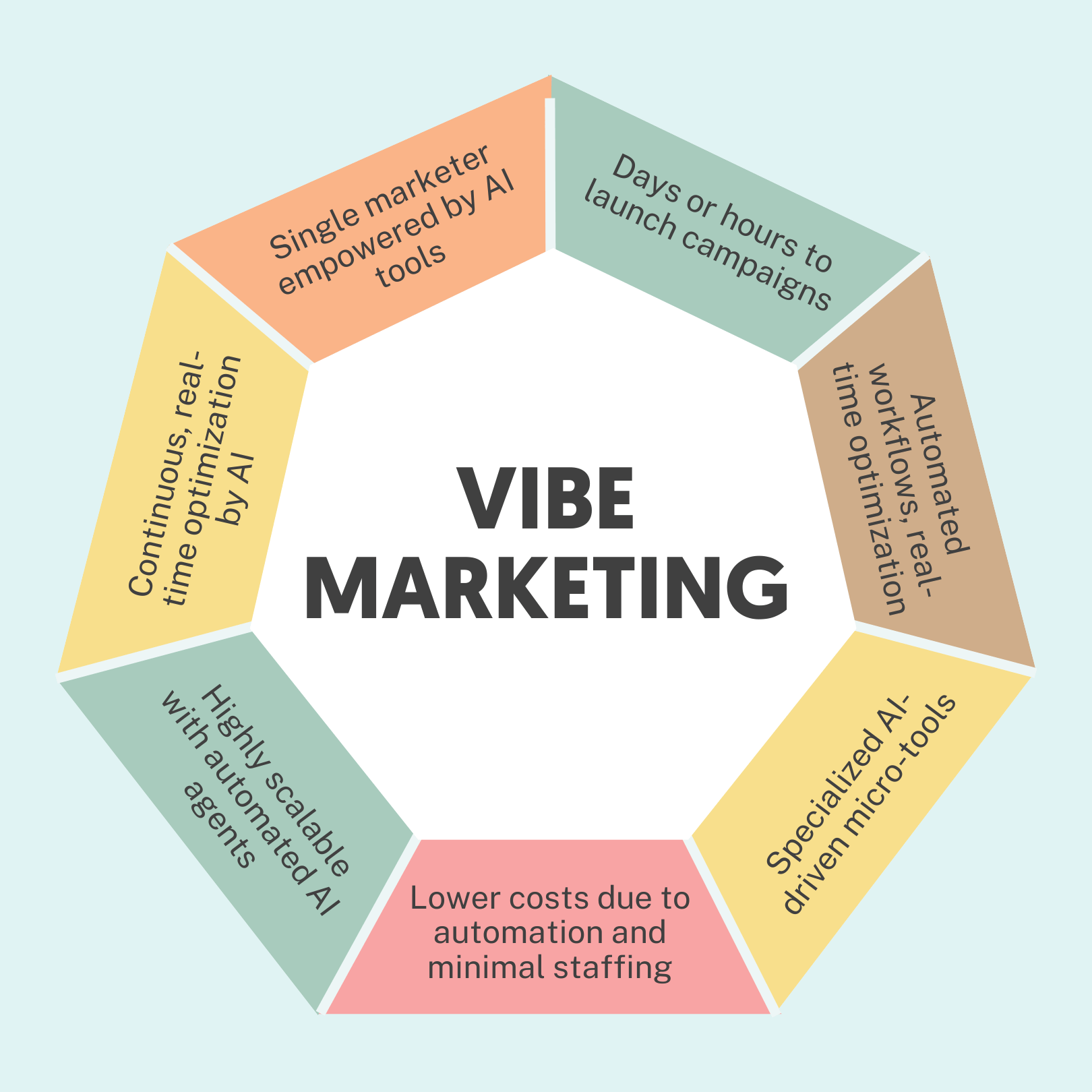
The table below summarizes how Vibe Marketing compares with traditional digital marketing, including where each one is weakest.
| Aspect | Traditional Marketing | Vibe Marketing |
|---|---|---|
| Team Structure | Large teams with specialized roles (copywriters, designers, analysts, media buyers) | Single marketer empowered by AI tools |
| Speed | Weeks or months to launch campaigns | Days or hours to launch campaigns |
| Workflow | Manual processes, multiple meetings, extensive communication | Automated workflows, real-time optimization |
| Tools Used | General marketing platforms, broad solutions | Specialized AI-driven micro-tools |
| Cost Efficiency | High costs due to labor-intensive processes | Lower costs due to automation and minimal staffing |
| Scalability | Limited by human resources | Highly scalable with automated AI agents |
| Optimization | Manual and periodic optimization | Continuous, real-time optimization by AI, reviewed by the marketer |
| Scarce Skill | Craft: writing, design, and campaign setup | Taste and briefing: knowing what to ask for and what to approve |
| Main Risk | Moving too slowly to catch trends and cultural moments | Publishing low-quality or off-brand content too fast |
How Does Vibe Marketing Work?
Vibe Marketing uses AI tools and automation to speed up and simplify the entire marketing process, from planning to optimization. Here’s how it works, step by step:
1. Idea Generation and Strategy
Everything starts with data. A marketer uses AI tools to quickly analyze customer behavior, sales data, trending topics, and social media conversations. Based on this, the AI suggests creative themes and campaign ideas that match people's current interests.
2. Content Creation
Once you choose a theme for your campaign, you can use AI to create content. Instead of needing an entire team of writers, designers, and video editors, the AI can generate everything for you:
- Ad copy
- Social media posts
- Product images
- Short videos
- Landing pages
- Email sequences
You just guide the AI with prompts and feedback to ensure the content matches your brand voice and goals.
Since content is so quick and cheap to produce, you can easily test different styles without wasting time or budget.
3. Campaign Launch
After creating the content, launching the campaign is simple. With just a few clicks, you can:
- Schedule social media posts
- Set up Meta and Google Ads campaigns
- Send marketing emails
AI agents help automate these tasks and ensure everything goes out on time.
4. Real-Time Tracking and Optimization
Once your campaign is live, AI agents continuously track how it’s performing. Platforms like Google Ads (with Performance Max) already use this kind of AI-powered optimization. They automatically test different combinations of headlines, images, and audiences to find what works best.
Getting Started with Vibe Marketing
If you’re not using AI tools or automated workflows yet, don’t worry. You don’t need to overhaul your entire strategy overnight. Vibe Marketing is all about working smarter, not harder, and starting small is easy.
Here’s how to take your first steps:
Step 1: Identify Repetitive Tasks You Can Automate
Look at your current marketing process and ask yourself: What do I spend time on that could be automated?
Common examples include writing variations of ad copy, scheduling social media posts, generating product descriptions, A/B testing emails or landing pages, and analyzing performance reports.
Pick one task and test a tool like ChatGPT, Gemini, or others that can help you automate it. You don’t need to use AI for everything right away.
Step 2: Learn How To Use AI Tools
Start with tools that are easy to use and don’t require technical skills. Some great entry points include:
- ChatGPT for writing ad copy, email subject lines, or brainstorming ideas.
- Google Ads Performance Max for automated Google Ads campaigns.
Pick one tool, familiarize yourself with it, and apply it to a real campaign.
Also, take time to learn how to prompt effectively. The better your prompts, the better the AI’s output. Be specific, give context, and don’t be afraid to experiment. Prompting is the new required skill in modern marketing, and the more you practice, the better results you’ll get.
Step 3: Write a Brand Brief for Your AI Tools
Before you generate anything, write down the context every AI tool needs to sound like your brand: who your audience is, your tone of voice, your products and offers, the words you use and avoid, and examples of content you liked. Save it as one document and paste it into every prompt, or load it into your AI tool’s project or custom instructions.
This brief is what keeps fast output on-brand. Without it, every tool guesses, and the results drift.
Step 4: Start with a Test Campaign
Choose a simple campaign you can run end-to-end with AI support. For example, promoting a single product launch or a seasonal discount.
Use AI to:
- Generate 3–5 creative ideas
- Write ad copy and social posts
- Create visuals
Step 5: Treat AI Like a Creative Partner, Not a Replacement
You’re still in charge. The AI helps generate ideas and content, but you guide the strategy and ensure the messaging fits your brand. Give clear prompts. Review and tweak AI-generated outputs. Use your marketing experience to decide what’s worth testing.
In vibe marketing, the scarce skills are no longer writing or design. They are taste, knowing what good looks like, and briefing, knowing how to ask for it. The best results come from your expertise combined with AI speed and scale.
Step 6: Learn How MCP Servers and AI Agents Work
MCP (Model Context Protocol) servers are special systems that help AI tools connect with different platforms like databases, apps, or file storage. Think of them as middlemen that make it easier for AI to talk to other tools using one simple connection.
In marketing, AI agents use these servers to connect with tools like your CRM, email marketing software, or analytics platforms. This means the AI can pull in real-time data, create personalized content, manage campaigns, and track performance without you copying data between tools.
Vibe Marketing Examples
Here is what vibe marketing looks like in practice. These are typical workflows a single marketer can run with today’s tools.
1. Ad creative testing in an afternoon. A marketer writes one brief for a product, asks an AI tool for 20 headline and image variations, and loads the best 10 into Meta Ads. By the next day, the data shows which angle works, and the marketer asks for 10 new variations of the winner.
2. Reacting to a trend the same day. A trend starts on social media in the morning. The marketer asks AI for five post ideas that fit the brand brief, picks one, generates the visual, and publishes before the trend peaks, instead of waiting a week for design and approval.
3. A landing page test without a developer. The marketer describes the offer, the audience, and the call to action, and an AI website builder produces two versions of the page. Traffic is split between them, and the better one stays.
4. An email sequence from a single brief. One brief becomes a five-email welcome sequence, with subject line variations for A/B testing, drafted in minutes and edited by the marketer before it goes live.
5. A weekly report written by an agent. An AI agent connected to Google Analytics and the ad platforms pulls the week’s numbers every Monday, summarizes what changed, and suggests what to test next. The marketer reads it and decides.
In every example, AI does the production work, and the marketer does the thinking and the approving.
Vibe Marketing Tools
You don’t need a special vibe marketing platform. Most vibe marketers combine general AI tools, grouped by the job they do:
- Writing and planning: ChatGPT, Claude, and Gemini for ideas, copy, briefs, and analysis. See our Claude AI marketing guide for a full example of a marketing system built around one AI tool.
- Images and video: image and video generators, including the AI features built into design tools like Canva, for ad creatives and social posts.
- Automation and agents: n8n, Make, and Zapier to connect tools and run multi-step workflows without code.
- Advertising: Google Ads Performance Max and Meta Advantage+ campaigns, which use AI to test creatives and audiences automatically.
Start with one tool from the first group, and add automation only when you have a workflow worth repeating.
Risks of Vibe Marketing
Speed is the point of vibe marketing, and it is also the main risk. When content is cheap and fast to produce, it is easy to publish too much of it without checking it properly.
Watch out for:
- Low-quality or off-brand content. Generic AI output that sounds like everyone else, or doesn’t sound like you at all.
- Factual errors. AI tools can state wrong prices, features, or statistics with complete confidence.
- Platform rules. Ad platforms and marketplaces have rules on AI-generated content and claims, and some require you to disclose it.
- Data privacy. Connecting AI agents to your CRM or email list means sharing customer data with another service. Check what each tool does with it.
The fix is the same for all of them: a human reviews everything before it goes live. Vibe marketing replaces the production work, not the judgment.
Why Vibe Marketing is the Future
AI is now powerful enough to handle complex marketing tasks. Automation tools are easier to use than ever, even for non-technical marketers. And building custom solutions no longer breaks the budget.
This shift is creating a faster, smarter, more cost-effective way to market.
Marketers who learn to direct AI now will be able to do the work of a whole team. The sooner you start, the bigger your advantage.
FAQ
Is vibe marketing just a buzzword?
The name is new, and some people use it mainly to get attention. But the shift it describes is real: small teams and solo marketers now use AI to do work that used to need several specialists. Whatever you call it, the skills are worth learning.
Do you need to know how to code for vibe marketing?
No. Most vibe marketing tools work with plain-language prompts, and automation tools like Zapier, Make, and n8n are built for non-developers. Basic technical skills help when you start connecting AI agents to other tools, but they aren’t required to begin.
Is there a vibe marketing course?
You don’t need a course with “vibe marketing” in the name. What you need is to learn how to use AI across your marketing channels. Our AI Digital Marketing Course teaches you how to use AI tools strategically in SEO, content, and digital marketing.