
Search engine marketing is a very effective digital marketing channel. With search marketing, you can put your business in front of people at the exact moment they search for what you offer.
In this guide, you’ll learn what search engine marketing is, how it differs from SEO, the different types of SEM, how much it costs, and examples of how businesses use it.
What Is Search Engine Marketing?
Search Engine Marketing (SEM) is the process of increasing a website’s visibility in search engines through paid search ads. Advertisers bid on the keywords people type into Google or Bing, and their ads appear on the results page for those searches. In most cases, they pay only when someone clicks on the ad.
This is how the term is used by most advertisers and ad platforms today, and it’s why SEM is often used as another name for paid search or pay-per-click (PPC) advertising.
You will also come across a broader definition. Some marketers use SEM as an umbrella term for every way of getting traffic from search engines, both paid (PPC) and organic (SEO). In this guide, we cover both: the paid side first, and then the organic side that the broader definition includes.
Why Is SEM Important?
Billions of people turn to a search engine (in most cases, Google) to look for information or products. Most clicks go to the results at the top of the page, which is where search ads and the first organic results appear.
What makes SEM different from other types of advertising is intent. Your ads are shown to people who are actively searching for your products or services, not to people scrolling through a feed. The search engine marketing processes will help you get that traffic by placing your ads or content in one of the top results for the keywords that matter for your business or website.
SEM vs. SEO
The main difference between SEM and SEO is that SEM uses paid ads to appear in search results, while SEO involves techniques for optimizing a website to get organic (free) traffic from search engines.
If you use the broader definition of SEM, SEO is part of SEM. Either way, the two work differently:
| SEM (paid search) | SEO (organic search) | |
|---|---|---|
| Cost | You pay for every click | Clicks are free, but content and optimization take time and money |
| Speed | Traffic starts as soon as your ads go live | Usually takes months to rank |
| When you stop | Traffic stops when you stop paying | Rankings and traffic can last for a long time |
| Placement | Labelled as sponsored results | The organic results |
| Best for | Fast results, testing keywords, promotions | Long-term, sustainable traffic |
Most businesses get the best results by using both. For a more detailed comparison, read our guide on the difference between SEO and PPC.
Types of Search Engine Marketing
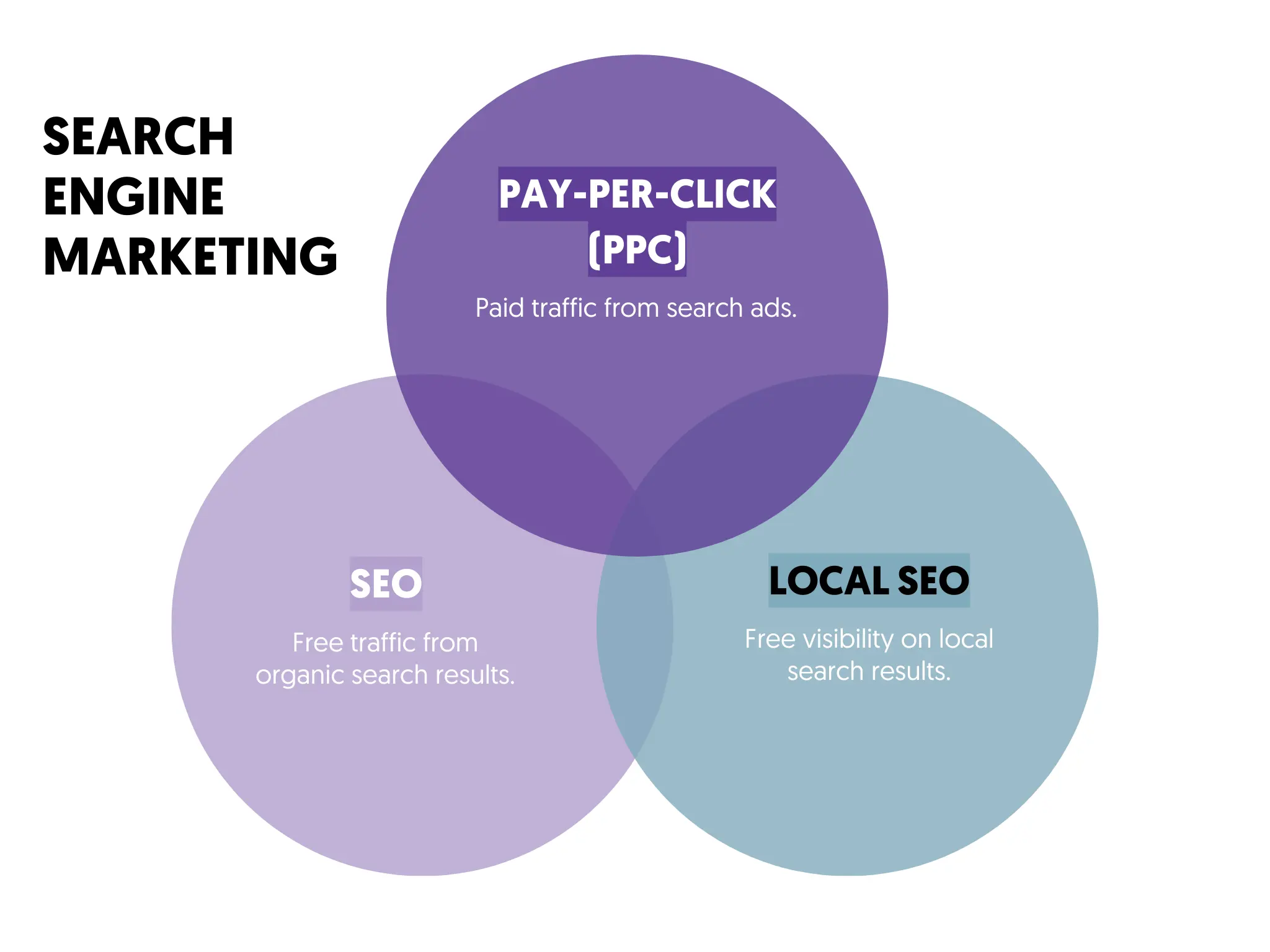
The most important search engine marketing types are Pay-Per-Click Ads (PPC), SEO (Search Engine Optimization), and Local SEO. In the narrow definition of SEM, only the first one counts, and it comes in several formats, which we cover below.
With PPC ads, you can get immediate visibility on the SERPs by bidding on specific keywords you want your ads to show. With SEO, you can rank higher in organic results by creating useful and relevant content. With Local SEO, you can get more exposure in the local search results for location-specific queries.
1. Pay Per Click Ads (PPC)
One of the ways to take advantage of the millions of users that use search engines daily and get targeted traffic to your website is through paid search ads.
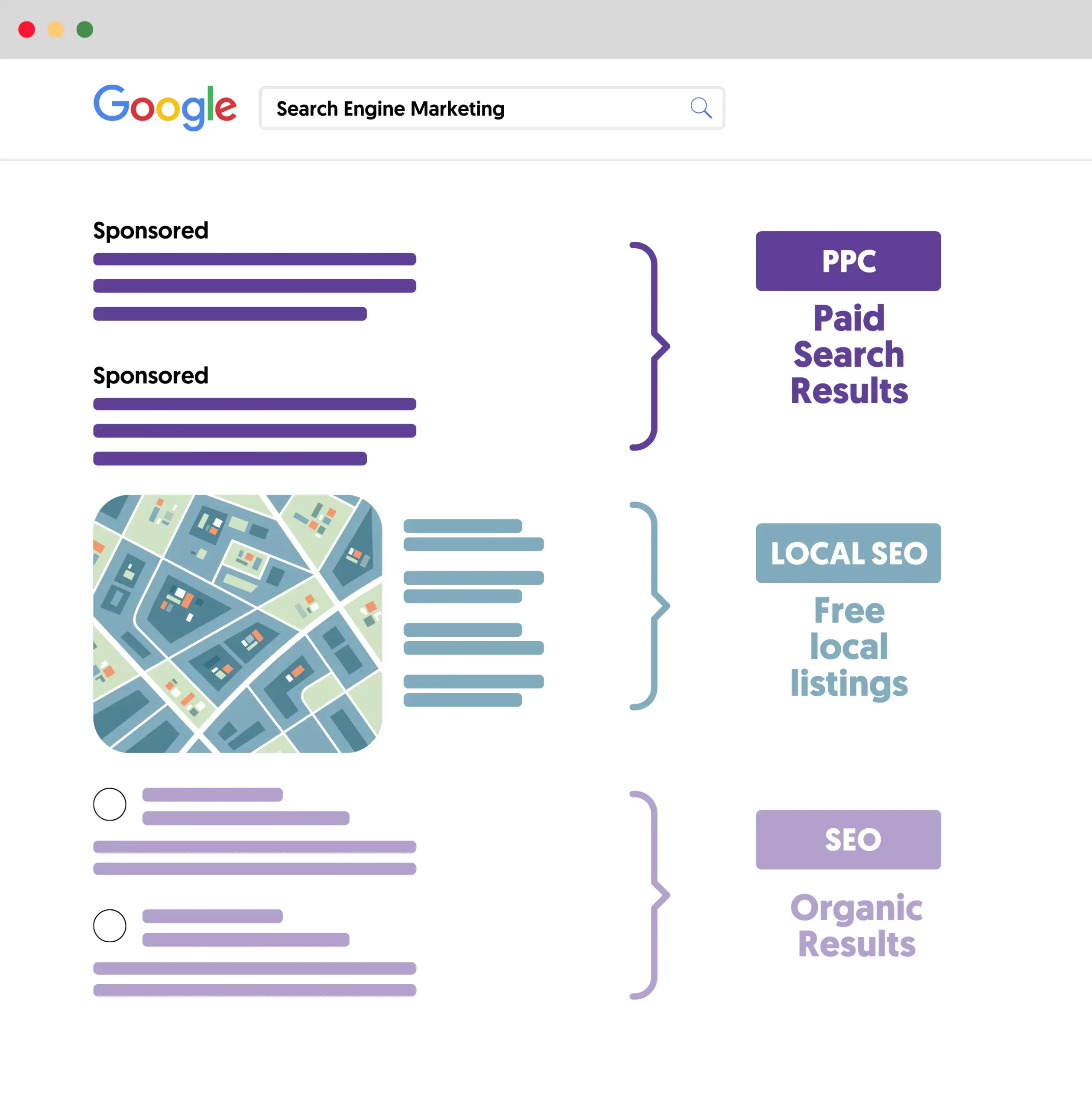
If you search Google, you will notice that sponsored ads usually appear above the organic results. This is what paid search advertising is about. Instead of trying to achieve high rankings through SEO, you can pay your way to the top.

Of course, as we will see below, that’s not so easy. It gets more complicated when several advertisers compete for one of the top ad positions.
The most commonly used model is the PPC (Pay Per Click), which means that you pay only when someone clicks on your ad. The two main platforms are:
- Google Ads - shows your ads on Google Search, and also on YouTube, Google Discover, and the thousands of websites that participate in Google AdSense.
- Microsoft Advertising - shows your ads on Bing and Microsoft’s partner sites.
Types of Search Ads
Paid search is not only text ads. The main formats are:
- Search ads - text ads that appear for the keywords you bid on. This is the classic form of SEM.
- Shopping ads - show a product image, price, and store name. They are used by online stores and are created from a product feed rather than keywords.
- Local Services Ads - listings for verified local service providers (plumbers, electricians, lawyers) at the top of the page. Unlike the other formats, you pay per lead, not per click.
- Performance Max - a Google Ads campaign type that runs your ads across Search, Shopping, YouTube, and Google’s other channels from a single campaign.
How does PPC Work?
The way it works is simple but gets more complicated when dealing with niches and keywords with a lot of competition. Here is an overview of the process:
- You can create a free account with Google Ads.
- You set up advertising campaigns. Each campaign can contain several ad groups, keywords, and ads.
- You specify your target audience, i.e., which people can see your ads (you can narrow down your selection by country, location, etc).
- You start the campaign and only pay when someone clicks on your ad.
- You monitor the results of your campaigns and make the necessary changes.
How much you pay every time someone clicks on your ad depends on many factors. Google Ads will indicate in advance how much you will be charged per click, but the actual amount is decided when it happens.
Google Ads is an auction-based system. This means that the cost of each click and the position of your ad will depend on ‘demand and supply’.
Every time a search is made on Google, Google Ads runs an auction for the available ad positions. The position of your ad is decided by its Ad Rank, which, according to Google, combines:
- Your bid.
- The quality of your ad at the time of the auction: expected clickthrough rate, ad relevance, and landing page experience.
- The minimum thresholds an ad must meet to show.
- The context of the search: the person’s location, device, time of search, and search terms.
- The expected impact of your ad assets, such as sitelinks.
This means a higher bid alone doesn’t guarantee the top position. A relevant, high-quality ad can outrank a competitor who bids more.
Consider this example to understand how SEM works.
Let’s say that 20 advertisers sell ‘engagement rings’ and want their ads shown on the first page of Google when people search for ‘Buy an Engagement Ring’.
Google has only a limited number of top ad positions on the first page, but there are 20 advertisers.
Which ads will show on the ad positions? This is where pay-per-click marketing comes into play. Like SEO, the Google Ads system considers several rules before deciding where each ad will be shown.
Advertisers can control some factors, such as the price they are willing to pay per click, the quality of the ads, etc. Some are decided during the auction, and some are only known to Google.
You need to understand that while Paid advertising is a great way to promote your website on Google, it’s not always as simple as setting up an account and running a campaign.
You need to optimize your campaigns through A/B testing to get the best ROI from your ad spend. This process takes time and requires specific skills. It's easy to lose money on ads without having a positive return, so sometimes, it is best to leave this task to professional marketers.
How to Measure SEM Results
These are the metrics to track in any paid search campaign:
- Clickthrough rate (CTR) - the percentage of people who click your ad after seeing it.
- Cost per click (CPC) - how much you pay, on average, for each click.
- Conversion rate - the percentage of clicks that turn into a sale, lead, or sign-up.
- Cost per acquisition (CPA) - how much you pay, on average, for each conversion.
- Return on ad spend (ROAS) - the revenue you earn for every dollar spent on ads.
Benefits of PPC Advertising
- With PPC ads, you can get results much faster than with SEO.
- You can bid on specific keywords, enabling your ads to show to users who are actively searching for products or services you are offering.
- You can target a specific audience by adding criteria for who will see your ads.
- PPC and SEO can work together in harmony. If you already have some good results with SEO, you can increase your market share by running ads for the same keywords that generate organic traffic for your business.
Disadvantages of PPC Advertising
- It's expensive. PPC ads are costly, especially for popular keywords.
- Unlike SEO, your traffic will drop when you stop paying for ads.
- It takes time and money to optimize a campaign for conversions.
- It's difficult for small businesses to compete with companies with bigger PPC budgets.
Resources to Learn More
- How to Become a PPC Specialist - a step-by-step guide on how to become a PPC expert.
- Best Google Ads Courses - a list of high-quality courses to learn Google Ads.
- Best PPC Marketing Certifications - the most valuable certifications to pursue to become certified in running paid ads.
2. SEO (Search Engine Optimization)
In the broader definition of SEM, the organic side is covered by search engine optimization. SEO is the process of optimizing your website to achieve higher rankings in search engines for specific keywords.
SEO principles can help you create high-quality websites with good content and satisfy the user intent.
How does SEO Work?
SEO is a complex process, and to get it right, you must consider many parameters. To make the whole process easier, it is broken down into the following SEO types:

Technical SEO - optimize your website for the crawling and indexing process so that search engines can discover, read, and index your website.
On-Page SEO - optimize all website pages individually and give search engines the right signals to understand your content.
Off-Page SEO - promote your website online, get good quality backlinks, and prove to search engine algorithms that your website deserves one of the top spots for the keywords you want.
You may also come across other terms that describe specific aspects of SEO, like:
- Content SEO - give both users and search engines the content they want and keep them happy.
- eCommerce SEO - SEO rules that apply to eCommerce websites only.
- Mobile SEO - make it easy for users to find and use your website on the go and from their mobile or tablet devices.
- International SEO - SEO settings for multilingual websites.
Benefits of SEO
- More traffic. The higher you rank, the more traffic you get. SEO is the way to go if your goal with search marketing is to get traffic to your website without paying for ads.
- Targeted traffic. Unlike traffic from social networks or other sources, organic traffic converts better because it's targeted.
- Trust and recognition. Users trust search engines because they know that they have strict rules as to which websites are shown in the search results, and in turn, they trust websites that rank in the top positions.
- Increases brand awareness. Trust generates more conversions and increases recognition and brand awareness, making your digital marketing efforts in other channels easier.
- Create better websites. SEO is not just about search engines but mainly about users. A fully optimized website for search engines is great for users.
Disadvantages of SEO
- It takes more time to work than PPC. SEO is a long-term marketing strategy that takes months to start generating results.
- SEO rules change all the time. Google reported 4,781 launches (changes) to Search in 2023, and some of them impact search rankings and traffic.
- Too competitive. Ranking high in the search results for keywords that can generate business has become very competitive.
- Requires ongoing work. With SEO, you must keep creating new content and improving your website. A process that takes time and costs a lot of money.
- Results cannot be guaranteed. Unlike PPC, where visibility is somewhat predictable, SEO cannot offer predictable results due to the nature of search algorithms.
Resources to Learn More
- The Complete SEO Course - Everything you need to know about SEO, from basic to advanced concepts.
- SEO Checklist - A comprehensive checklist to optimize your website for search engines.
- SEO Certifications - A list of accredited certifications to become SEO certified.
3. Local SEO
Local SEO is part of general SEO, but it’s often listed as a separate type of search marketing because it involves specific techniques to increase your visibility in the local search results and on Google Maps. Local businesses that want to get customers to their door prioritize local SEO over other types to get free traffic and leads. On the paid side, the same businesses can use Local Services Ads.

How does local SEO Work?
Optimizing your website to appear for location-aware searches includes several key strategies:
- Create a Google Business Profile listing: One of the most critical steps in local SEO is claiming and optimizing your Google Business Profile listing. This involves providing accurate information about your business (including images, contact details, hours of operation, and more).
- Optimize your titles, meta descriptions, and URLs to include location-specific keywords.
- Get backlinks from other websites (local newspapers, local directories, and other local businesses) to rank higher in the local results.
- Get positive customer reviews on your Google Business Profile and other review platforms (Yelp, TripAdvisor, Facebook, etc).
- Add the relevant structured data on your website to help search engines associate your website and physical location.
Benefits of Local SEO
- Increase visibility in local search results and get more customers.
- Easier to implement than general SEO and PPC.
- Cost-effective compared to PPC Ads.
Disadvantages of Local SEO
- Google algorithms are constantly changing the rules of local SEO rankings.
- Limited reach. Only customers in your geographical area will see your business in their SERPS.
- It is too competitive, especially in areas where many local businesses are competing for a position in the local results.
Resources to Learn More
- What Is Local SEO? - how local SEO works and how to get started.
- Best Local SEO Courses - online courses to build your local SEO skills.
Search Engine Marketing Examples
Here are three simple examples of how different businesses use SEM:
A local plumber runs Local Services Ads so that their business appears at the top of the page when people nearby search for "emergency plumber". They pay only when a customer calls or messages them, and they work on local SEO so that their Google Business Profile also appears in the map results.
An online store selling running shoes uses Shopping ads to show product images and prices for searches like "trail running shoes", and search ads for broader terms like "running shoe sale" during promotions.
A software company bids on keywords that show buying intent, such as "project management software for small teams", sends the clicks to a dedicated landing page with a free trial, and tracks the cost per sign-up to decide which keywords to keep. At the same time, it publishes guides to rank organically for informational searches that are too expensive to advertise on.
How Much Does SEM Cost?
There is no fixed price for SEM. With PPC, you set your own budget, and you can start with any amount. What you actually pay depends on:
- Your keywords - popular keywords in competitive industries (like insurance, legal, or finance) cost much more per click than niche keywords.
- Your competition - the more advertisers bid on the same keywords, the higher the cost per click.
- Your ad quality - relevant, high-quality ads have a higher Ad Rank and can win better positions without a higher bid.
- Your targeting - locations, devices, and times of day all affect the cost.
You can see the estimated cost per click for any keyword in the Google Keyword Planner before you spend anything. For a closer look at whether paid search makes sense for your business, read our guide on whether Google Ads is worth it.
How To Get Started With SEM
If you are new to search marketing, you must understand that to succeed, you should prioritize the user experience over anything else. Your first task is to make sure you have a great website that is functional and easy to use, then to work on your content and deliver the best possible result to your users.
Once you have this in place, your next step is to start working on your SEO to improve your organic rankings gradually. In parallel, start working on your PPC campaigns and maximize your return on investment (ROI).
Enrolling in a good SEM training course is the best way to build the necessary skills.