- Are free AI courses actually worth it?
- Best Free AI Courses List
- Free AI Courses Compared
- Free AI Courses for Beginners
- Free AI Courses for Prompting and Practical Skills
- Free AI Courses for Technical Learners
- Free to Audit, Paid Certificate
- How to choose the right free AI course
- Do free AI courses come with certificates?
- Next steps
The best free AI courses are Elements of AI and OpenAI Academy for complete beginners, Anthropic's Claude 101 and AI Fluency for using AI at work, DeepLearning.AI's prompt engineering course for practical skills, and Google's Machine Learning Crash Course and Harvard's CS50 AI for technical learners. All 15 courses below are free to take, and many end with a free certificate or badge.
You really can build real AI skills right now without paying a cent. The hard part is not finding free AI courses. It is finding the ones that are not outdated, broken, or secretly locked behind a paywall.
So I did the boring work for you. Here are the ones I would actually tell a friend to take, checked against each provider's own course page.
Are free AI courses actually worth it?
Short answer: yes, but only some of them. A lot of courses were not worth finishing.
Some were years out of date. Some called themselves free but locked the useful parts, or only let you learn for free and charged for the certificate. A few were just sales pages in disguise.
The 15 below are the ones that survived. They come from trusted names like Google, OpenAI, Anthropic, IBM, Harvard, Microsoft, AWS and the University of Helsinki. Every one can be taken without paying, and the table shows which ones also give you a free certificate or badge.
A free course is only worth your time if it teaches you something you can use the next day.
If you want the bigger picture on paid options too, I keep a wider roundup of the best Coursera certificates that pairs well with this list.
Best Free AI Courses List
These are the 15 free AI courses I would actually recommend, grouped by where you are starting. Tap any course to jump straight to it.
- Elements of AI
- OpenAI Academy: AI Foundations
- Claude 101
- AI Fluency: Framework and Foundations
- IBM SkillsBuild Artificial Intelligence Fundamentals
- AI for Business Professionals
- Generative AI for Educators with Gemini
- ChatGPT Prompt Engineering for Developers
- Foundations of Prompt Engineering
- Learn How to Use AI for Coding
- Intro to AI Agents
- Introduction to Vertex AI Studio
- Machine Learning Crash Course
- CS50's Introduction to AI with Python
- AI for Beginners
Free AI Courses Compared
| Course | Provider | Time | Level | Free certificate? |
|---|---|---|---|---|
| Elements of AI | University of Helsinki | 6 chapters, self-paced | Beginner | Yes |
| OpenAI Academy: AI Foundations | OpenAI | 60-75 min | Beginner | Badge |
| Claude 101 | Anthropic | 2.5 hr | Beginner | Badge |
| AI Fluency: Framework and Foundations | Anthropic | 4 hr | Beginner | Badge |
| IBM SkillsBuild AI Fundamentals | IBM | 3-10 hr | Beginner to intermediate | Badge |
| AI for Business Professionals | HP LIFE | Self-paced | Beginner | Yes |
| Generative AI for Educators with Gemini | 2 hr | Beginner | Yes | |
| ChatGPT Prompt Engineering for Developers | DeepLearning.AI and OpenAI | 1 hr 40 min | Beginner | No (paid plan) |
| Foundations of Prompt Engineering | AWS | 4 hr | Intermediate | No |
| Learn How to Use AI for Coding | Codecademy | 1 hr | Beginner | No (paid plan) |
| Intro to AI Agents | Codecademy | Under 1 hr | Beginner | No (paid plan) |
| Introduction to Vertex AI Studio | 2 hr | Introductory | Badge | |
| Machine Learning Crash Course | About 13 hr | Technical | No | |
| CS50's Introduction to AI with Python | Harvard | 7 weeks | Technical | No (paid on edX) |
| AI for Beginners | Microsoft | 12 weeks, 24 lessons | Technical | No |
Free AI Courses for Beginners
No technical background needed. Start here if you want to understand AI and use it at work.
1. Elements of AI (University of Helsinki)
This is the best place to start if you want to understand what AI actually is before you use it. More than 2 million people have signed up.
Created by the University of Helsinki and MinnaLearn, it explains what AI can and cannot do and how it affects daily life, across six chapters with no complicated math or programming.
The certificate is free, and in some cases you can even claim university credits for it. The follow-on course, Building AI, is free to take too, though its certificate costs 50 euros.
2. OpenAI Academy: AI Foundations (OpenAI)
OpenAI Academy is free for anyone with a ChatGPT account, and AI Foundations is the course to begin with. OpenAI puts it at 60 to 75 minutes.
It covers AI basics, clear prompting, giving the right context, reviewing what comes back, and using AI responsibly at work. Pass the assessment and you earn an OpenAI Academy badge.
When you finish, the same pathway continues with Applied AI Foundations and Agents and Workflows, both free.
3. Claude 101 (Anthropic)
Claude 101 is Anthropic's introduction to using Claude for everyday work. It takes about 2.5 hours across 13 lessons and ends with a quiz and a completion badge.
You learn to write better prompts, then use projects, artifacts, skills and connected tools so Claude works from your own context. It works on any Claude plan, including Free, though a few lessons need a paid plan to try hands-on.
Anthropic has more than 25 free courses on its Claude Academy. We go through the best of them in our guide to the free Claude courses from Anthropic.
4. AI Fluency: Framework and Foundations (Anthropic)

This one comes from Anthropic, the company behind Claude. It takes about 4 hours across 14 lessons and ends with a completion badge.
It is built around a simple way to work with AI called the 4D Framework: Delegation, Description, Discernment, and Diligence.
You learn how to hand off the right tasks, give clear context, judge the output, and use AI in a safe, honest way. It works with any AI tool, not just Claude, and it is a great mental model to carry into everything else.
5. Artificial Intelligence Fundamentals (IBM SkillsBuild)

If you want to see what an AI career really looks like, this is a strong pick. IBM lists it at 3 to 10 hours on its free SkillsBuild platform.
It covers the history of AI and how systems make predictions, understand language, and read images, with a hands-on simulation where you build and test a machine learning model.
Pass the quizzes and assessments and you earn a free IBM Credly badge that employers can verify. If you want more, see our guide to the best IBM courses.
6. AI for Business Professionals (HP LIFE)

This short, self-paced course focuses on using AI for better decisions and career growth.
You learn the difference between standalone AI tools and built-in AI features, so you can pick the right one for marketing, communications, or operations.
It also covers writing strong prompts for tools like ChatGPT and Canva. By the end you can build a clear, ethical plan to bring AI into your daily work, and you get a free certificate.
7. Generative AI for Educators with Gemini (Google)

This short course is built for teachers and takes about two hours. If you work in education, it is time well spent.
You learn how to use Gemini and NotebookLM to build lesson plans and create materials students actually engage with, while using these tools responsibly.
Pass the optional final assessment and you get a free certificate, which some school districts accept for professional development.
Free AI Courses for Prompting and Practical Skills
These teach you to get better results from AI tools, write prompts that work, and put AI into your own projects.
8. ChatGPT Prompt Engineering for Developers (DeepLearning.AI)
This is one of the most popular prompt engineering courses anywhere, taught by Isa Fulford of OpenAI and Andrew Ng. It takes about 1 hour 40 minutes across 9 video lessons with code examples.
You learn two core prompting principles, then practise summarizing, inferring, transforming and expanding text, and finish by building a simple chatbot.
It is marked Beginner and is free to learn. A certificate of accomplishment needs DeepLearning.AI's paid Pro plan.
9. Foundations of Prompt Engineering (AWS)

This is the deeper prompt engineering course on the list. It takes about four hours and is free on AWS Skill Builder.
It walks you through the core principles and best practices for writing prompts, then moves on to advanced techniques. It also shows you how to spot prompt misuse and reduce bias, so your results stay reliable.
AWS rates it Intermediate and builds its examples on Amazon Bedrock, so take a beginner course first if prompting is new to you.
10. Learn How to Use AI for Coding (Codecademy)

This takes about an hour and needs no prior experience. It turns tools like ChatGPT into your personal coding helper.
You learn prompt engineering made for software work, so you can generate code, write Bash commands, create regular expressions and database queries, write tests and debug faster.
The lessons are free, though the certificate needs a paid Plus or Pro plan.
11. Intro to AI Agents (Codecademy)

This is the one most people skip, and it might give you the biggest edge. It takes less than an hour and needs no coding background.
It explains what makes a system an agent, the difference between workflows and agents, and how agents use tools and retrieval to finish tasks on their own.
It is a short introduction, not a build course, but it gives you the vocabulary to follow the fastest-moving area in AI. The certificate needs a paid Plus or Pro plan.
Free AI Courses for Technical Learners
These go under the hood. You will need some comfort with code, and for most of them, with Python.
12. Introduction to Vertex AI Studio (Google)

This is a good fit if you want to see how businesses build with AI, not just chat with a bot. It takes about two hours on Google Skills.
You learn how to take an idea, build a prototype, and ship it, with a hands-on lab where you design prompts and build with Gemini. Google has since renamed Vertex AI to Gemini Enterprise Agent Platform, and the lab now runs in Agent Studio, but the skills are the same.
The course is partially free: the lessons are free, and the lab may use credits. The free Google Developer Program, with its GEAR sign-up, gives you monthly credits for labs like this one. You earn a digital badge at the end.
13. Machine Learning Crash Course (Google)

Here is where things get more technical. Google's modules add up to about 13 hours.
It explains the core ideas of machine learning, including loss, gradient descent, neural networks and large language models, through interactive exercises that use Keras, NumPy and pandas.
You do not need past machine learning experience, but you should be comfortable with algebra, basic statistics and Python.
You do not need to spend a single dollar to start building real AI skills.
14. CS50's Introduction to Artificial Intelligence with Python (Harvard)
This is Harvard's famous CS50 series applied to AI, and you can take the whole thing free through Harvard's OpenCourseWare.
Over seven weeks of lectures and hands-on projects, you learn graph search, classification, optimization, machine learning and large language models, and build them into your own Python programs.
You need CS50x or about a year of Python first. The course is free; a verified certificate is available through edX for a fee.
15. AI for Beginners (Microsoft)
Despite the name, this is a full technical curriculum: 12 weeks and 24 lessons, free on GitHub, with quizzes and labs.
It covers neural networks and deep learning, computer vision, natural language processing and AI ethics, with code in both TensorFlow and PyTorch.
It is a good self-study path if you want to understand how modern AI systems are built, not just how to use them.
Free to Audit, Paid Certificate
These popular AI courses often show up on "free" lists, but only the learning is free, and sometimes only for a limited time. The certificate costs money. They are still worth knowing about if you want a credential from a big name.
Google AI Essentials (Coursera)

A five-course Google AI Essentials program for people who want to use AI to speed up daily work. Coursera lists it at about 4 hours; the individual courses add up to about 8.
You learn to write clear prompts, use AI tools to get more done, and use AI responsibly. It costs $49 per month on Coursera after a 7-day free trial, and Coursera's own FAQ says you cannot take it for free. Financial aid is available. Compare it with Google's other programs in our list of the best Google career certificates.
Google AI Professional Certificate (Coursera)
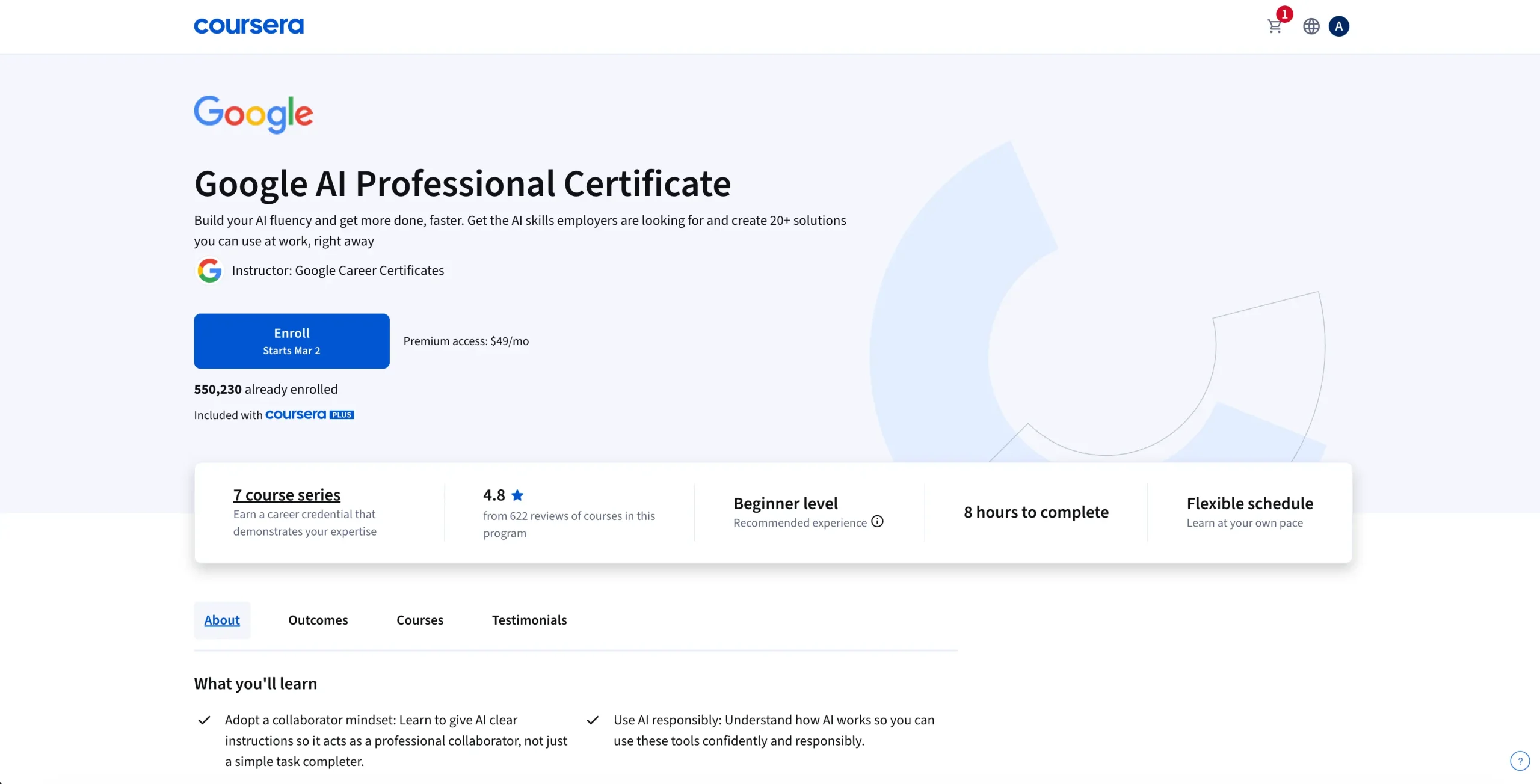
The Google AI Professional Certificate is Google's deeper program: eight courses, from AI fundamentals to building and deploying your own AI apps.
It costs $49 per month on Coursera. The 7-day free trial does not earn you the certificate; you become eligible after your first payment. US businesses with up to 500 employees can get it at no cost through Google and Coursera's small-business offer. Read our full Google AI Professional Certificate review before you sign up.
IBM AI for Everyone (edX)

IBM AI for Everyone: Master the Basics is one of the safest picks for a true beginner. It takes about four weeks at one to two hours a week and needs zero technical background.
It explains what AI is, the core ideas behind machine learning, deep learning and neural networks, and covers risks and career paths. You can audit it free for a limited time; the verified certificate costs $99.
Harvard Machine Learning and AI with Python (edX)

Machine Learning and AI with Python is the deepest course here: six weeks at four to five hours a week, at intermediate level.
It teaches you to build decision trees, random forests and gradient boosting models in Python, test your results, and avoid biased outcomes. You can audit it free for a limited time without graded work; the verified certificate costs $299.
How to choose the right free AI course
Fifteen options can feel like a lot, so here is the simple way I would pick.
If you are brand new, start with Elements of AI or OpenAI Academy's AI Foundations. They build the base everything else sits on.
If you want to use AI at work, take Claude 101 or AI Fluency next, then learn prompting properly. If you want a stronger foundation there, our guide to prompt engineering pairs well with the DeepLearning.AI course.
If you can already code, go straight to Google's Machine Learning Crash Course, CS50 AI, or Microsoft's AI for Beginners.
If you only have an hour, OpenAI's AI Foundations or either Codecademy course gives you a real win in one sitting.
Start with one short course, finish it, then pick the next one.
Do free AI courses come with certificates?
Some do, and some do not, so it helps to know before you start.
Elements of AI, HP LIFE and Google's Generative AI for Educators give you a free certificate. OpenAI Academy, Anthropic's Claude Academy, IBM SkillsBuild and Google Skills give you a free badge.
Others, like DeepLearning.AI, Codecademy, CS50 AI on edX, and the Coursera and edX programs above, let you learn for free but charge if you want the certificate.
My honest take: the skill matters far more than the paper. Take the course free first, then decide if the certificate is worth paying for. If a credential matters to you, see our list of the best free AI certifications.
Next steps
Pick one course from the list and start it today. Do not try to do all 15 at once.
The goal is to finish one, use what you learned on a real task, then come back for the next. Momentum beats a long wishlist every time.
If you want a wider view of what is out there, browse our roundup of the best online courses for more options.
And when you are ready for a structured path that turns AI into real income, take a look at the Reliablesoft Academy. It bundles our digital marketing and AI training in one place so you can go from learning to earning.