
- What makes a free AI certification worth your time
- The 9 best free AI certifications in 2026
- Free AI certifications compared
- More free AI certifications worth your time
- Free to learn, paid to certify: what to watch for
- What the data actually says about certificates
- How to choose the right one for you
- Mistakes to avoid
- Your first week plan
- Frequently asked questions
- Key takeaways
The best free AI certifications come from OpenAI, Microsoft, IBM, Google and Oracle, followed by Elements of AI, Databricks, Salesforce Trailhead and Anthropic's Claude Academy. All nine cost nothing to learn and nothing to earn, and each gives you a badge, credential or exam result you can show an employer.
Most free AI certifications are worthless. You watch a few videos, you download a PDF, and nobody ever looks at it again.
But a handful of them are built differently. They come from the companies that build AI, they cost exactly nothing, and they give you something a recruiter can click on and verify.
What makes a free AI certification worth your time
We looked at dozens of free AI programs while researching this. Most of them fell apart on the same three questions.
Who issues it? A badge from a company that actually builds AI carries weight. A badge from a course platform nobody has heard of does not.
Can an employer verify it? A PDF you download is not proof of anything. A credential with a public verification page is a completely different signal.
Did you actually do something? Watching videos and clicking next teaches you very little. Completing a real task in a real environment teaches you a lot.
Only nine programs passed all three. If you want the wider picture, including the paid options, our guide to the best AI certifications covers the full landscape.
One thing to understand before you start. There are three different things people call a certification, and they are not equal.
- Completion certificate: proof you finished the material. Useful, but it does not test you.
- Verified credential or badge: a shareable badge with a public page listing the skills you demonstrated.
- Assessed certification: you pass an exam or a hands on task. This is the strongest signal.
Every option below gives you at least a badge you can share. Microsoft, Google and Oracle go further and test you on a real task or a proper exam.
The 9 best free AI certifications in 2026
- OpenAI Academy
- Microsoft Applied Skills
- IBM SkillsBuild AI Fundamentals
- Google Skills
- Oracle Agentic AI Foundations
- Elements of AI
- Databricks Generative AI Fundamentals
- Salesforce Trailhead AI badges
- Anthropic Claude Academy
Free AI certifications compared
| Certification | Issuer | What you earn | Time | Level |
|---|---|---|---|---|
| OpenAI Academy | OpenAI | Course badge, pathway certificate | 60-90 min per course | Beginner |
| Microsoft Applied Skills | Microsoft | Verified credential from a lab | 30-45 min per lab | Beginner to intermediate |
| IBM SkillsBuild AI Fundamentals | IBM | Credly badge | 3-10 hr per credential | Beginner |
| Google Skills | Skill badge from a challenge lab | 30 min to 1 hr per course | Beginner to intermediate | |
| Oracle Agentic AI Foundations | Oracle | Certification exam | 6 modules plus a 60 min exam | Intermediate |
| Elements of AI | University of Helsinki and MinnaLearn | Certificate | Self-paced, 6 chapters | Beginner |
| Databricks Generative AI Fundamentals | Databricks | Badge after a quiz | About 1 hr plus a 20 min quiz | Beginner |
| Salesforce Trailhead | Salesforce | Badges and Agentblazer status | 10 min to 10 hr | Beginner |
| Claude Academy | Anthropic | Completion badge | 45 min to 9 hr per course | Beginner to advanced |
1. OpenAI Academy
This is the name most people still do not know is open to everyone.
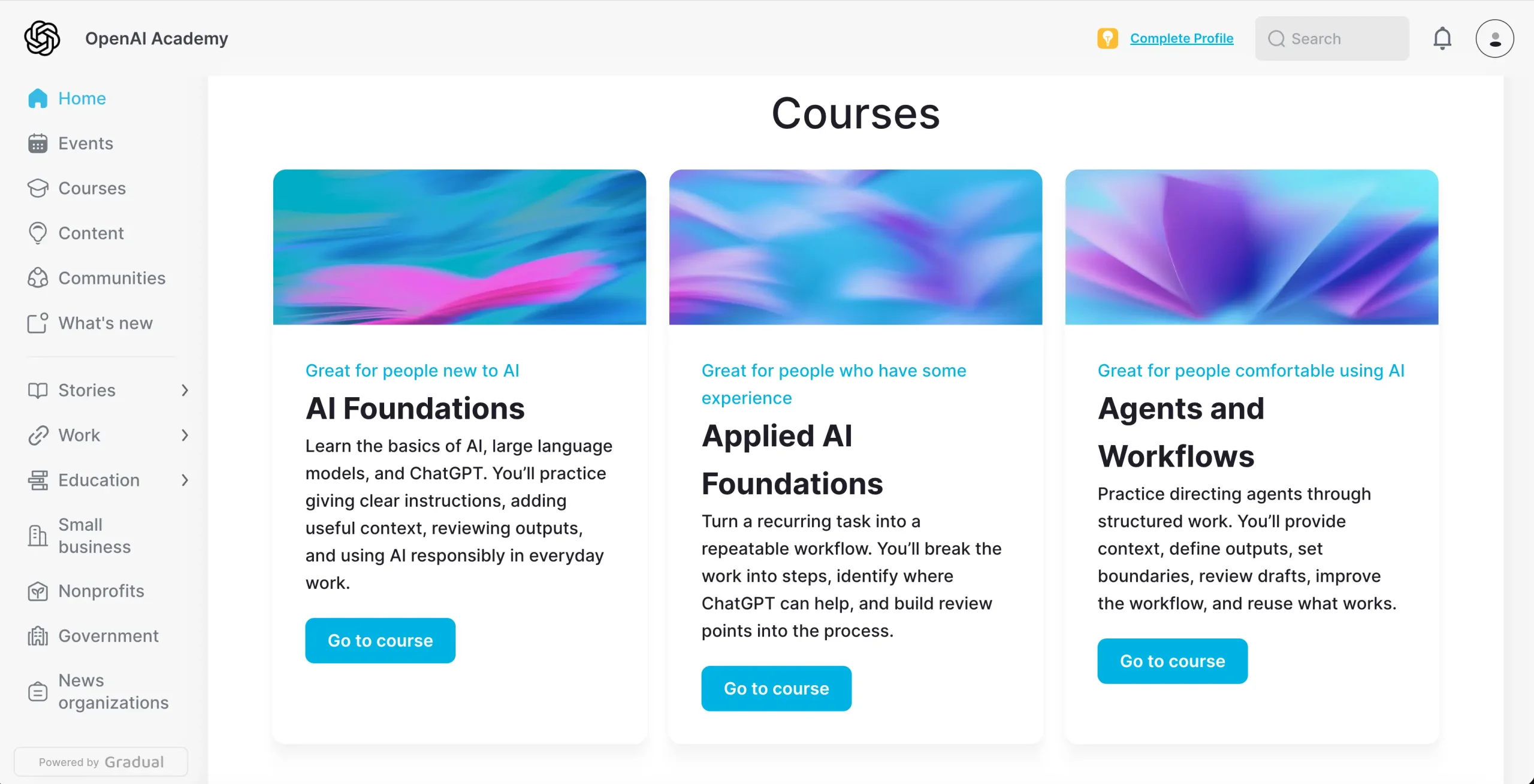
OpenAI Academy courses are free and available to anyone with a ChatGPT account. You can browse without signing in, then sign in with a free ChatGPT account to enroll. No employer sponsorship, no waitlist, no payment.
The one to begin with is AI Foundations. It covers AI basics, clear prompting, giving the right context, reviewing what comes back, and using AI responsibly at work.
OpenAI puts it at 60 to 75 minutes. That is a lunch break.
It is the first of three courses in the Foundations pathway. Applied AI Foundations takes one repetitive task from your real job and turns it into a repeatable workflow, with clear inputs, outputs and review points.
Then there is Agents and Workflows, which teaches you how to direct an AI agent through structured work. That is probably the most valuable skill on this entire page. Each of the two takes 75 to 90 minutes.
The catalog now runs to 14 free courses, including tracks on the OpenAI API, Codex, AI leadership, and AI for educators and college students.
Now the honest part, because most articles skip it. Pass a course assessment with 80% or more and you earn an OpenAI Academy badge. Finish a whole pathway and you get a certificate of completion. OpenAI says plainly that these are not certifications.
The formal OpenAI Certified program is a separate thing, built with Coursera, ETS and Credly by Pearson. For now it is invite-only for ChatGPT Enterprise and Edu workspaces.
So why is it still number one? Because OpenAI has said it wants to certify 10 million Americans by 2030.
This is the ground floor of that. Getting the foundations done now, for free, before the formal certification opens to everyone, is exactly where you want to be standing.
2. Microsoft Applied Skills
Skip the obvious answer here. Most roundups will point you at Azure AI Fundamentals, but that exam costs money.
Its old AI-900 exam retired on June 30, 2026. The replacement, AI-901, is more technical, expects some Python, and costs $99 in the United States. So a lot of the advice you will find about it is already out of date.
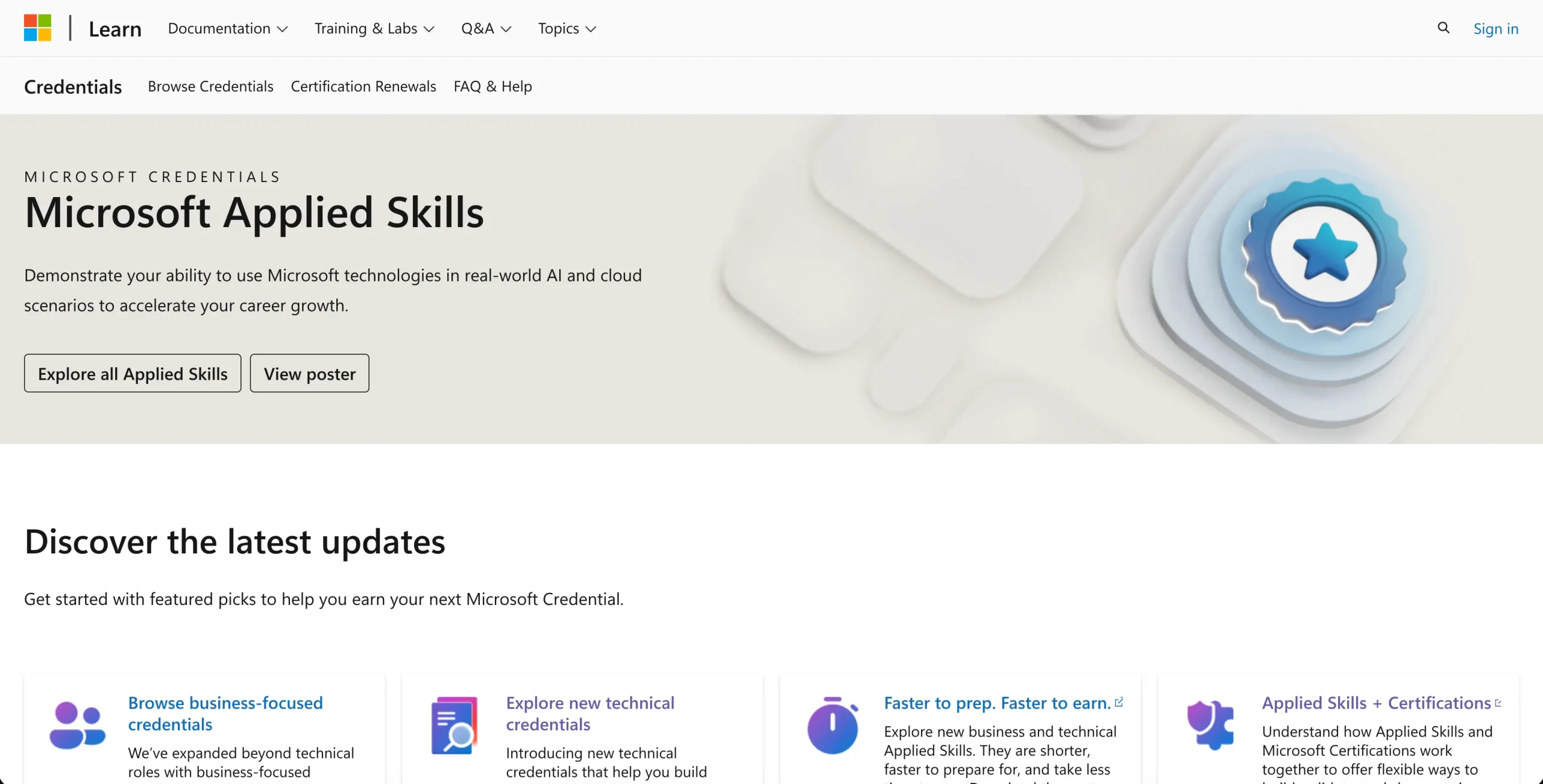
The genuinely free Microsoft route is Applied Skills. These are lab based assessments you take directly on Microsoft Learn, at no cost.
We like these a lot, and the reason is simple. You are not answering multiple choice questions about AI. You get dropped into a real environment and asked to complete an actual task.
Beginner labs give you 30 minutes, and intermediate labs give you 45. You either do it or you do not. Once you earn it, it never expires, and it shows up as a Microsoft verified credential you can share on LinkedIn.
On the business side you have "Generate reports with AI research agents" and "Streamline business workflows with AI chat", which is really about using Copilot properly in your day to day work. Both are beginner level.
On the technical side there is "Build an agent in Microsoft Copilot Studio", "Get started developing agents in Microsoft Foundry", and "Integrate model context protocol tools with agents in Microsoft Foundry". That last one sits right at the front of where AI is heading.
One thing to watch. Microsoft is retiring a large part of its credential catalog this year, including several Applied Skills, while it adds new ones.
Check the official Applied Skills list on Microsoft Learn before you start a lab, so you do not spend your time on something that is about to disappear.
3. IBM SkillsBuild AI Fundamentals
This is the most beginner friendly credential on the list.
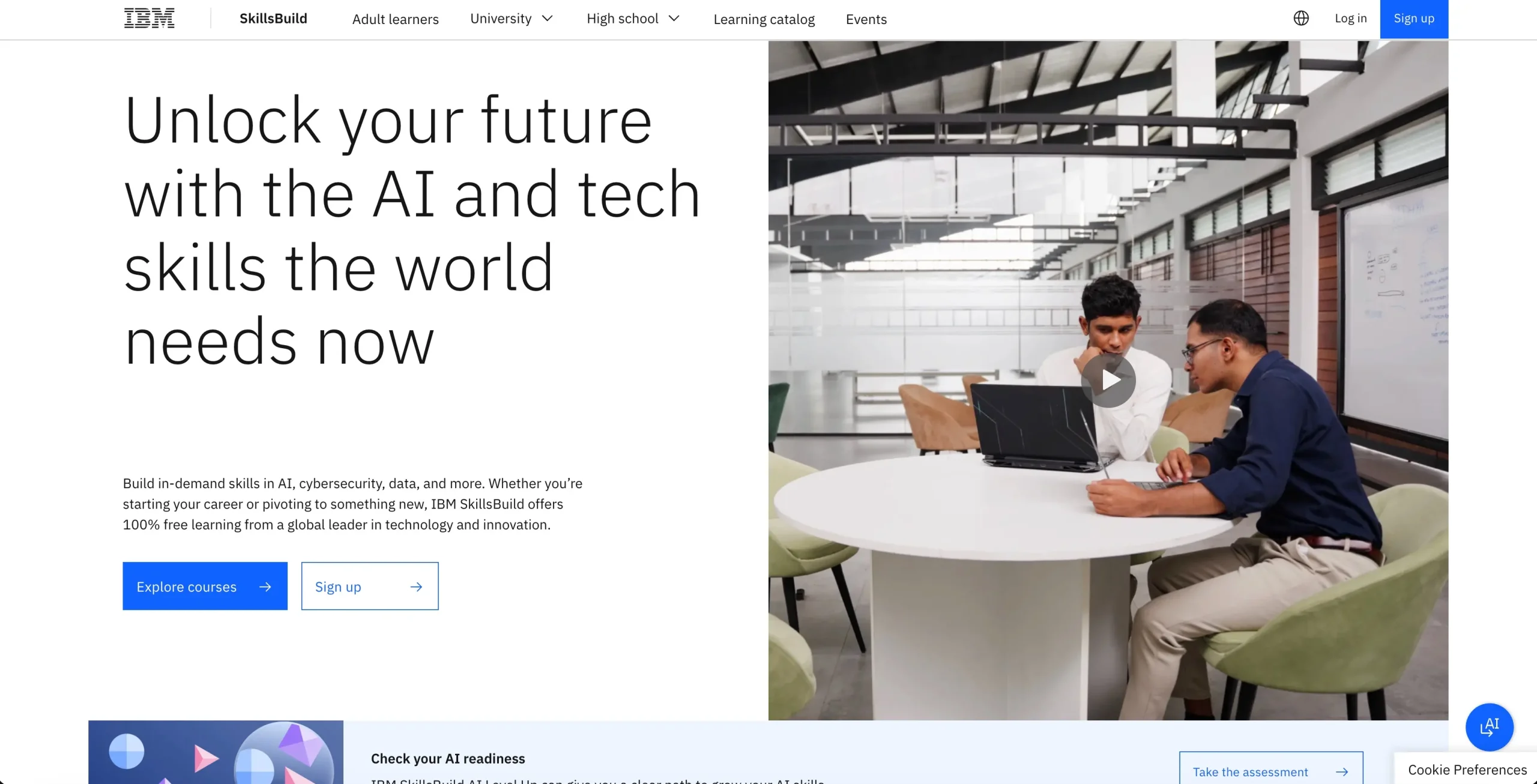
Go to skillsbuild.org, create a free account, and choose from two credentials: AI Fundamentals: Foundations for Understanding AI, and AI Fundamentals: Language and Vision in AI. IBM lists each one at 3 to 10 hours.
Between them they cover machine learning, neural networks, computer vision, natural language processing, large language models, agentic AI and AI ethics. You earn each credential by scoring 80% or more on the end of module quizzes.
What makes it worth your time is the badge. IBM issues a Credly credential, and when a recruiter clicks it they land on a verification page that lists the exact skills you demonstrated.
That is a completely different signal from a certificate of completion, and it is the main reason this one beats most beginner courses.
IBM is not doing this for fun either. In 2023 the company committed to training 2 million people in AI by the end of 2026, on top of an earlier pledge to skill 30 million people by 2030.
This is also the company whose apprenticeship program has hired people without four year degrees since 2017, which tells you something about how it treats credentials.
If you want to go further than the fundamentals badges, we break down the full catalog in our guide to IBM AI certifications.
4. Google Skills
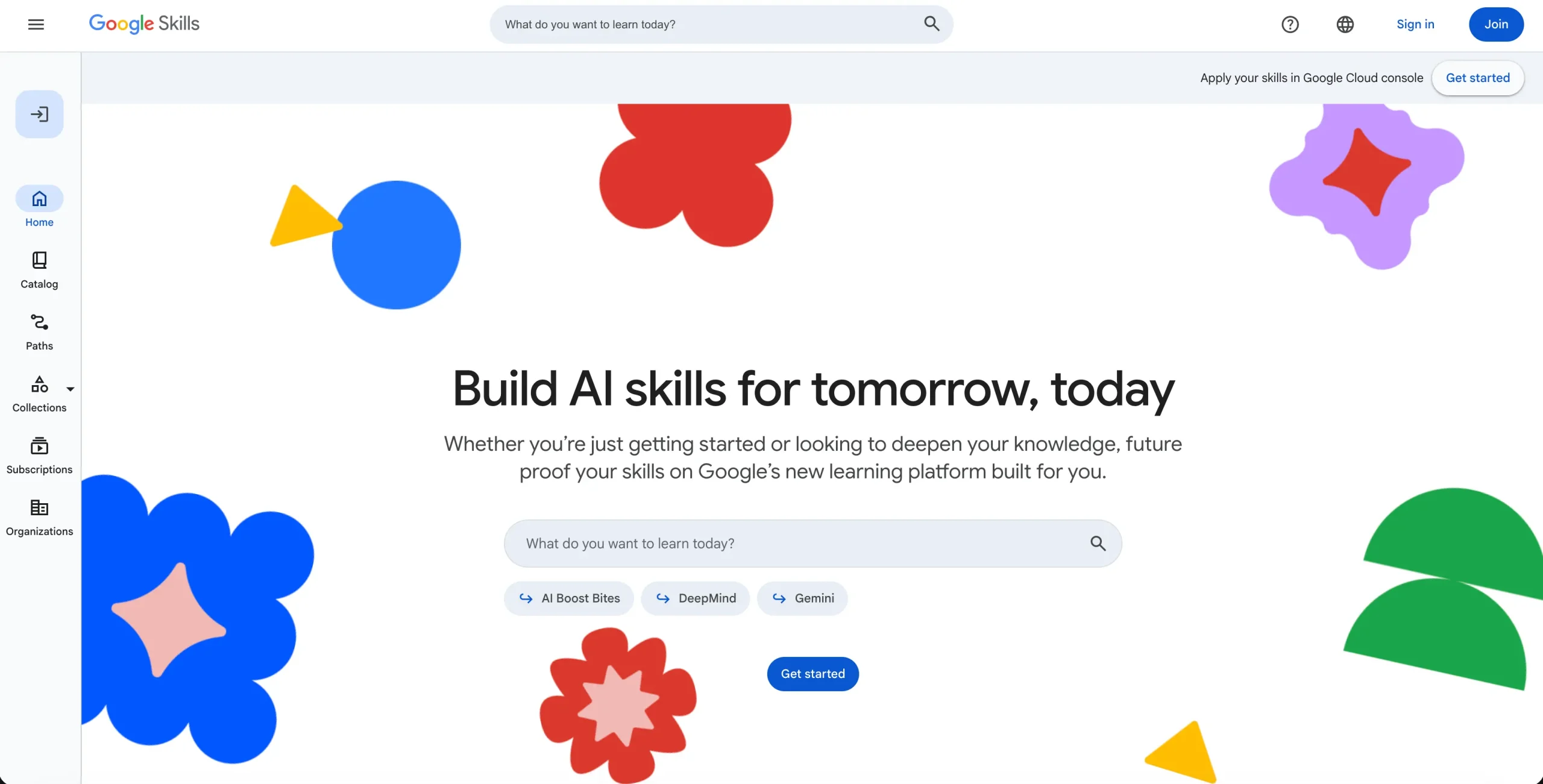
Google needs a bit of untangling. It has a huge amount of AI training, and most of its certificates sit behind a paid Coursera subscription, which is exactly why people get confused about what is actually free.
The genuinely free route is a platform called Google Skills. Google launched it in October 2025 to pull everything into one place: nearly 3,000 courses, labs and credentials from Google Cloud, Google DeepMind, Grow with Google and Google for Education.
If you are starting from scratch, four short introduction courses are free: Introduction to Generative AI (45 minutes), Introduction to Large Language Models (1 hour), Introduction to Image Generation (30 minutes), and Transformer Models and BERT Model (30 minutes, intermediate).
You can get through the whole set in a single afternoon.
Then it gets more interesting. Join the free Google Developer Program and sign up for its GEAR program, and you get 35 lab credits every month.
Those labs put you inside a live Google Cloud environment with real credentials and real APIs. You are not clicking through a simulation. You are running actual commands against actual services.
Finish something like Prompt Design in Agent Platform, pass the challenge lab at the end, and you earn a skill badge. That badge is verifiable and shareable through Credly, and you can make your Google Skills profile public.
There is one more reason we would point you here. A lot of these free paths are the official prep material for Google Cloud's paid certifications, which cost $200 per exam at the professional level.
So even if you never pay for the exam, you are learning the exact material employers are hiring against. Our full breakdown of the Google AI certifications explains which paid paths are actually worth it later.
5. Oracle Agentic AI Foundations
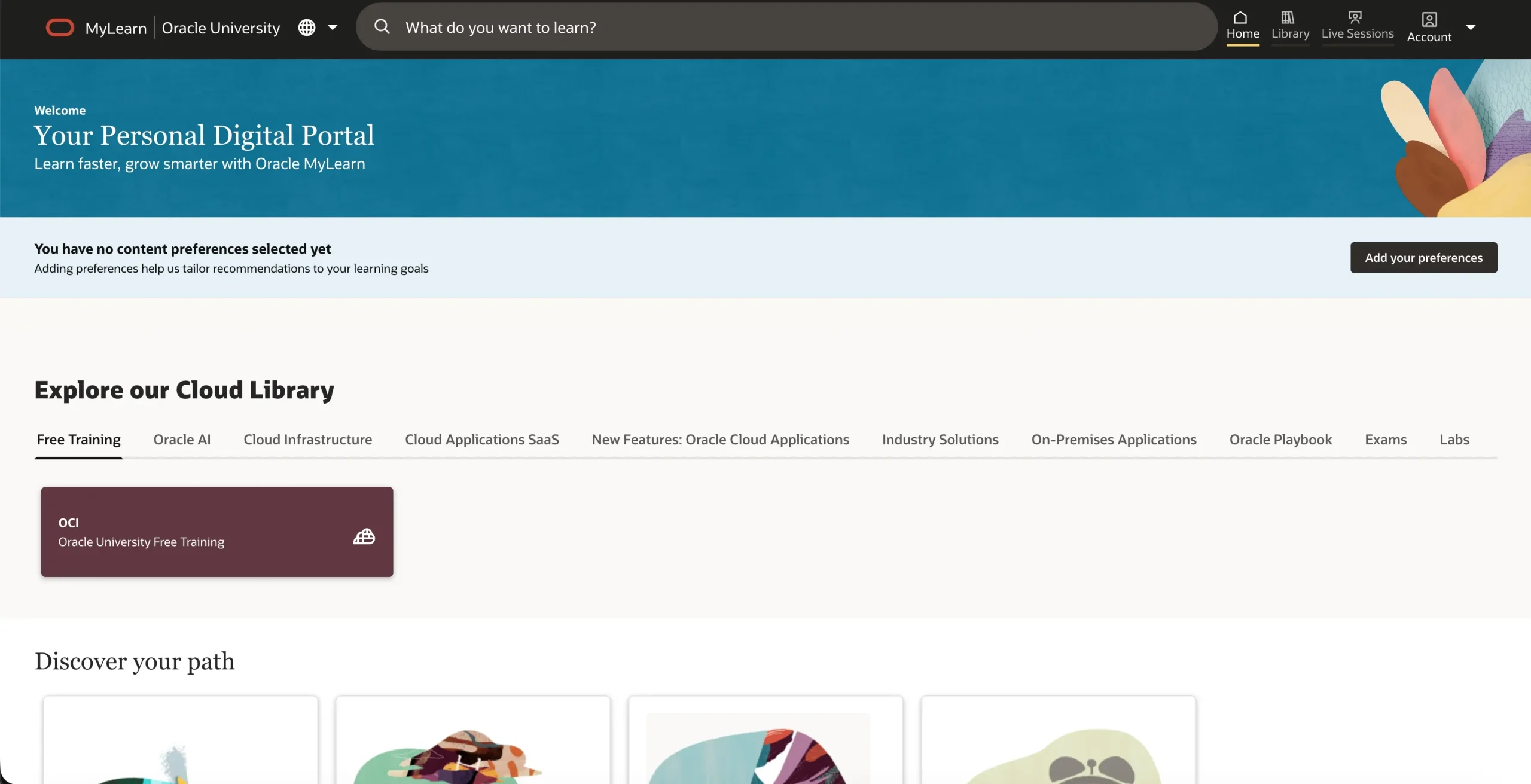
Oracle launched this in June 2026, and we would be surprised if you have heard about it yet.
It is completely free, and it is the only certification here built entirely around AI agents.
Why does that matter so much? Because agents are the shift happening right now. A chatbot answers your question and stops.
An agent takes a goal, works out the steps by itself, uses tools to get things done, checks its own results, and keeps going until the job is finished.
Every company you can think of is trying to work out how to use this, and almost nobody has the skills yet. That gap is your opportunity.
The course takes you through it across six modules. You start with how agents reason and make decisions, then build your first one using LangChain.
From there you get into Model Context Protocol, the standard that lets agents plug into tools and data. Then the OpenAI Responses API and Agents SDK, running agents on Oracle's enterprise AI platform, and finally connecting them to Oracle AI Database.
When you have worked through it, you can take the certification exam to prove what you learned. It is free as well: 40 questions in 60 minutes, with 65% needed to pass. There is a free practice exam to try first.
Oracle has also said that every Foundations level course and certification stays free, which includes OCI AI Foundations Associate if you want a second Oracle credential.
Brand new material on the skill that is in shortest supply, from the company behind Oracle Database, at zero cost.
More free AI certifications worth your time
These four are smaller or more specialised than the five above, but each one is free to learn and free to earn.
6. Elements of AI
Elements of AI is a free introduction to AI from the University of Helsinki and MinnaLearn, and the only university-backed option on this list. More than 2 million people have signed up.
It explains what AI is, what it can and cannot do, and how it affects daily life, across six chapters with no complicated math or programming. It is written for complete beginners.
The certificate is free. In some cases you can also claim 2 ECTS credits through the University of Helsinki Open University, which is rare for a free course.
Where it falls short: it is conceptual. You learn how AI works, not how to use today's tools. The follow-on course, Building AI, is also free to take, but its certificate costs 50 euros.
7. Databricks Generative AI Fundamentals
Databricks Generative AI Fundamentals is a free accreditation from the data and AI platform company Databricks.
The training takes about an hour. It covers generative AI concepts, spotting business use cases, the trade-offs between model quality, speed and cost, governance and hallucinations, and AI agents. A 20-minute assessment follows, and scoring 80% earns you a Databricks badge you can share.
It is the fastest way on this list to get a verifiable generative AI badge from a company whose platform data teams actually use.
Where it falls short: it is introductory, and the badge is issued on Databricks' own credentials site rather than Credly.
8. Salesforce Trailhead AI badges
Salesforce Trailhead is Salesforce's free learning platform, and it has some of the easiest AI badges to earn anywhere.
The AI Fundamentals badge takes about 10 minutes. If you want more, the Agentblazer Champion trail bundles about 10 hours of badges on generative AI, large language models, prompt building and Salesforce's Agentforce agents.
Finishing it earns Agentblazer status, which comes in three tiers (Champion, Innovator and Legend) and renews every year.
Where it falls short: most of it is built around Salesforce products. It is worth it if you work in a Salesforce shop or want to, and much less so if you do not.
9. Anthropic Claude Academy
Claude Academy is Anthropic's free learning site, with 27 courses on using Claude, AI fluency, Claude Code, Model Context Protocol and the Claude API. Most courses end with a quiz and a completion badge.
Two stand out for this list. Claude 101 (about 2.5 hours) is the practical starting point. AI Fluency: Framework and Foundations (about 4 hours) teaches a way of working with AI that carries over to any tool, and it was built with two university professors.
We go through the best of them, and which ones award a badge, in our guide to the free Claude courses with completion badges.
Where it falls short: the badge shows you finished a course. Anthropic does not present it as an accredited or proctored certification.
Free to learn, paid to certify: what to watch for
Some of the most searched "free AI certifications" are free to study but charge for the certificate. That does not make them bad. It just means they do not belong on a zero cost list.
| Program | Learning | Certificate |
|---|---|---|
| Google AI Essentials | 7-day free trial on Coursera | $49 per month after the trial (US and Canada), financial aid available |
| Google AI Professional Certificate | Paid subscription on Coursera, Google Skills or Udemy | $49 per month |
| IBM AI for Everyone (edX) | Free to audit, for a limited time | $99 verified certificate |
| Microsoft Azure AI Fundamentals (AI-901) | Free study material on Microsoft Learn | $99 exam |
| Google Cloud professional certifications | Free prep on Google Skills | $200 exam |
Google has also offered the AI Professional Certificate at no cost to small businesses through Grow with Google, so check that page if you run one.
What the data actually says about certificates
Here are the numbers that decide whether any of this works for your career.
Coursera surveyed over 3,500 learners, employers and higher education leaders for its 2026 micro credentials report.
It found that 94% of employers are willing to offer higher starting salaries to graduates with micro credentials, and 92% say entry level hires with them perform better in their first year.
Worth noting that Coursera sells credentials, so it has a commercial interest in those numbers. Treat them as a direction, not gospel.
Because that is only half the picture. In a 2023 study for the Future Skills Centre, only 12% of micro credential earners surveyed in Alberta said one had helped them secure a new job or a promotion. Only half of the employers surveyed said they look for micro credentials when assessing candidates.
So what is actually going on here?
A certificate does not get you hired. It gets you considered.
It is the line on your profile that answers one question before anyone talks to you: has this person actually done anything about AI?
What gets you hired is what you can do when someone hands you a real task. That is also what separates people who land the high paying AI jobs from people with a stack of badges and nothing to show.
How to choose the right one for you
You do not need all nine. Start with one question: do you want AI skills for business work, or technical skills for building with AI?
You want AI skills for business work. Start with OpenAI Academy, then add the IBM badge if you want something verifiable on your profile. Elements of AI is the best choice if you want to understand AI before you use it, and Claude Academy if Claude is the tool you use every day.
Your company runs on Microsoft. Go straight to Applied Skills. The Copilot credentials map directly onto work you are already being asked to do.
Your company runs on Salesforce. Trailhead's AI badges and Agentblazer status are the obvious fit.
You are technical and want cloud skills. Google Skills gives you live environments and free monthly credits, and it doubles as prep for the paid exams. Databricks is a quick add if you work with data teams.
You want the skill nobody else has yet. Oracle Agentic AI Foundations. Agents are where the demand is heading and the supply of people who understand them is tiny.
If you would rather build the underlying knowledge first, we keep a running list of the best free AI courses that pair well with any of these.
Mistakes to avoid
Collecting badges instead of building skills. Five certificates and no story loses to one certificate and one real project, every single time.
Starting a lab that is about to retire. Microsoft in particular moves fast. Check the current catalog before you commit hours to something.
Confusing a completion certificate with a certification. Be accurate on your profile. Recruiters who know the difference will notice if you are not.
Assuming free means a free certificate. Many courses are free to watch and charge for the credential. Check what you actually get at the end before you start.
Paying for something you can get free. Plenty of resellers charge for material that Google, IBM and Oracle publish at no cost. Always start on the official site.
Waiting for the perfect one. These programs change every few months. The one you finish this week beats the one you research for a year.
Your first week plan
Here is exactly what we would do, starting today.
Day 1. Do OpenAI AI Foundations. It takes about an hour. Pass the assessment and add the badge to your profile the same day.
Days 2 and 3. Pick one boring, repetitive task from your actual job. Rebuild it using what you learned. Write down what worked and what did not.
Days 4 and 5. Start a second credential based on the stack your employer uses. Microsoft if you are on Copilot, Google if you are on Cloud, Salesforce if you are on Salesforce, Oracle if you want agents.
Weekend. Write a short post about the task you rebuilt. Not a humble brag, just what you tried and what happened. That post is now your proof.
That combination, the credential plus one real thing you can talk about, is what actually moves the needle.
If you want structured help turning these skills into paid work, our Reliablesoft Academy courses cover the practical side, and the AI Builders Lab community is where members share what they are building.
Frequently asked questions
Is Google AI certification free?
Google's AI training on Google Skills is free, including skill badges you earn in challenge labs. Its best-known certificates are not: Google AI Essentials and the Google AI Professional Certificate cost $49 per month on Coursera after a 7-day free trial, and Google Cloud professional exams cost $200.
Is Microsoft AI certification free?
Microsoft Applied Skills are free. They are lab-based credentials that take 30 to 45 minutes and never expire. The Azure AI Fundamentals certification is not free: its AI-901 exam costs $99 in the United States.
Are AI certificates worth it?
Yes, as a way to get considered, not as a way to get hired on their own. A free credential from a company that builds AI shows you have taken AI seriously. What gets you the job is a real task you can show and talk about.
What are the top 5 free AI certifications?
OpenAI Academy, Microsoft Applied Skills, IBM SkillsBuild AI Fundamentals, Google Skills badges and Oracle Agentic AI Foundations. All five come from companies that build AI, cost nothing, and give you something an employer can verify.
Which free AI certification is best for beginners?
OpenAI Academy's AI Foundations is the fastest start at about an hour. IBM SkillsBuild AI Fundamentals is the best verifiable badge for beginners, and Elements of AI is the best if you want a clear, non-technical explanation of how AI works.
Do free AI certifications expire?
Some do. Microsoft Applied Skills never expire. Oracle certifications are valid for 24 months, and Salesforce's Agentblazer status renews every year. Course badges from OpenAI, IBM, Google and Anthropic show you completed a course at a point in time.
Key takeaways
- Nine free AI certifications are genuinely worth your time in 2026, led by OpenAI, Microsoft, IBM, Google and Oracle.
- All nine cost nothing and all nine produce something a recruiter can verify.
- OpenAI Academy is the fastest win at around an hour, though it issues a badge rather than a formal certification.
- Microsoft Applied Skills and Oracle Agentic AI Foundations are the most rigorous, because both test you on a real task or a proper exam.
- Google AI Essentials and IBM AI for Everyone are free to study, but their certificates cost money.
- Certificates get you considered, not hired. Pair one with a real project you can talk about.