
Most AI certifications are a waste of your time and money. Employers barely glance at them.
But a small handful actually move the needle on your salary and your job prospects. Almost all of them come from one company.
Below are the seven Google AI and Cloud credentials worth your time, ranked from beginner to advanced. For each one I cover who it is for, what you need before you start, what you actually learn, and the jobs it opens up.
Why Google AI certifications are worth it
I have spent a lot of time digging into AI credentials. Dozens of them. And honestly, most left me unimpressed.
Plenty of them teach you nothing practical, and hiring managers know it. So they get ignored on a resume.
Google certifications are a different story. They come from the company that built much of the modern AI we use every day, and employers genuinely respect that name.
When you hold a Google credential, a company knows you were tested on practical, real world tasks, not just theory you read in a slide.
A Google credential tells an employer you can actually do the work, not just talk about it.
The money side matters too. Workers with AI skills earned a 56% wage premium over similar workers without them, according to PwC's 2025 Global AI Jobs Barometer.
And AI skills no longer live only in tech. They now show up in job ads across almost every industry, from marketing to finance to operations.
If you want the wider picture, I also keep an updated guide to the best Google certifications across all categories.
The 7 best Google AI certifications
Here is the full list. Tap any one to jump straight to it.
- Google AI Professional Certificate
- Cloud Digital Leader
- Generative AI Leader
- Associate Cloud Engineer
- Professional Cloud Architect
- Professional Machine Learning Engineer
- Professional Data Engineer
Google AI Certifications Compared
| Certification | Level | Course cost | Exam fee | Study time |
|---|---|---|---|---|
| Google AI Professional Certificate | Beginner | $49 per month | None, the certificate is the credential | About 8 hours |
| Cloud Digital Leader | Foundational | $49 per month | $99 | About 40 hours |
| Generative AI Leader | Foundational | $49 per month | $99 | About 8 hours |
| Associate Cloud Engineer | Associate | $49 per month | $125 | About 40 hours |
| Professional Cloud Architect | Professional | $49 per month | $200 | About 40 hours |
| Professional Machine Learning Engineer | Professional | $49 per month | $200 | About 80 hours |
| Professional Data Engineer | Professional | $49 per month | $200 | About 40 hours |
1. Google AI Professional Certificate
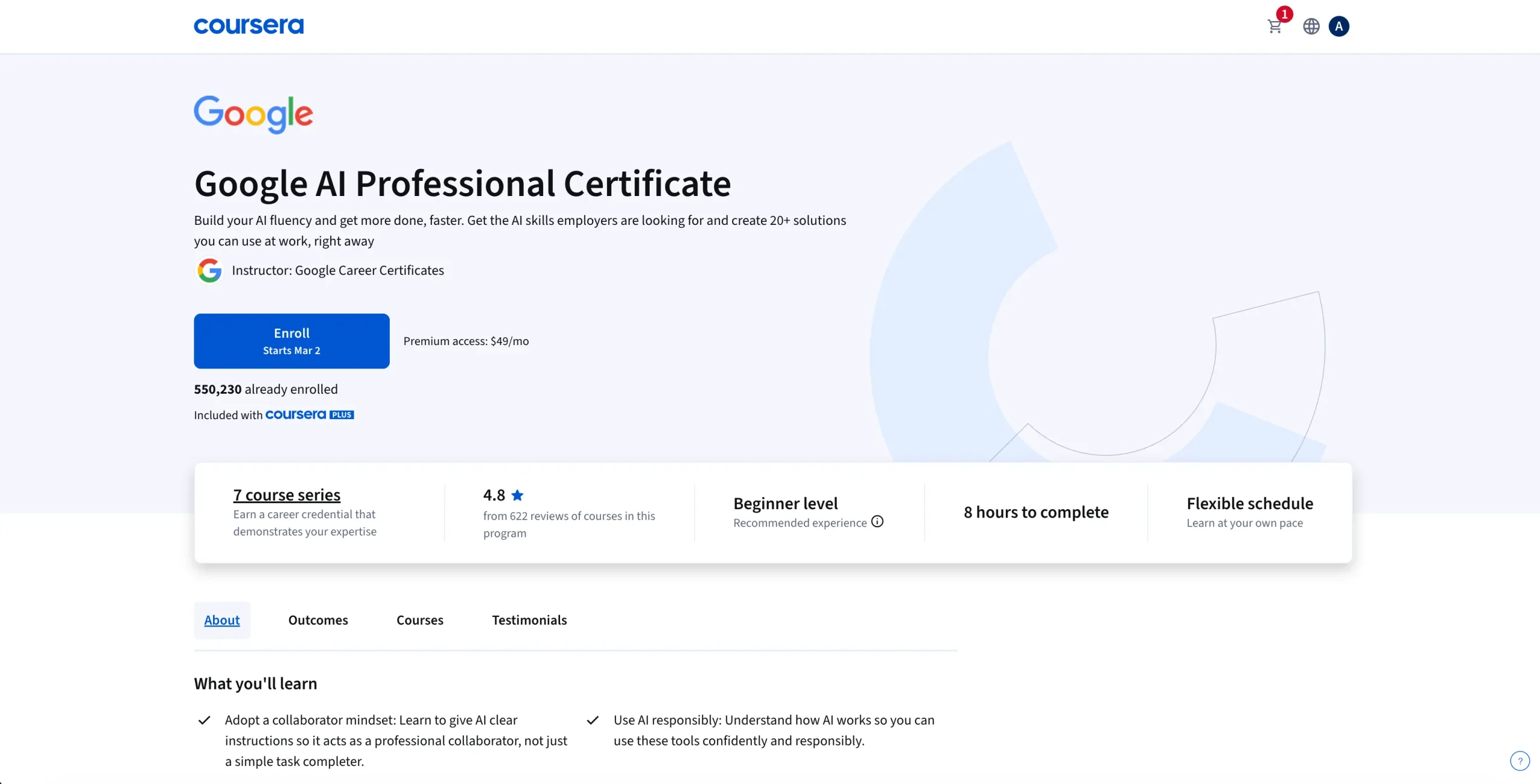
- Best For: Office professionals who want to use AI in daily work.
- Cost: $49 per month, no separate exam fee
- Duration: About 8 hours
- Enroll Now For Free
If you have zero experience with AI tools but want to use AI in your daily work, start here. This is Google's newest AI credential, launched in February 2026.
It sits alongside Google AI Essentials rather than replacing it. Essentials is the shorter, free introduction to AI literacy; the Professional Certificate goes further, applies AI across specific work domains, and carries a stronger credential. If you are weighing the two, I compared them in detail in Google AI Essentials vs Google AI Professional Certificate.
There are no prerequisites. It is built for everyday professionals, not engineers.
It includes eight short courses and takes only about eight hours to finish. Google added a vibe coding course to the program after launch. It sits inside Coursera at $49 a month, and most people clear it inside one billing cycle or even the 7 day free trial.
A nice bonus: enrolling gets you three months of free access to Google AI Pro.
You will get hands on practice with Gemini, NotebookLM, Gemini inside Google Workspace, and Google AI Studio. You learn to use AI for brainstorming, planning, research, writing, content creation, data analysis, and even building your first simple apps.
This is less about becoming a machine learning engineer and more about becoming the person on your team who actually gets results from AI.
That makes it a strong resume booster for almost any office job. If you want a deeper look, I wrote a full Google AI Professional Certificate review.
2. Cloud Digital Leader
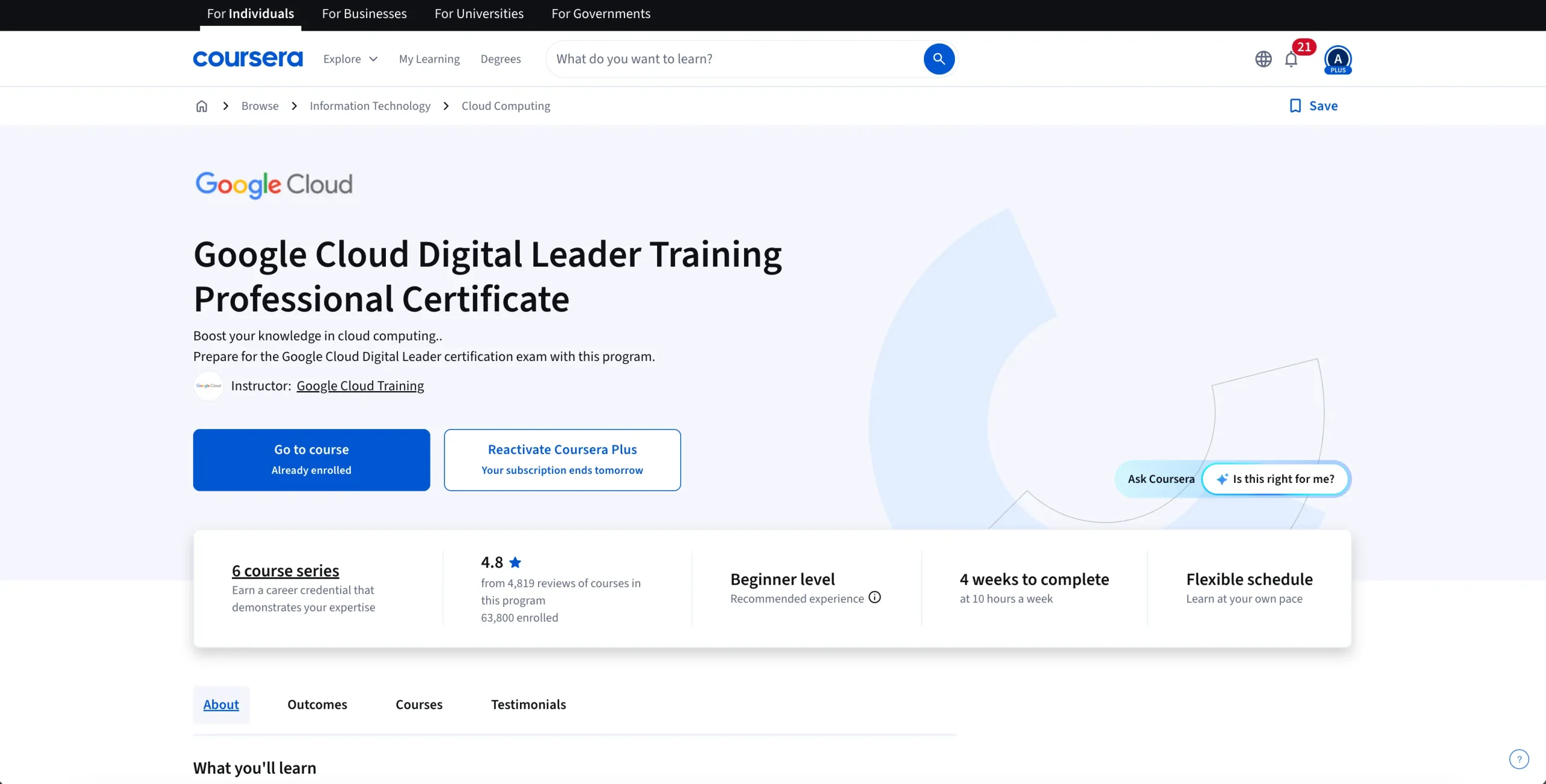
- Best For: Business, sales and project roles that need cloud and AI vocabulary.
- Cost: $49 per month, plus a $99 exam fee
- Duration: About 40 hours
- Enroll Now For Free
This one is for business professionals, project managers, and sales teams who need to understand cloud and AI without getting technical. Its official name is Cloud Digital Leader, and it sits at the foundational level of Google Cloud's certification track.
There are no technical prerequisites. The Coursera preparation program includes six courses and takes around 40 hours in total, then you sit the $99 exam separately.
You learn the language of the cloud: how Google Cloud works, how companies use it to scale and save money, and how that setup powers modern AI. By the end, you can spot where a business could use AI to fix an old problem.
It is a great fit for roles in tech sales, account management, and IT project management.
It tells employers you can sit in a meeting, follow what the technical team is saying, and make smart, profitable decisions.
3. Generative AI Leader
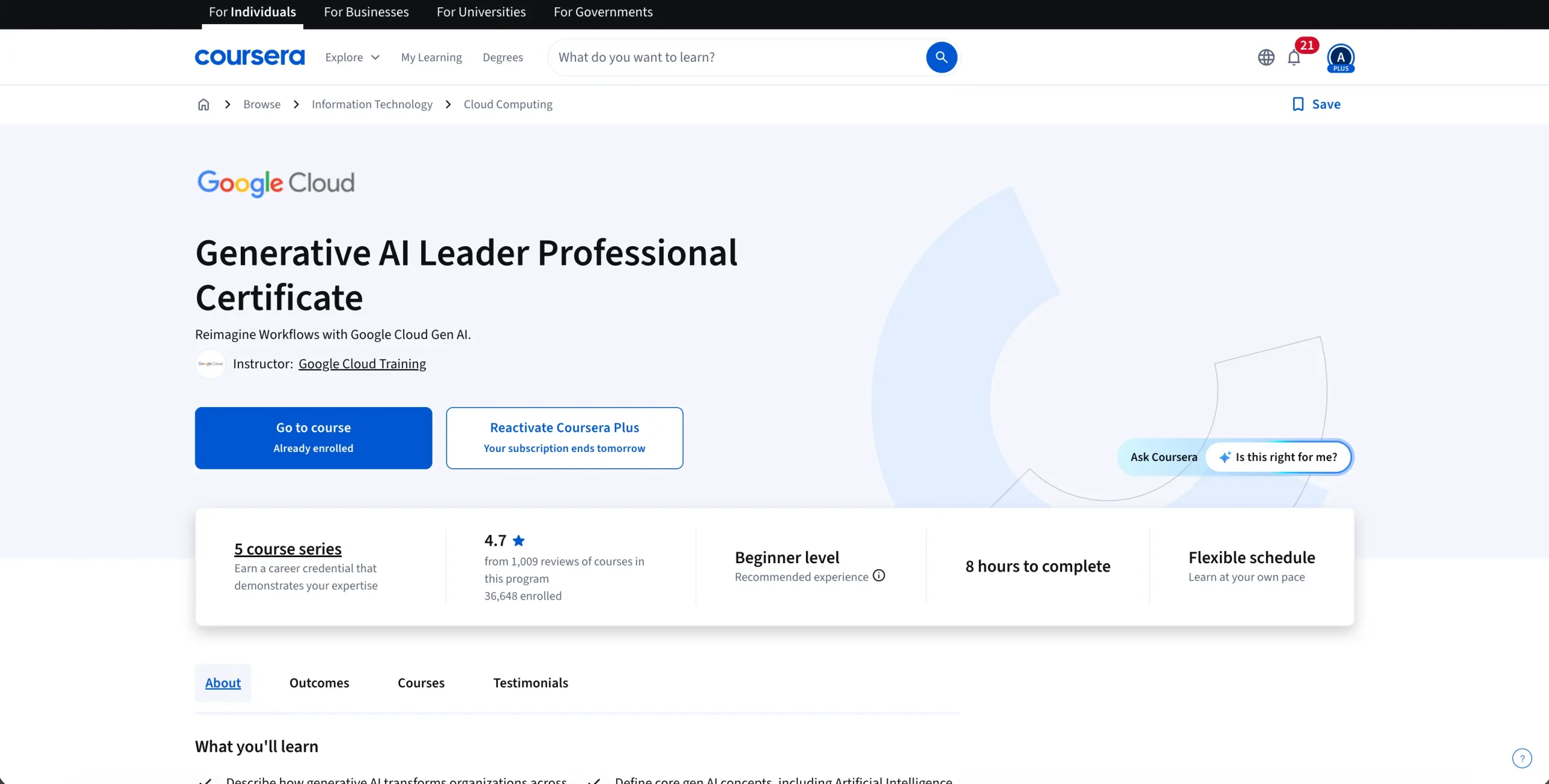
- Best For: Executives and managers responsible for an AI strategy.
- Cost: $49 per month, plus a $99 exam fee
- Duration: About 8 hours
- Enroll Now For Free
This is a targeted credential for executives, directors, and decision makers. If you have been handed the job of building an AI strategy for your team or your company, this is where to be.
Two names get used interchangeably here, so it is worth separating them. Generative AI Leader is the Google Cloud certification, sitting at the foundational level alongside Cloud Digital Leader. Generative AI for Leaders is the Coursera program that prepares you for it. You take the course, then sit the $99 exam.
The preparation program includes five courses and takes only about eight hours.
You learn how to roll out generative AI responsibly across a whole organization. That means exploring use cases, managing risks like data privacy, and handling the ethical questions that come with these tools.
You also learn how to build an AI ready culture, judge where AI investments make financial sense, and use Google's tools to lift your own productivity as a leader.
Companies do not just want people who use AI. They want leaders who know how to roll it out the right way.
The roles here pay well. Companies are hiring Directors of AI Strategy, Chief Innovation Officers, and managers who can put AI to work in a way that grows revenue.
4. Associate Cloud Engineer
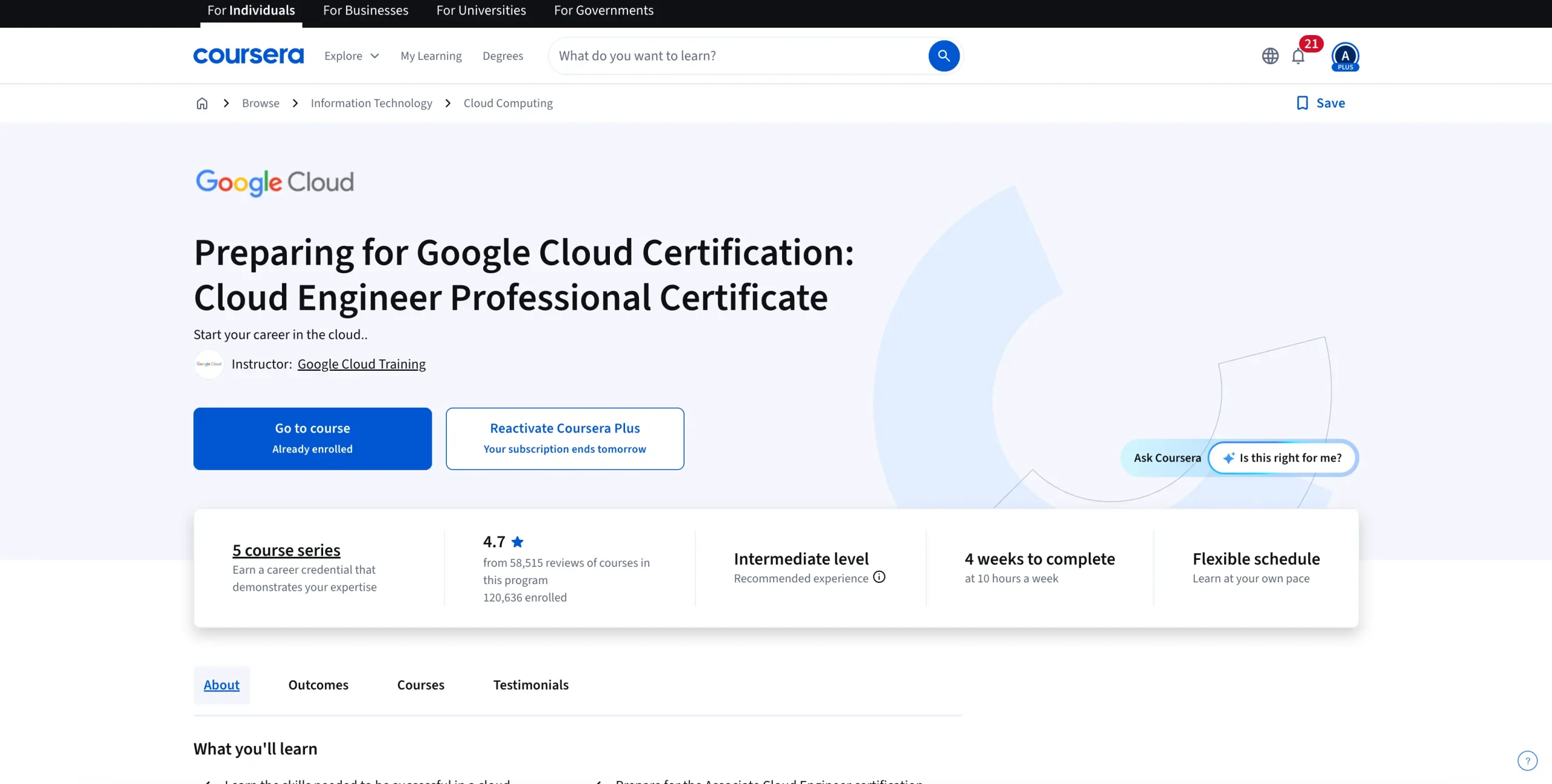
- Best For: Aspiring IT pros and system administrators moving into cloud.
- Cost: $49 per month, plus a $125 exam fee
- Duration: About 40 hours
- Enroll Now For Free
Now we move into the hands on, technical track. Google's official name for this one is Associate Cloud Engineer, and it is for aspiring IT pros, system administrators, and anyone who wants to build and run cloud environments.
The bar steps up here. You should already be comfortable with virtual machines, IP networking, and web servers.
You can start the training right away, but Google suggests at least six months of real experience inside Google Cloud before you sit the exam. The preparation program includes six courses and takes around 40 hours, then the exam costs $125.
You learn to deploy apps, monitor operations, and manage solutions on Google Cloud. You get your hands dirty with the command line, virtual machines, and scalable storage.
Why does this matter for AI? Because AI needs a powerful, secure place to run, and that place is the cloud. Before a company can launch big machine learning models, it needs a well managed home for them.
Demand for Associate Cloud Engineers is strong, and this is a clean entry point into a high paying tech career.
5. Professional Cloud Architect
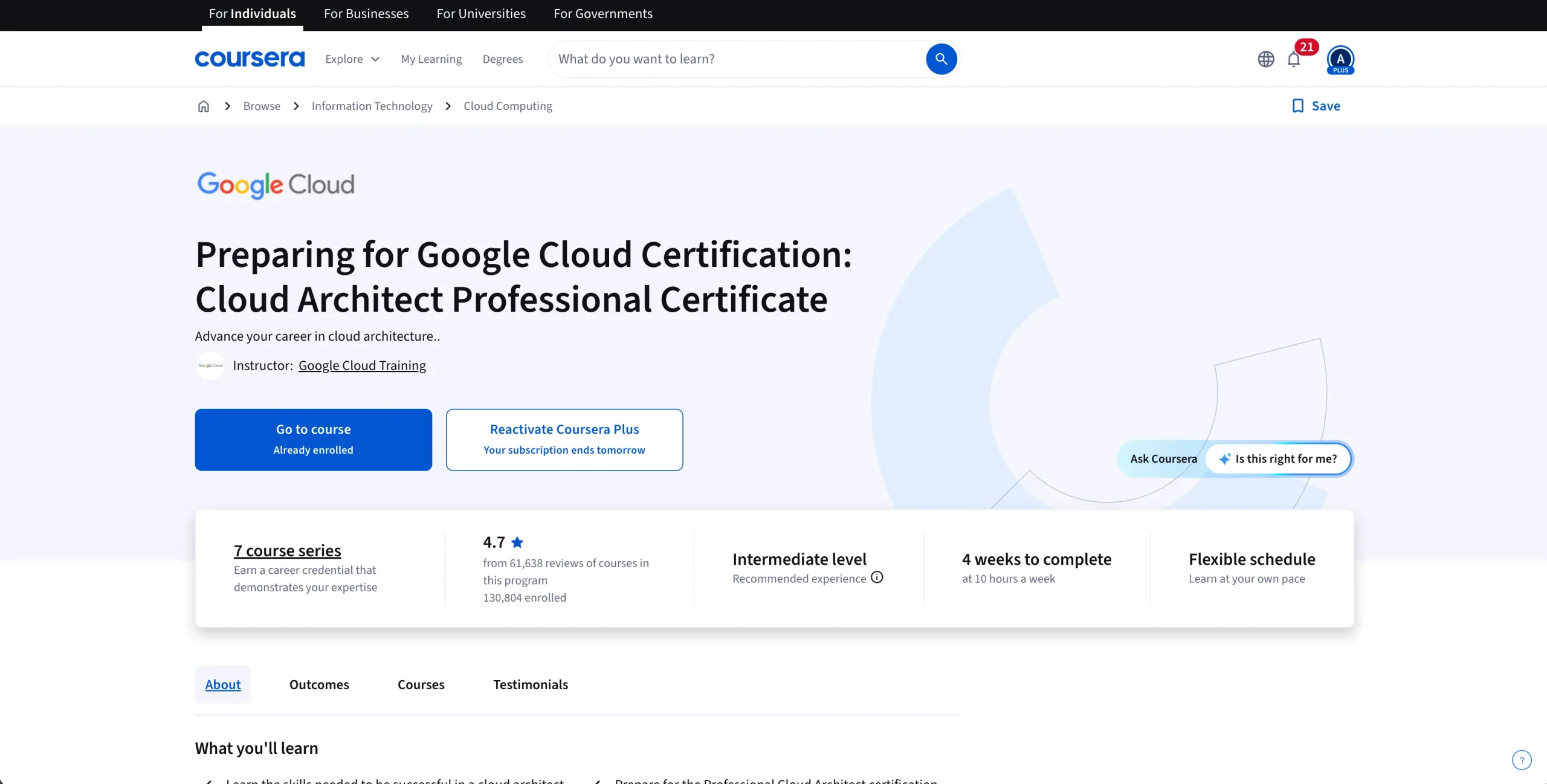
- Best For: Experienced IT pros designing a company's cloud systems.
- Cost: $49 per month, plus a $200 exam fee
- Duration: About 40 hours
- Enroll Now For Free
This is the advanced, highly respected tier. Officially the Professional Cloud Architect, it is for experienced IT pros who want to lead the overall design of a company's cloud systems.
Instead of running daily operations, you decide what technology is needed and how every piece connects securely.
You need a real background for this. Google recommends at least three years in the industry, with at least one year designing and managing solutions on Google Cloud, before the exam. The preparation program includes seven courses and takes around 40 hours, and the exam itself costs $200.
You learn to design cloud setups that are secure, scalable, and reliable. You take messy business requirements and turn them into a clean technical plan.
When a huge company wants to launch a global AI app for millions of users without it crashing, they hire a Cloud Architect to design it.
It also pays extremely well, consistently ranking as one of the highest paying IT certifications, with average US salaries reported around $165,000 by Skillsoft.
6. Professional Machine Learning Engineer
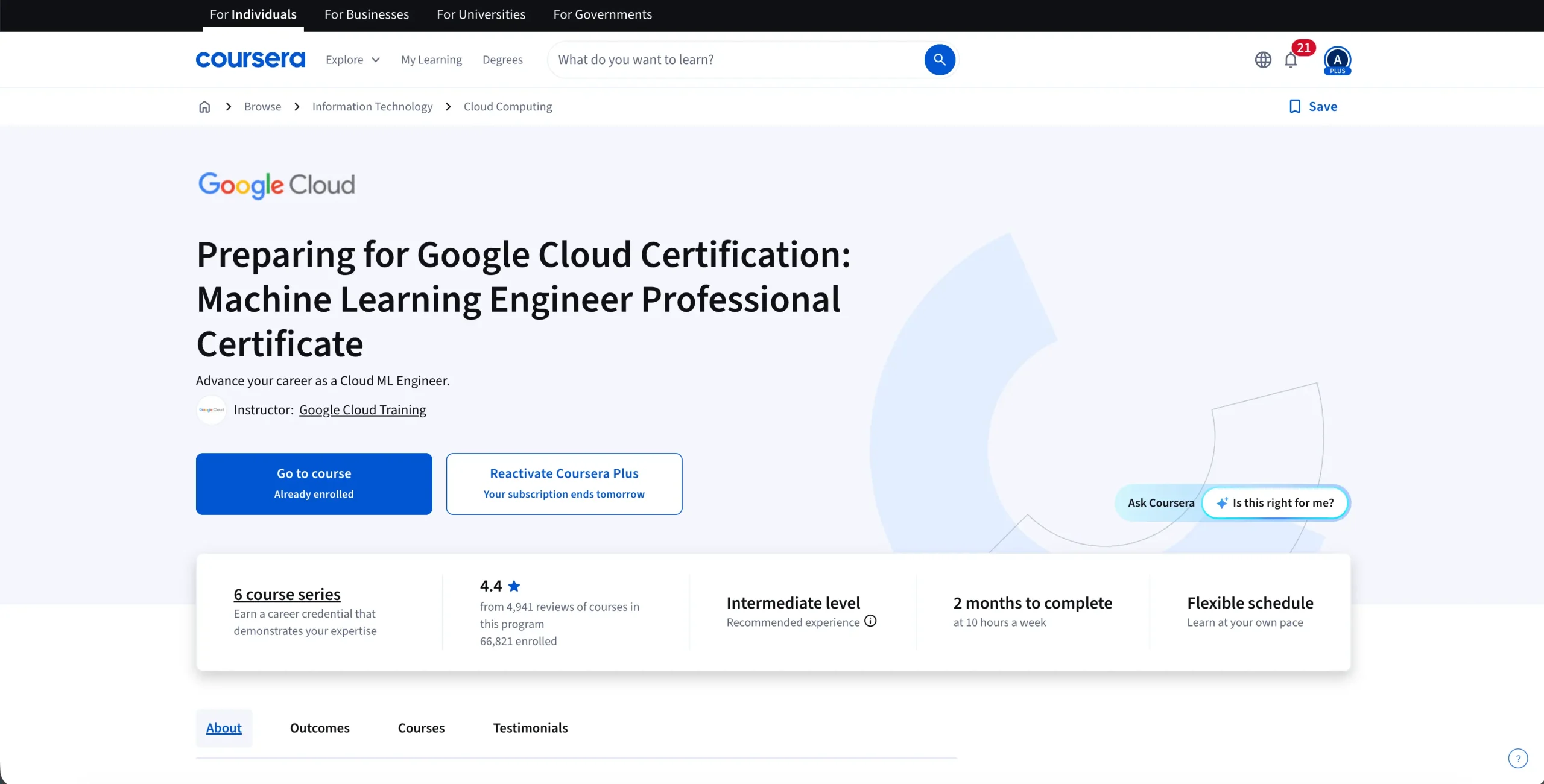
- Best For: Developers and data scientists who want to build and deploy models.
- Cost: $49 per month, plus a $200 exam fee
- Duration: About 80 hours
- Enroll Now For Free
If you want to be the person who actually builds and trains AI, this is your certification. Officially the Professional Machine Learning Engineer, it is an advanced, specialized credential for data scientists, software developers, and aspiring machine learning engineers.
The prerequisites are serious. You need to code in Python and have a solid grasp of statistics and basic machine learning ideas.
Google recommends at least three years of overall industry experience, with at least one year working on machine learning solutions on Google Cloud, before the exam. The preparation program has nine in depth courses and takes most people around 80 hours, and the exam costs $200.
You dive deep into Google's Vertex AI platform. You learn to build, train, test, and deploy machine learning models at scale.
Training a small model on your laptop is one thing. Deploying a large model to the cloud so it serves thousands of users safely is a much bigger challenge, and that is exactly what you practice.
Demand here is off the charts. This is how you stand out for roles like Lead AI Developer or Senior Machine Learning Engineer.
7. Professional Data Engineer
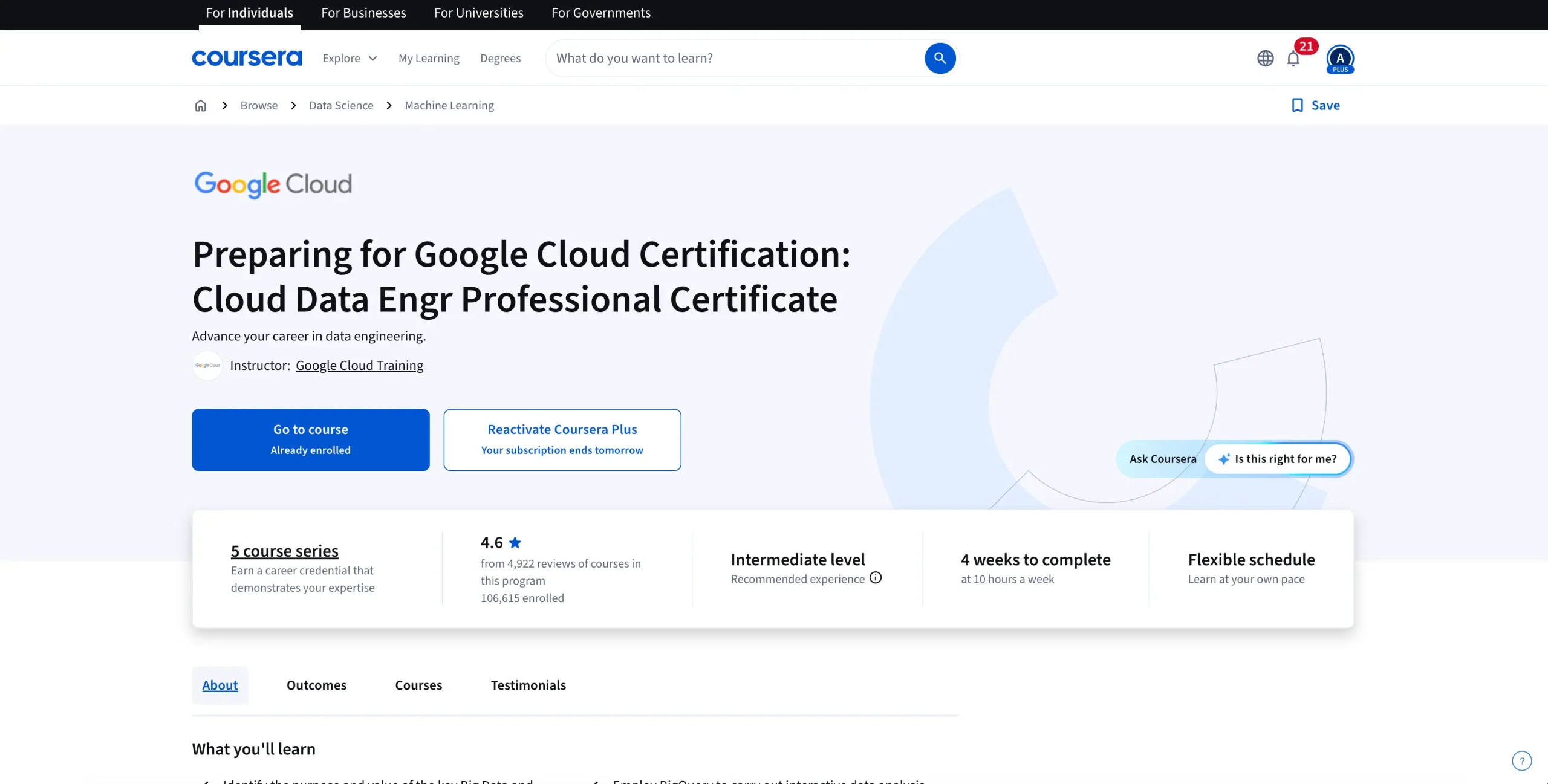
- Best For: Advanced data professionals building the pipelines AI runs on.
- Cost: $49 per month, plus a $200 exam fee
- Duration: About 40 hours
- Enroll Now For Free
Finally, the foundation that makes all of this AI possible. Officially the Professional Data Engineer. You might wonder why a data certification lands on an AI list.
The answer is simple. Machine learning models are like fast sports cars, and data is the fuel. Without clean fuel, the car goes nowhere.
This is for advanced data professionals. You need strong programming skills, deep database knowledge, and fluency in SQL.
Like the other advanced certs, Google recommends at least three years of overall experience, with one year on Google Cloud, before the exam. The preparation program includes six in depth courses and takes most people around 40 hours, and the exam costs $200.
You learn to design complex data systems, clean up massive messy datasets, and organize them perfectly. You master tools like BigQuery and learn to feed machine learning models fresh, reliable data.
Every company chasing AI has discovered the same thing: they have a data problem first.
That is why demand for Data Engineers is arguably even stronger than for Machine Learning Engineers right now, making it one of the most secure and lucrative paths in tech.
Going from course to certified
For the Google AI Professional Certificate there is nothing extra to do. You finish the courses and Coursera issues the credential.
For the six Google Cloud certifications there are two steps. The Coursera program teaches you the material and gets you exam ready, then you book the certification exam itself with Google. Exams run through Pearson VUE, either at a test centre or online with a remote proctor, and cost $99 at foundational level, $125 for associate and $200 for professional.
Start with the course. It is the part that actually teaches you the skills, and you can decide about the exam once you know the material.
How to choose the right one for you
Do not pick by salary alone. Pick by where you are right now.
If you work an office job and just want to be faster and smarter, the Google AI Professional Certificate is the obvious start. It is cheap, quick, useful from day one, and it has no exam fee.
If your role is business or sales, Cloud Digital Leader gives you the cloud and AI vocabulary you need. If you lead a team and need to shape strategy, Generative AI Leader fits best.
Ready to go technical? Start with Associate Cloud Engineer, then climb toward Professional Cloud Architect, Machine Learning Engineer, or Data Engineer as your experience grows.
If you are weighing options across platforms, my roundup of the best Coursera certificates can help you compare, and the best Google career certificates guide covers the wider Google catalog.
Are Google AI certifications worth the cost
For most people, yes, and the entry point is cheaper than people expect.
The Google AI Professional Certificate costs a single $49 Coursera month if you move quickly, and some people finish inside the free trial. There is no exam fee, so that is the whole cost. For a credential that improves how you work every day, that is hard to beat.
The Google Cloud certifications cost more, between the Coursera subscription and a $99 to $200 exam fee, but they also sit in front of the highest paying roles on this list. A Cloud Architect averaging around $165,000 pays back a few hundred dollars almost immediately.
The key either way is to actually use what you learn. A certificate sitting on a profile does little. A certificate plus a small project you can show in an interview does a lot.
These credentials are also a smart move if you want remote work, since many of these roles hire globally. My guide to the best certifications for remote jobs goes deeper on that.
Frequently Asked Questions
How much does a Google AI certification cost?
It depends which one. The Google AI Professional Certificate costs only the $49 monthly Coursera subscription, with no exam fee, so finishing in a month costs $49. The Google Cloud certifications add a separate exam fee on top: $99 for Cloud Digital Leader and Generative AI Leader, $125 for Associate Cloud Engineer, and $200 for the professional level certifications.
Does Google offer a free AI certification?
Google AI Essentials is free to audit and is the closest thing to a free option. For fully free options, see these free AI certifications from Google and others. Every certification on this list requires either a Coursera subscription, an exam fee, or both. Coursera's 7 day free trial is enough to complete the Google AI Professional Certificate if you work quickly.
Is the Google AI Professional Certificate the same as Google AI Essentials?
No, and one did not replace the other. Both are live. Essentials is the shorter, more introductory program covering AI literacy and prompting. The Professional Certificate is longer, applies AI across specific work domains, includes three months of Google AI Pro, and carries the stronger credential.
Do I need the Coursera course to get certified?
No. The Coursera programs are optional preparation. Google Cloud certifications are earned by passing the proctored exam, and you can book that exam without taking any course. Most people take the preparation program because the exams are demanding, but it is not a requirement.
What jobs can you get with a Google AI certification?
It depends on the level. The AI Professional Certificate strengthens almost any office role rather than qualifying you for a new one. Cloud Digital Leader and Generative AI Leader suit tech sales, account management and strategy roles. The technical certifications map to real job titles: cloud engineer, cloud architect, machine learning engineer and data engineer.
Do Google Cloud certifications expire?
Yes. Google Cloud certifications have an expiry date and must be renewed by retaking the exam. The Google AI Professional Certificate, being a Coursera credential rather than a Google Cloud certification, does not expire.
Next steps
The hardest part is starting. So keep it simple.
Pick the one certification that matches your current skill level and your goal. Check whether it carries an exam fee, enroll, block out a few hours, and finish it before you talk yourself out of it.
The AI field is moving fast, and getting certified now is the cleanest way to make sure you are not left behind.
And if you want to pair these technical skills with marketing and SEO know how, our Reliablesoft Academy and the digital marketing course bundle can round out your skill set.