There are more than a dozen IBM AI certificates on Coursera right now. Pick the wrong one, and you can lose months on skills that have nothing to do with the job you want. I went through them all to find the ones that actually pay off. Here is what made the cut, and who each one is for.
What to know before you enroll
Here is one thing that saves a lot of confusion later. Every certificate on this list is free to enroll in, so you can start learning today without paying anything.
The shareable certificate that goes on your resume and LinkedIn does need a Coursera subscription once you claim it. So the learning is free, and you only pay when you want the credential itself.
That alone takes the pressure off picking the perfect program on day one. If you want the wider picture first, our roundup of the best IBM courses covers more than just AI.
A few of these certificates also carry college credit recommendations from ACE. In plain terms, that means some schools may count the work toward a degree, which is handy if you plan to study further later.
Most of them are beginner level too, so you do not need a tech background to start. The one big exception is flagged clearly below, so you will not pick it by accident.
Think of these as free to explore, and paid only when you want the credential itself.
The 7 Best IBM AI certifications
Out of more than a dozen, these seven are the ones I would actually point people toward. Use the list below to jump straight to the one that fits you.
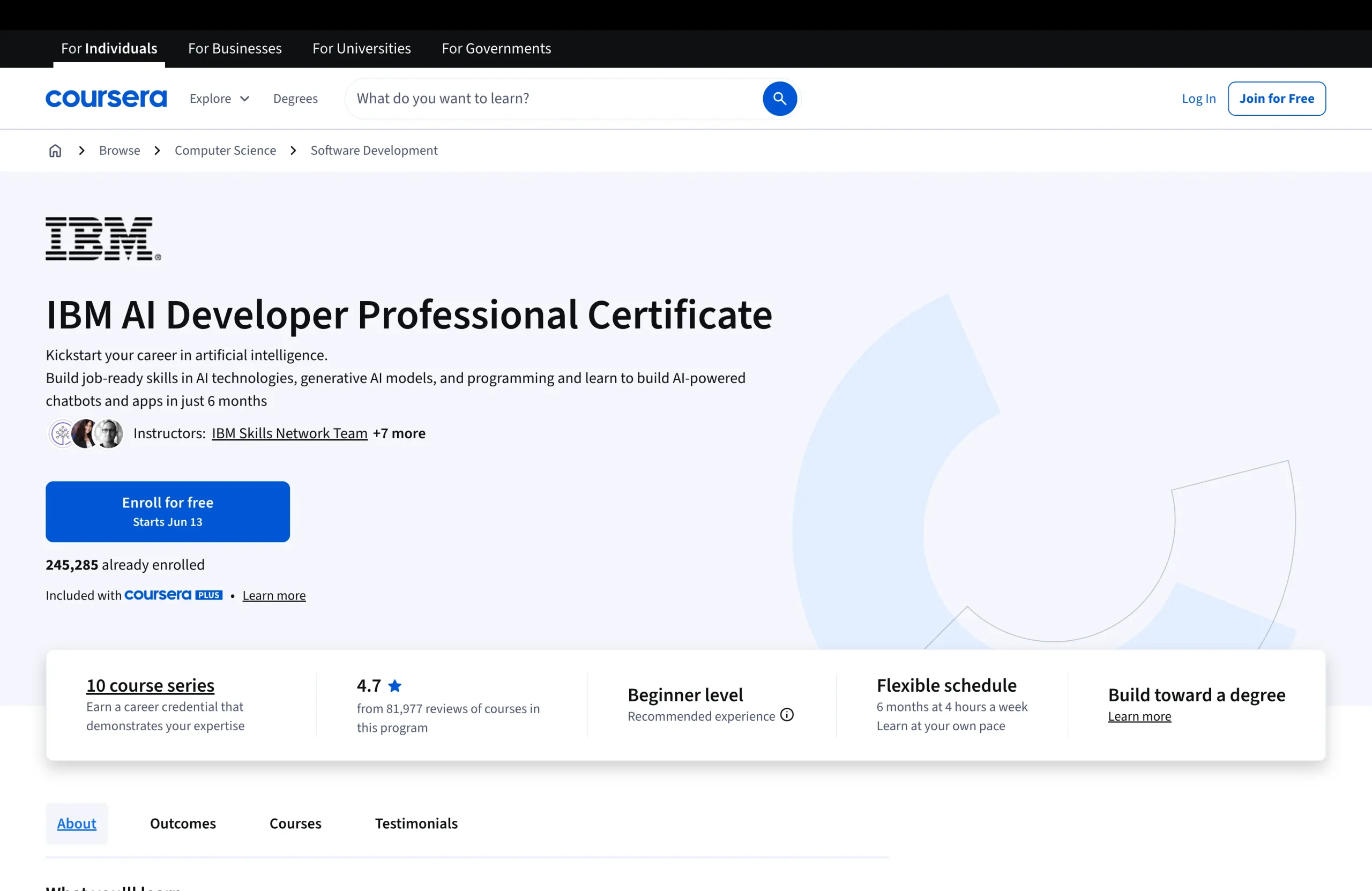
This is your starting point if you want to build AI powered apps and chatbots, not just talk about them. It runs ten courses at beginner level, with no coding needed to begin.
You can finish in about six months at four hours a week. Along the way you pick up software engineering basics, Python, a little HTML and JavaScript, prompt engineering, and Flask.
The best part is what you build. You put it all together with real projects like a voice assistant using GPT APIs and an AI meeting companion built with Llama.
Those are things you can actually show in an interview when someone asks what you have made. It also holds a 4.7 rating across more than eighty thousand reviews, which tells you the material works for a lot of people, not just a lucky few.
If your goal is to ship working software, start with the IBM AI Developer certificate. It also makes a clean stepping stone if you later want to move into deeper engineering work.
2. IBM Generative AI Engineering Professional Certificate
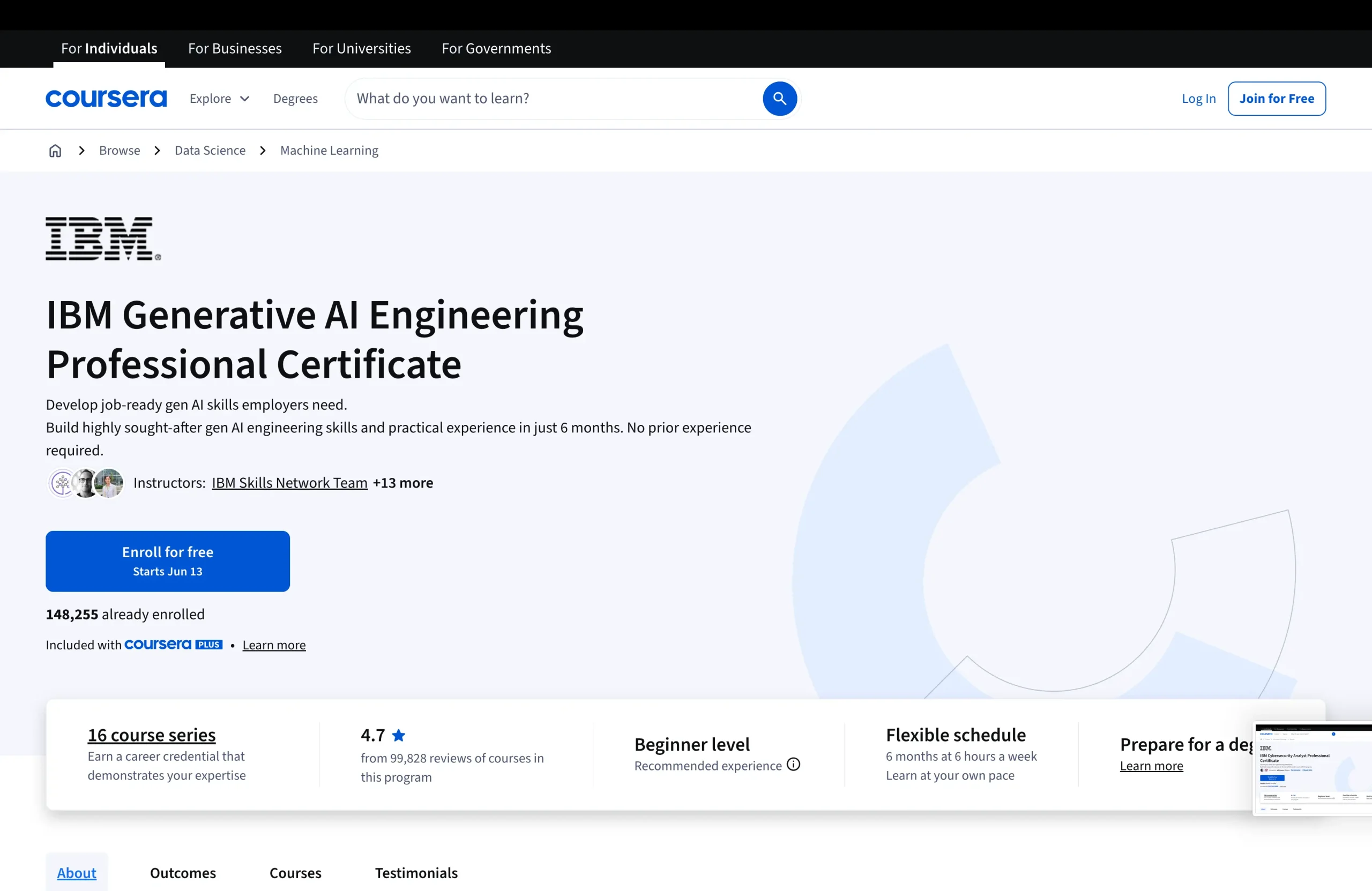
Want the deep, behind the scenes version? This is the most complete program on the list. It runs sixteen courses across about six months at six hours a week.
It goes far past the basics. You work through machine learning, deep learning, natural language processing, and transformers like BERT and GPT.
You also get hands on with the tools real engineers use, including Hugging Face, PyTorch, RAG, LangChain, and fine tuning methods such as LoRA and RLHF.
It even carries an ACE college credit recommendation worth up to seventeen credits, which no beginner program here offers. Pay for these roles sits around $116,000 a year, based on ZipRecruiter data.
The honest catch is that this is the most demanding certificate here. Only commit if you are truly ready to put in the hours, because half finishing sixteen courses helps nobody. When you are ready, the IBM Generative AI Engineering certificate is the one to pick.
3. IBM AI Engineering Professional Certificate
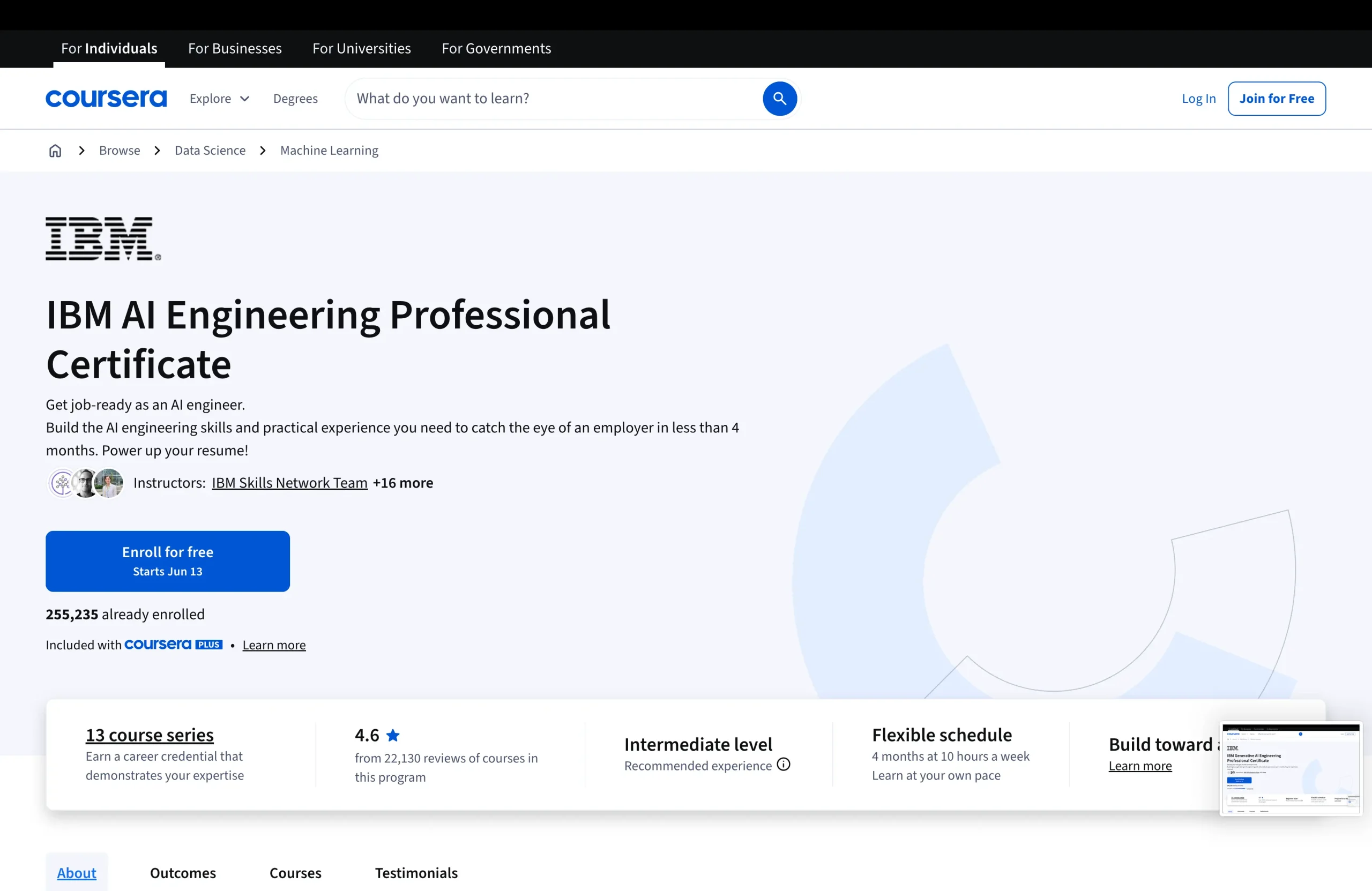
Here is the one people pick by mistake, so read this part closely. It is the only program on this list rated intermediate, not beginner.
It expects you to already know Python and Jupyter notebooks before you start. IBM even recommends you finish their Data Science certificate first, which tells you how much it assumes.
So if you are brand new, this is not your starting point. Forcing it early is exactly how people get stuck and quit.
But if you already have some Python, this is where you go deep. Across thirteen courses over about four months you build neural networks with Keras, PyTorch, and TensorFlow, and work on computer vision and language tasks.
AI engineer roles run around $106,000 a year, so the IBM AI Engineering certificate pays off well for the right person.
4. IBM AI Product Manager Professional Certificate
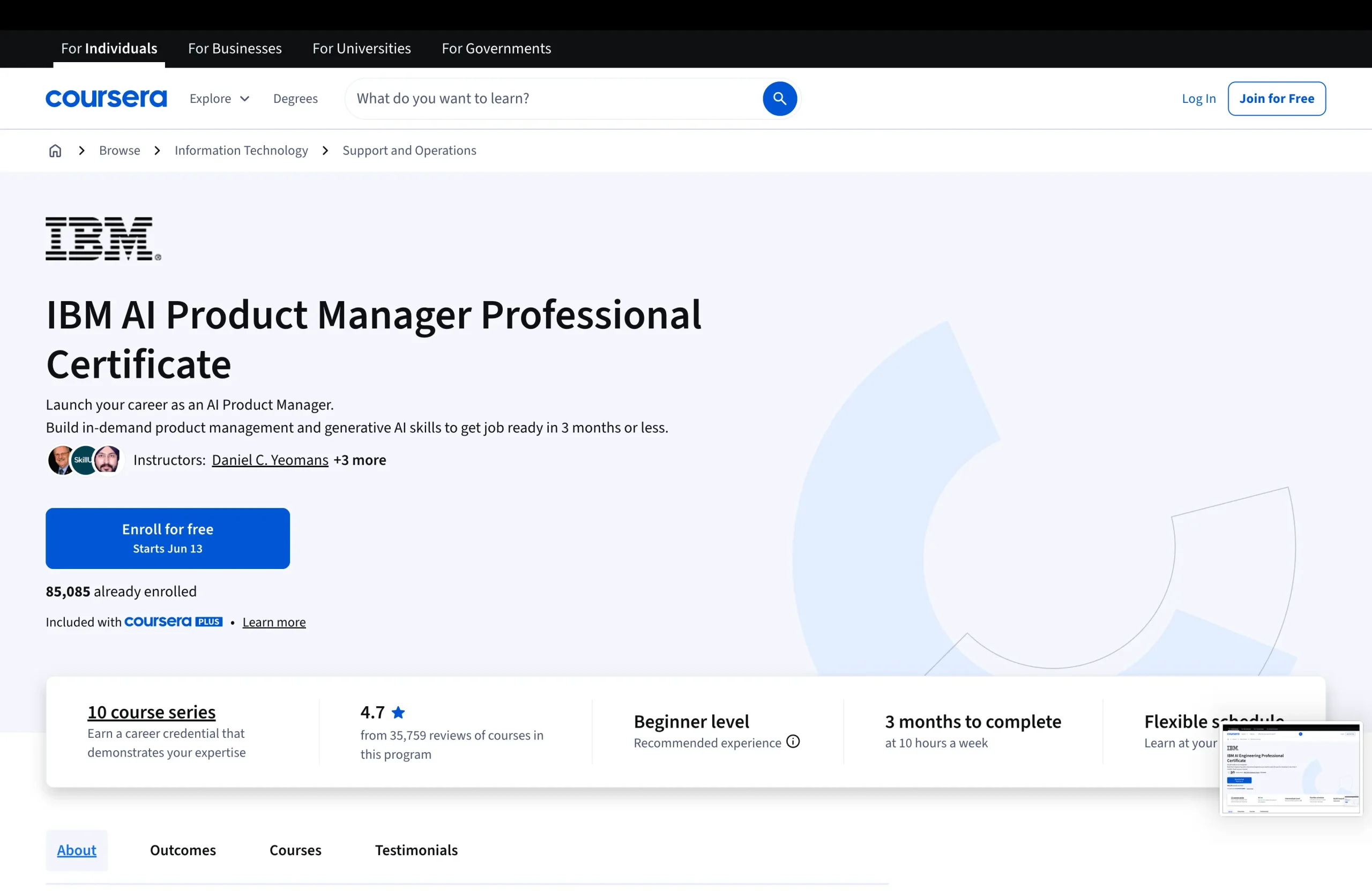
Remember the path for someone who never wants to write code? Here it is. This one lets you work with AI without ever touching Python.
It runs ten courses at beginner level with no experience needed, and you can finish in about three months. You learn product management from the ground up, including roadmaps, stakeholder work, and Agile.
You also pick up enough generative AI to lead real products, like prompt engineering and foundation models. So you can guide AI work instead of just sitting in meetings about it.
And the money surprises people. These roles average around $159,000 a year, the highest figure on this whole list. For a path that asks for zero lines of code, that ceiling is remarkable.
It deserves a real look from anyone in business, marketing, or operations. Start with the IBM AI Product Manager certificate, and if pay is driving your choice, our guide to high paying AI jobs is worth a look.
5. IBM Data Analyst Professional Certificate
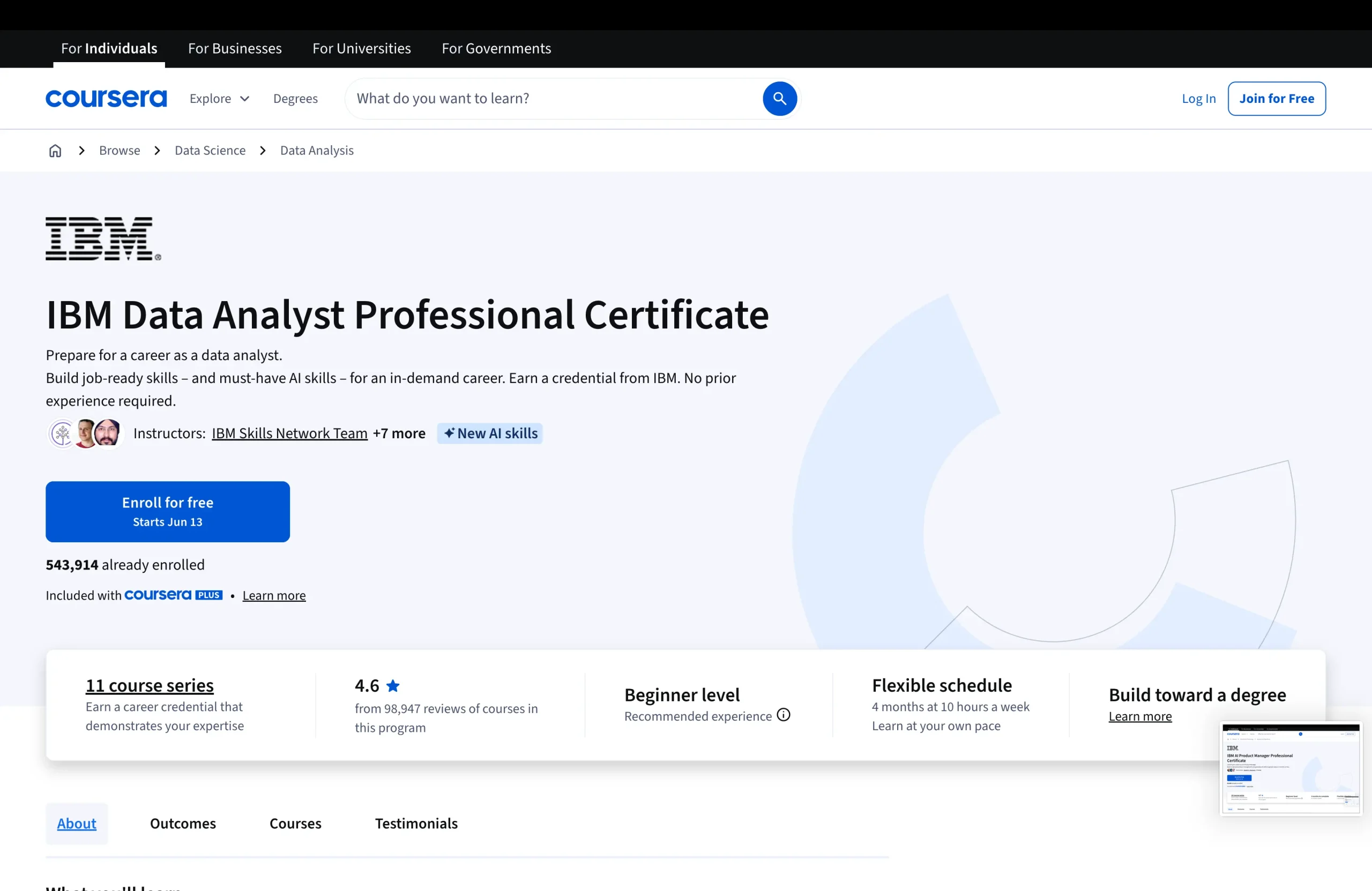
If the words data scientist sound scary, start here instead. This is the most beginner friendly way into a data career, and there is no shame in starting at the base.
It is eleven courses with no math or coding background needed, running about four months at ten hours a week. You learn Excel, SQL, Python, and Pandas, plus dashboards and visualization in tools like Cognos and Tableau.
More than half a million people have enrolled, and it carries college credit worth up to twelve credits. It ends with a capstone project you can drop straight into a portfolio.
Data analyst roles average around $83,000 a year, and entry level pay sits lower than that. Still, the IBM Data Analyst certificate is one of the cleanest ways to break into tech, especially if you are switching from another field.
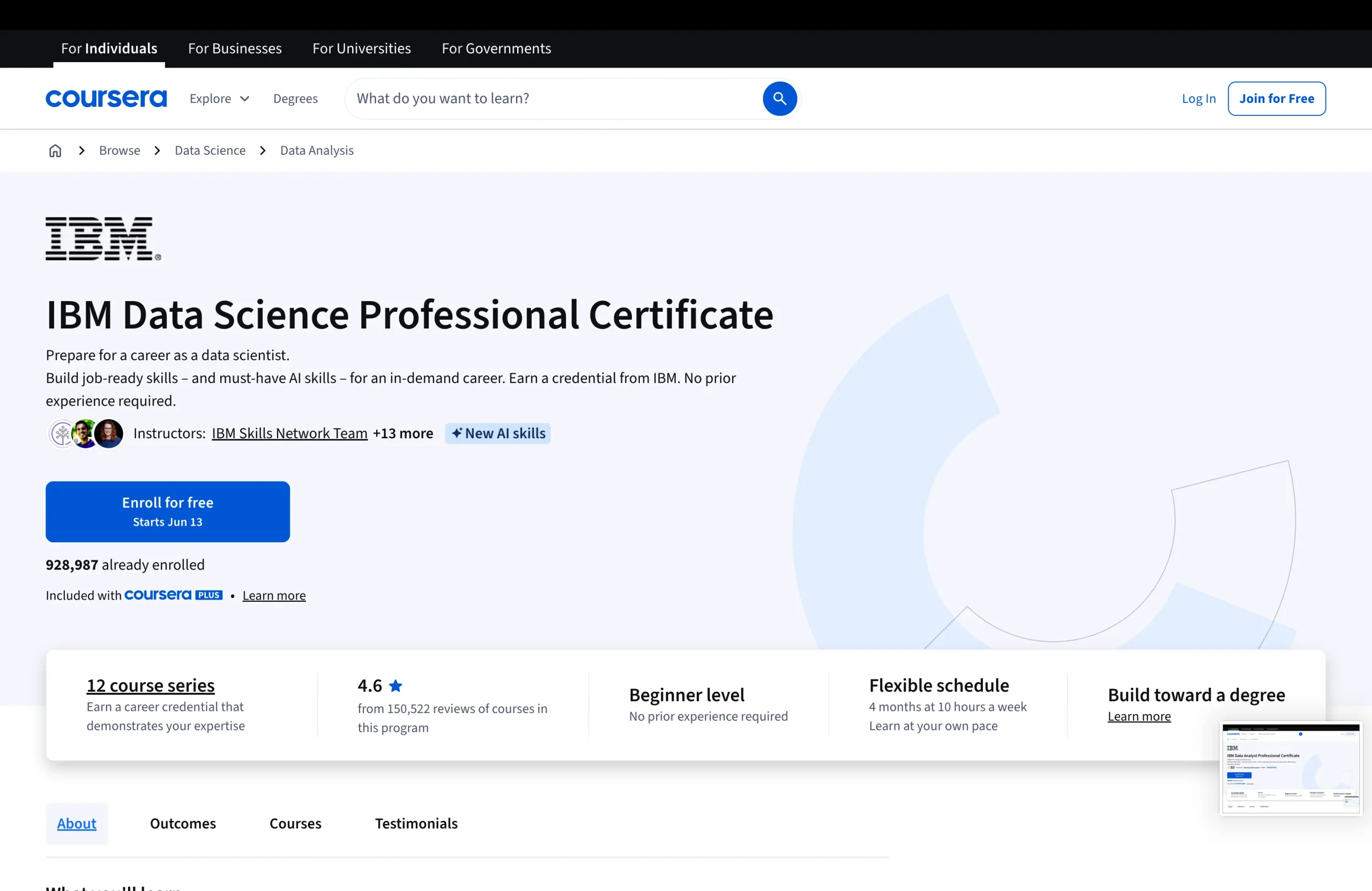
6. IBM Data Science Professional Certificate
This is the big one, with close to a million learners. It is IBM's flagship program, plain and simple.
It runs twelve courses at beginner level, with no prior programming needed to begin. You go further than the analyst track, into Python, SQL, machine learning, predictive modeling, and data mining.
You work with tools like Jupyter, GitHub, and R that show up in real data jobs every day. It also opens access to IBM's Talent Network, where you can see jobs matched to your skills.
It carries up to twelve college credits, and these roles average around $123,000 a year. We broke this program down in full in our IBM Data Science certificate review if you want the long version.
If you want the full data toolkit and the most proven IBM program here, the IBM Data Science certificate is the one to commit to.
Stuck between this and the analyst track? A simple rule helps. Pick the analyst path if you want a faster, gentler start, and pick this one if you want to learn modeling and machine learning from the very beginning.
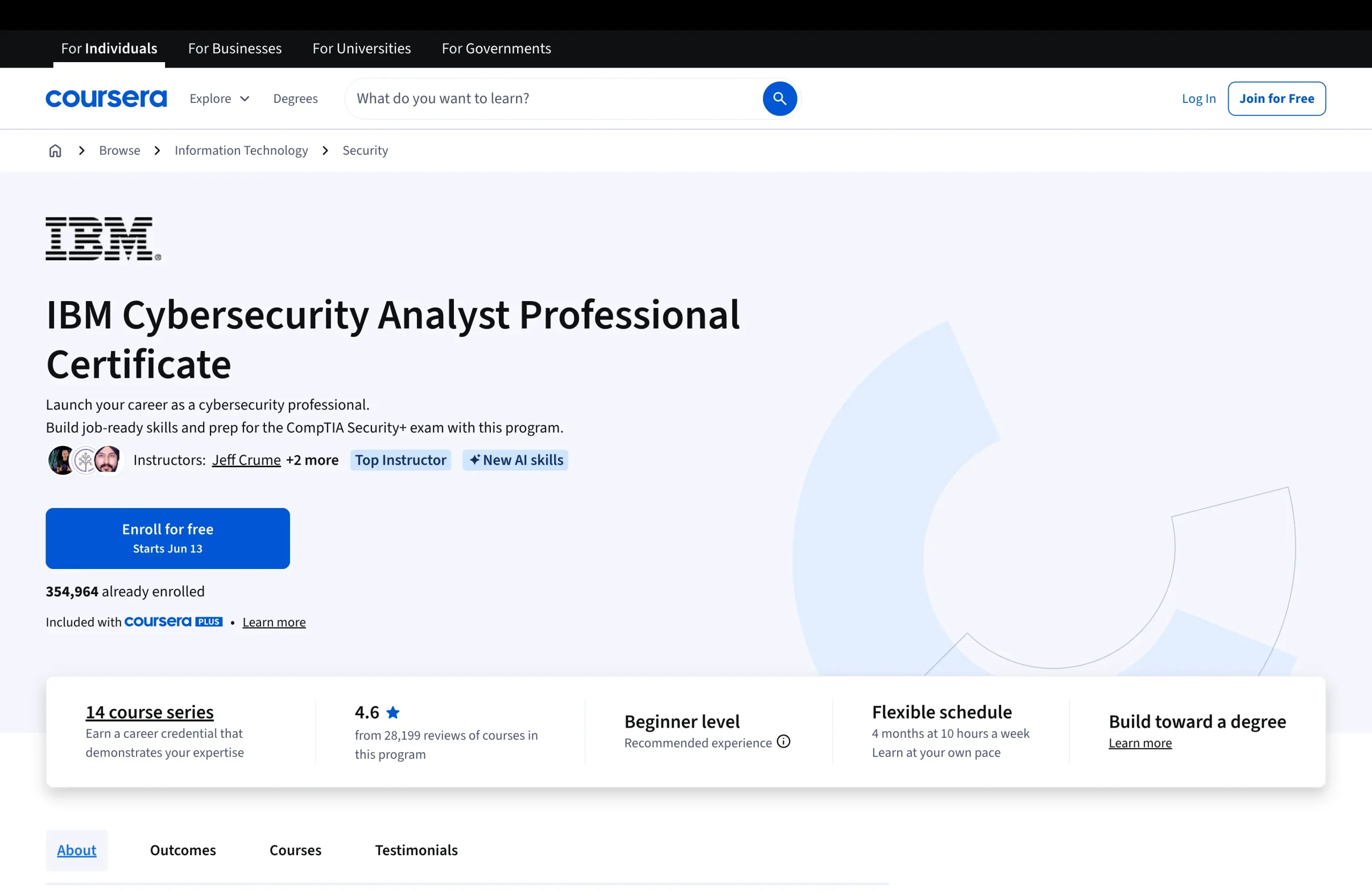
7. IBM Cybersecurity Analyst Professional Certificate
Last up is the one that preps you for an exam employers ask for by name. It is built a little differently from the rest.
Across fourteen courses over about four months, it is designed to help you prepare for the CompTIA Security+ exam. That is one of the most requested entry level security credentials, so it pulls double duty.
You learn network security, penetration testing, threat intelligence, and how to use generative AI for security work, with hands on labs throughout. IBM reports that around 91 percent of learners saw a positive career outcome, which is a strong signal in this space.
Cyber security analyst roles average around $99,000 a year. Just note that the Security Plus exam fee is separate and not included, so budget for it when you are ready to sit the test.
If security is the field you want, the IBM Cybersecurity Analyst certificate is a smart place to begin.
How to choose the right IBM AI certification
Here is the truth after going through all of them. None of these seven are bad, and any of them can move your career forward.
The real mistake is picking one that does not match where you are starting from. That is how people lose months on a program that was never built for them.
The real mistake isn't picking a bad certificate. It's picking one that was never built for where you start.
If you have never coded and you do not want to, look hard at the AI Product Manager or the Data Analyst path. Both meet you exactly where you are.
If you want to build AI apps and ship them, the AI Developer certificate is your starting point. If you are already technical and want depth, Generative AI Engineering is the strongest choice.
And if security or data science is calling you, you have two excellent options. It comes down to which field you actually want to work in. To see how these stack up against other providers, our roundup of the best AI certifications puts them side by side.
One last filter helps more than people expect. Be honest about your weekly hours before you enroll.
A three month program at a few hours a week is very different from sixteen courses at six hours a week. The right certificate is the one you will still be working on in month three, not the one you quit in week two.
Next steps
So let us bring it back to that trap from the start. The fix is simple once you see it.
A finished certificate in the right field beats an abandoned one every single time.
Pick the certificate that fits the career you actually want, and that you can realistically finish. Do not chase the biggest salary number on the page.
Every program here is free to enroll in, so you can look around before you commit to a paid plan. Start with the one that fits where you are, and build from there.
And if you would rather learn marketing and AI skills with structured, step by step guidance, the Reliablesoft Academy is built for exactly that.
About the author
Alex Chris is a digital marketing consultant, author, and instructor. He has more than 18 years of practical experience with SEO and digital marketing. Alex holds an MSc Degree in eCommerce and has consulted with Fortune 500 companies in different industries. He blogs regularly about SEO and Digital marketing, and his work has been referenced by leading marketing websites.
Connect with Alex on Twitter and LinkedIn.