

Average Time It Takes to Learn Digital Marketing
The average time it takes to learn digital marketing for beginners is 3-5 months. This assumes that you’ll allocate at least a couple of hours per day to learn the theory of online marketing and practice on your properties.
Here is what a typical timeline looks like:
| Stage | Time | What you learn and do |
|---|---|---|
| 1. Basics | 2-6 weeks | What digital marketing is, how the main channels work (SEO, PPC, social media, email, content), and the key terms |
| 2. Structured learning | 1-3 months | A course or certification that teaches each channel step by step, plus tools like Google Analytics and Google Ads |
| 3. Practice | 2-3 months (alongside stage 2) | Run your own website, social accounts, and small ad campaigns, and build a portfolio of results |
| 4. Job-ready | 3-5 months in total | Apply for internships, entry-level roles, or first freelance clients |
| 5. Specialist | 6-12+ months | Go deep in one area, such as SEO, paid ads, or analytics, through real projects |
How many hours a week do you need? If you study part time (5-10 hours a week), expect the job-ready stage to take 5-6 months or more. If you can study close to full time (20 or more hours a week), you can get there in about 3 months.
Learning for your own business or for a career? If you want to market your own business, you don’t need to learn every channel. Focus on the two or three channels your customers use, and you can see results within a few weeks of practice. If you want a job in digital marketing, you need a broader base, a certification, and a portfolio, which is where the 3-5 months come in.
What does learning digital marketing mean?
Digital marketing is a complex discipline. It involves using a number of digital channels and strategies to reach your target audience to promote your products or services.
As a new learner, you first need to learn what each digital marketing channel does and then how they can be used together in a digital marketing strategy.
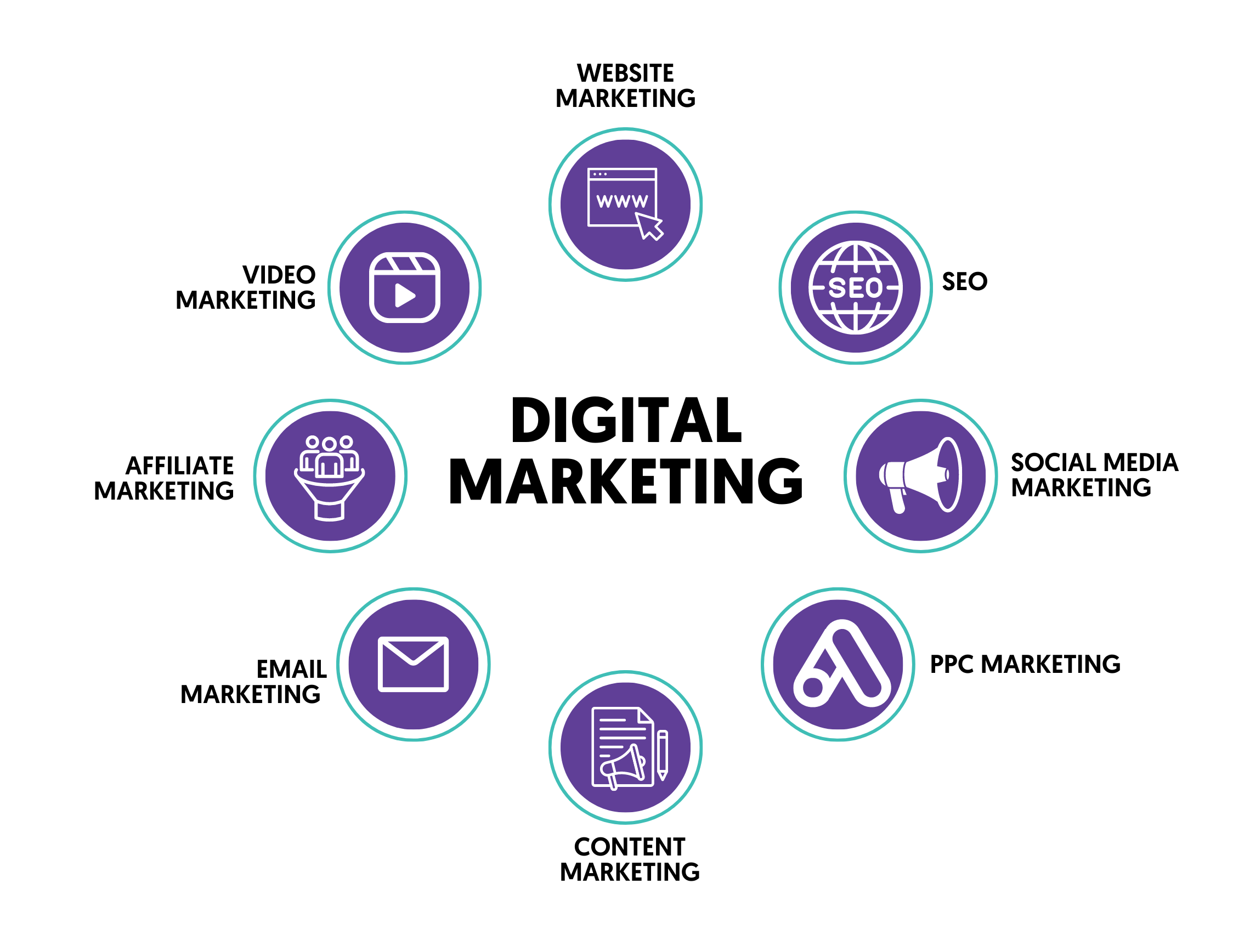
In practice, this means you need to build skills in a number of areas, including:
- Internet marketing fundamentals
- Copywriting
- Keyword research
- SEO Fundamentals
- Social media management
- Email marketing
- Content strategy
- Search Engine Marketing (SEM)
- Social media advertising
- Conversion rate optimization
- Analytics and data interpretation
- Marketing automation
- Advanced SEO tactics
- Video Marketing
- Influencer marketing
- Affiliate Marketing
- eCommerce marketing
- Website marketing
- Retargeting
For each channel, you must learn how it works, what the strategies involved, how to optimize your campaigns, and how to measure and analyze the results.
Can I Learn Digital Marketing on My Own?
There are many ways to learn digital marketing, including using self-study resources.
As shown in the diagram below, the suggested learning plan for going from a novice to a digital marketing pro is as follows:
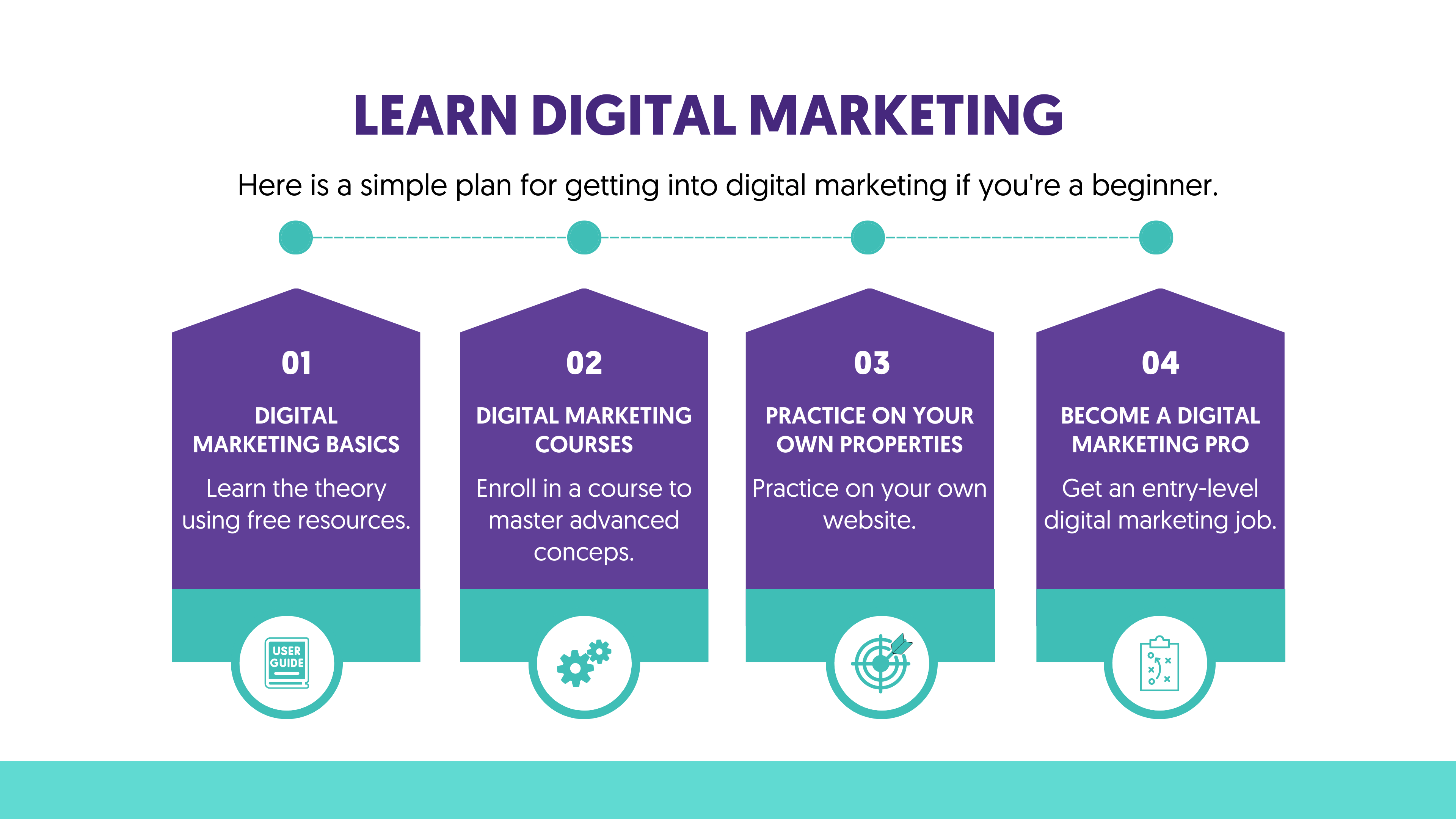
Step 1: Learn The Basics of Digital Marketing
There are several free resources you can use to learn what digital marketing is and how it works.
For this part, you only need to allocate a few hours. It’s the easiest part of the process, but it’s not less important.
As a beginner, you need to understand how the different components of digital marketing can work together for the maximum possible results.
We’ve hand-picked some high-quality resources you can use to understand the basics.
Step 2: Digital Marketing Courses
After you learn the basics, the next step is to follow a more structured learning approach and learn the specifics of each digital marketing channel.
We suggest using an online course for this purpose since many great courses are available that will save you a lot of time than trying to learn using free resources.
Courses vary a lot in length and price. Self-paced courses like our Digital Marketing Full Course ($127, 21 courses) can be completed in a few weeks to a couple of months. The Google Digital Marketing & E-commerce Certificate costs $49 per month on Coursera, and Google says most learners finish in 3 to 6 months (see our full review). University programs and bootcamps take longer and cost much more.
If you’re not sure which type of course fits you, start with our list of digital marketing courses for beginners.
Instead, you can use our guides below to find the best course for your needs and budget.
Step 3: Practice on Your Own Properties
This is an important step that many people entering digital marketing neglect.
You cannot learn digital marketing by studying only the theory. Digital marketing is a highly practical discipline, and this means that in order to become an expert, you need to do a lot of practice.
The best way to practice is to start a website and apply the techniques that you’ll learn through a course (step 2) to get traffic to your website using SEO, social media, paid ads, and other methods.
Many of our students ask me if it’s possible to learn digital marketing without going through the process of creating a website and publishing content, and the answer is no.
Even if you learn the theory well, you won’t be able to work as a digital marketer if you don’t have practical hands-on experience.
When you have your own website or blog and try to rank for your chosen keywords in Google, you’ll learn many valuable lessons along the way.
You’ll have to build several skills, including keyword research, SEO, copywriting, CRO, and many others, that will prove very valuable in your digital marketing career.
In addition, doing this work will help you build self-confidence, a factor that is super-important if you want to start your own digital marketing agency or do consulting work.
Step 4: Become a Digital Marketing Pro
The next step is to put your skills to the test by applying for an internship or entry-level job.
Getting an entry-level digital marketing job is necessary for new digital marketers because it will give you a chance to work with experienced marketers and learn various techniques and strategies they are using.
An established digital marketing team, either in an agency or in a digital marketing department of a company, will have processes, workflows, and standards you can learn from that are proven to work.
This way, you won’t have to wonder what the best approach to optimize a campaign is, but it’s a matter of following a blueprint with more chances of getting positive results.
What Speeds Up Learning Digital Marketing?
Some people become job-ready in three months, while others take a year. These factors make the biggest difference:
- Hands-on practice: running your own website, social accounts, or a small ad campaign teaches you far more than theory alone.
- Specializing first: trying to master every channel at once slows you down. Learn the basics of all channels, then go deep in one, such as SEO or paid ads.
- Prior experience: skills like writing, design, sales, or working with data transfer directly to digital marketing roles.
- A structured course: a good course gives you a clear order to learn things in, so you don’t waste time piecing together free resources.
Is it Hard to Learn Digital Marketing?
Digital marketing is not hard to learn, provided that you’re willing to put in the required effort to go through the necessary learning curve. How steep the learning curve will be depends on your background and previous experience.
If, for example, you have a degree in Marketing, digital media, or Journalism, it will be easier for you to understand the different concepts, and learning will be faster.
If you have no degree or a degree in a totally different subject, you’ll need to work harder in the beginning to understand the specifics of the digital marketing landscape.
The good news is that anyone can start a digital marketing career with or without a degree.
There are many courses and certifications (like the ones listed above) that require no prior experience and will teach you everything you need from the beginning.
Does Learning Have a Start and Finish?
One of the things you need to realize from the beginning is that digital marketing learning never stops.
Maybe a degree and certification are enough in other industries to become a pro and work in the field, but that’s not the case with digital marketing.
The industry constantly changes with new technologies and tools that affect digital marketing. A recent example is AI tools like ChatGPT, Gemini, and Claude, which have changed how marketers research, write, and analyze campaigns.
The key takeaway is that once you get into digital marketing, you must be prepared for lifelong learning and development.
Learning digital marketing does not have a start and finish point; it’s a continuous process.
Is Digital Marketing a Good Job?
Yes, for most people who enjoy a mix of creativity and data. Demand is growing: the US Bureau of Labor Statistics projects employment of market research analysts and marketing specialists to grow 7% from 2025 to 2035, much faster than average. Many roles can also be done remotely or as a freelance digital marketing professional.
Pay depends on your role and experience. According to Indeed, the average base salary for a digital marketer in the United States is $66,033 per year, and managers and specialists in areas like SEO and paid ads earn more. See our guide to digital marketing salaries and the list of highest-paying marketing jobs. For the pros and cons of the career in more detail, read is digital marketing a good job.
Conclusion
Learning digital marketing is a continuous process. While you can learn the basics and get started in 3-5 months, learning never stops.
Digital marketing is a dynamic industry that changes all the time. Once there was Facebook, then came TikTok, and then AI was introduced.
Successful digital marketers are constantly educating themselves to stay current and find ways to use new technology to create better and more effective campaigns.
How Long to Learn Digital Marketing FAQ
Can I learn digital marketing in 1 month?
You can learn the basics in a month, such as how the main channels work and the key terms. Becoming job-ready usually takes 3-5 months, because you need practice and a portfolio, not just theory.
Can I learn digital marketing in 3 months?
Yes, if you study close to full time and practice as you learn. Three months is enough to learn the fundamentals, earn a certification, and build a small portfolio for entry-level roles.
Is a digital marketing course easy or hard?
Most beginner courses are not hard, because they start from the basics and need no technical background. The harder part is applying what you learn: running campaigns, reading data, and improving results takes practice.
Is digital marketing still worth learning in 2026?
Yes. Businesses still need people who can bring in customers online, and demand for marketing specialists is projected to keep growing. AI tools are changing how the work is done, so marketers who learn to use them well have an advantage.