
- 1. Fast Results
- 2. Measurable Results
- 3. No Dependency on SEO or Google Algorithmic Changes
- 4. Reach the Right Audience
- 5. Take Advantage of Business Opportunities
- 6. Brand Recognition
- 7. Open Your Doors to Local Customers
- 8. Budget Friendly
- 9. It’s a Great Tool to Test Your Marketing Strategies
- 10. Rich Functionality and Reporting
- Disadvantages of PPC
- Which PPC Campaigns Fit Your Goal?
- Conclusion
- PPC Benefits FAQ

Small businesses can gain many benefits from PPC (pay-per-click) advertising. A well-run PPC campaign is one of the fastest ways to get traffic, leads, and sales, and it helps a business grow while its organic channels build up.
PPC is an excellent tool for reaching your target audience at the right moment and when they are ready to convert.
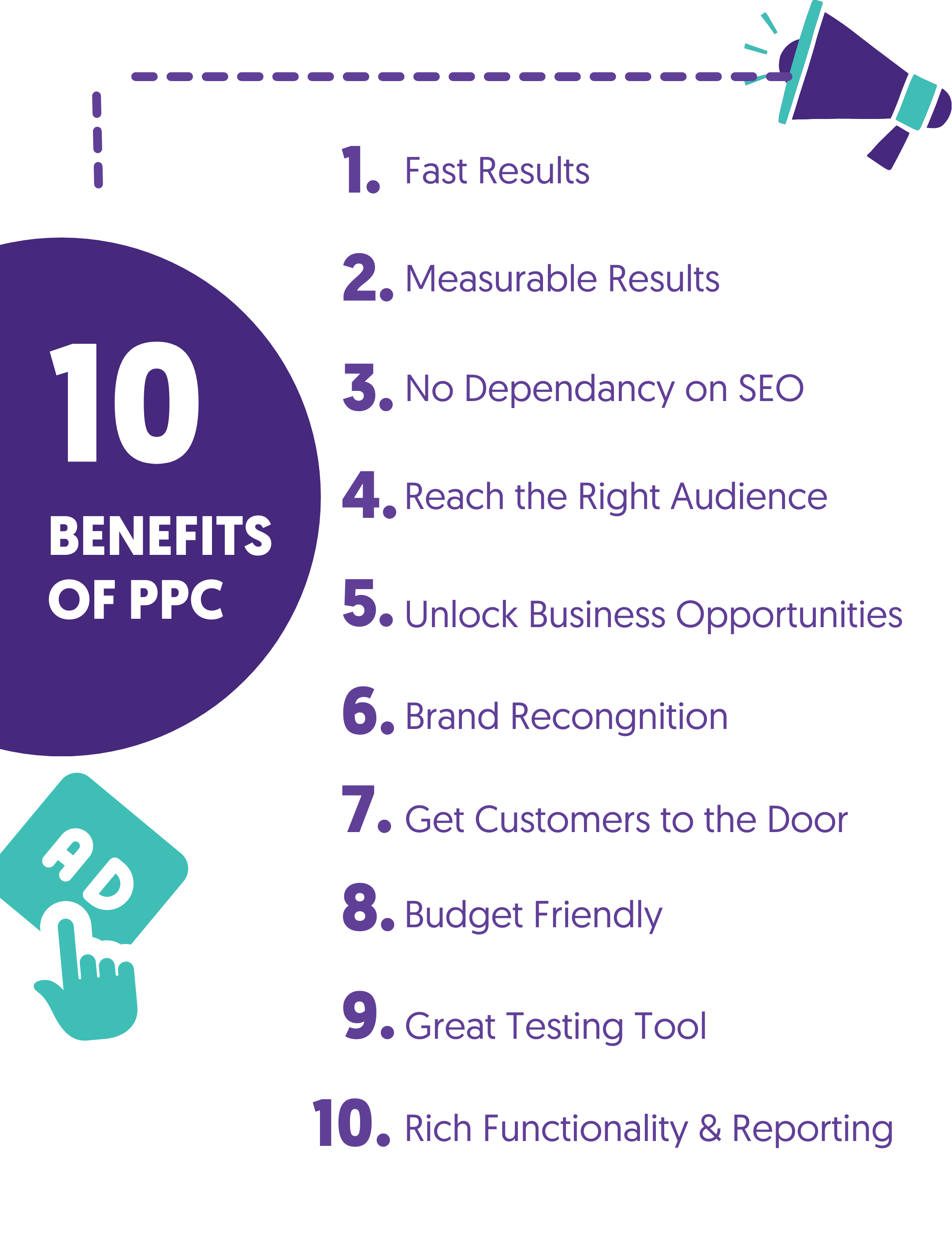
1. Fast Results
Businesses need results, and they want them fast. PPC is one of the fastest ways to get results: your ads can go live within hours, and they reach people who are already searching for what you sell, so they are closer to buying.
To simplify things, if you have a website up and running, you can quickly create a Google Ads account, set up your ads and run them in the Google network and start getting traffic.
This is a very simplified version of how it works, but I just wanted to help you understand that PPC is very efficient in reaching your target audience in the fastest possible way.
2. Measurable Results
Another important benefit of PPC is that everything you do has a clear, measurable target.
You can measure anything related to a PPC campaign, from costs, profits, views, clicks, visits, and more.
When you start a PPC campaign, you know how much you have spent and if you are generating profit or a loss.
There are many reports and KPIs that provide you with all the information you need, data that is essential to marketing departments and CEOs.
3. No Dependency on SEO or Google Algorithmic Changes
I love SEO, and for long-term success, you need to have an SEO-friendly website and also comply with SEO best standards and practices.
BUT one of the nice things about PPC is that once you create profitable campaigns, you don’t need to worry about Google and the changes they are doing to their ranking algorithms.
4. Reach the Right Audience
When running a PPC campaign, you choose where and when your ads will appear based on several factors, including keywords, location, website, device, time and date, and much more.
This flexibility allows you to segment your market and bring your products and services in front of the right audience. You can also use remarketing to show ads to people who already visited your website but didn’t buy. Read more about remarketing and retargeting.
5. Take Advantage of Business Opportunities
Let’s say you sell web hosting packages, and one of your main competitors is offline due to a technical problem.
This is a great opportunity to run a targeted PPC campaign and give those angry customers another option.
This is only possible with PPC because it is easy to implement and generates instant results.
6. Brand Recognition
You can use PPC to target keywords related to your industry so that people searching for those keywords will constantly see your ads.
Although general keywords will not generate more sales, indirectly, they help you increase brand awareness and establish your business as an authority and leader in your industry.
7. Open Your Doors to Local Customers
PPC is highly effective for local search.
People searching using their mobiles for products or services in their area can see your ads, click on them and get instructions on how to reach your store.
If they don’t see your ad, they will probably click on your competitor's ad, and you lose a customer.
8. Budget Friendly
With PPC, you only pay when someone clicks your ad, not for showing it. You set a daily budget for each campaign and can raise, lower, or pause it at any time, so you stay in control of your spending. There is no minimum spend, so you can start small and increase your budget as campaigns prove profitable.
As mentioned above, since everything is measurable, you can easily analyze whether your spending creates a profit or a loss and decide accordingly.
As a rule of thumb, if a campaign is profitable, you can safely spend more money until you reach your maximum ROI.
9. It’s a Great Tool to Test Your Marketing Strategies
Let’s say you want to test which product headline or ad copy will perform better in a campaign.
What you can easily do is setup different ads in a Google Ads campaign, run them for a couple of weeks online and analyze the results.
The ad with the highest CTR (Click Through Rate) probably has the most attractive copy for users. Check conversions too, since the ad that gets the most clicks isn’t always the one that brings the most sales. To measure sales and leads, set up conversion tracking in Google Ads.
10. Rich Functionality and Reporting
PPC platforms like Google Ads and Microsoft Advertising provide the tools to run your campaigns, collaborate with your teammates, and analyze your data and results (reporting).
This is considered a business advantage because without the right tools and reporting system is like swimming in the sea with your eyes and ears closed.
The right marketing strategy tools can give you the right results.
Disadvantages of PPC
PPC isn’t right for every business at every stage. Before you start, consider these drawbacks:
- Costs can add up: in competitive industries, such as legal or insurance, clicks can be expensive, and a poorly managed campaign can spend its budget without bringing sales.
- Traffic stops when you stop paying: unlike SEO, PPC doesn’t build a lasting asset. As soon as you pause your ads, the traffic stops.
- It takes skill to run well: keyword selection, bidding, ad copy, landing pages, and tracking all affect results, and there is a learning curve.
- It needs ongoing management: competitors, costs, and platform features change, so campaigns need regular monitoring and optimization.
If you’re deciding whether to invest in Google Ads specifically, read our guide on whether Google Ads is worth it.
Which PPC Campaigns Fit Your Goal?
The right type of campaign depends on what you want from PPC:
- Leads: search campaigns on keywords that show buying intent, sending people to a landing page with a form or a booking option.
- Online sales: Shopping or Performance Max campaigns that show your products with their price and image, plus remarketing to bring back visitors.
- Local calls and visits: search campaigns targeted to your area, with call and location details added to your ads so people can call or get directions directly.
Conclusion
To take advantage of the above benefits, you need to make sure that:
- You don’t spend more on PPC than the return you get
- You optimize your campaigns - this may take time and effort
- You test different scenarios, ads, and strategies until you find what works best for your business
- You should check what your competition is doing in PPC. There are many tools for checking how your competitors use PPC, and you can use this to get ideas for your campaigns.
PPC has many benefits for businesses, mainly because it can generate fast results by targeting the right people at the right time.
PPC and SEO can work together harmoniously for the best possible results, as they are two of the major components of digital marketing.
Even if you don’t get good results from PPC the first time, you can try again by further optimizing your campaigns or hiring PPC professionals to help you. If you want to learn to run campaigns yourself, our Google Ads Course shows you how to set up and optimize them step by step.
PPC Benefits FAQ
What is the main purpose of PPC?
The main purpose of PPC is to bring targeted visitors to your website quickly by paying for ads that appear when people search for, or show interest in, what you offer. You pay only when someone clicks.
Is PPC better than SEO?
Neither is better; they do different jobs. PPC brings traffic immediately but stops when you stop paying. SEO takes longer but keeps bringing traffic without paying for each click. Most businesses get the best results by using both. See the difference between SEO and PPC.
Is pay-per-click advertising worth it for small businesses?
It can be, if the value of a customer is higher than what you pay to get one through ads. Start with a small budget, track conversions, and scale the campaigns that are profitable. Our guide on whether Google Ads is worth it explains how to work this out.
How much should a small business spend on PPC?
There is no minimum. Many small businesses start with a small daily budget, test for a few weeks, and increase spending on the keywords and campaigns that bring leads or sales.