
Yes, digital marketing is legit. It is how most businesses find customers online, through search engines, social media, email and ads, and it is a real career with real salaries. What is not legit are the schemes that borrow its name: courses that teach you to resell the same ebook, ads promising thousands of dollars in weeks, and "marketing" jobs that turn out to be commission-only sales.
Despite being around for many years, some people still question whether digital marketing is legitimate. This is mainly due to many scams claiming to make a fortune in just a few months with minimum effort.
When people read these claims, they often confuse them with the legitimate efforts made by digital marketers to promote businesses online and help them make money through different digital marketing channels.
What Is Digital Marketing About?
Digital marketing is not a scam but a form of marketing that involves finding people interested in your products or services online. Through advertising, blogging, email marketing, social media postings, and other methods, your goal is to engage with your audience, build trust with your brand, and increase sales.

Here is a quick overview of the main components of digital marketing:
Search Engine Optimization (SEO) involves optimizing your website and content to rank higher in the organic search engine results. It's a process that takes time and considerable effort to get free traffic from Google and other search engines.
Content marketing is the process of creating and distributing valuable, relevant content to attract and engage with your target audience. This can include blog posts, videos, podcasts, webinars, and more.
Social media marketing is about getting traffic and making sales from social media platforms like Facebook, Instagram, X (Twitter), and LinkedIn.
Pay-per-click (PPC) marketing helps you get traffic by paying for ads that appear on search engines or social media platforms. You only pay when someone clicks on your ad, making it a cost-effective way to reach a targeted audience.
Email marketing is still one of the most effective ways to keep your audience informed and engaged and convert them into customers.
Affiliate marketing is a great way to scale up your business by giving commissions to others to sell your products and services.
Influencer marketing is a form of marketing that involves collaborating with influencers with a large following to promote your brand to their audience.
There are other types of digital marketing, but the above are the most effective channels applicable to almost all businesses.
How Can Digital Marketing Legitimately Help Businesses?
Now that you've seen what digital marketing is all about, let's see the benefits it can offer to businesses.
Increased Online Exposure
By optimizing your website for search engines (SEO) and using social media marketing, your business can appear in front of more potential customers actively searching for your products or services.
Precise targeting
Digital marketing allows you to target specific demographics, interests, and behaviors. This means your ads reach the people most likely to be interested in what you offer, increasing the ROI of your marketing spend.
Cost-Effective
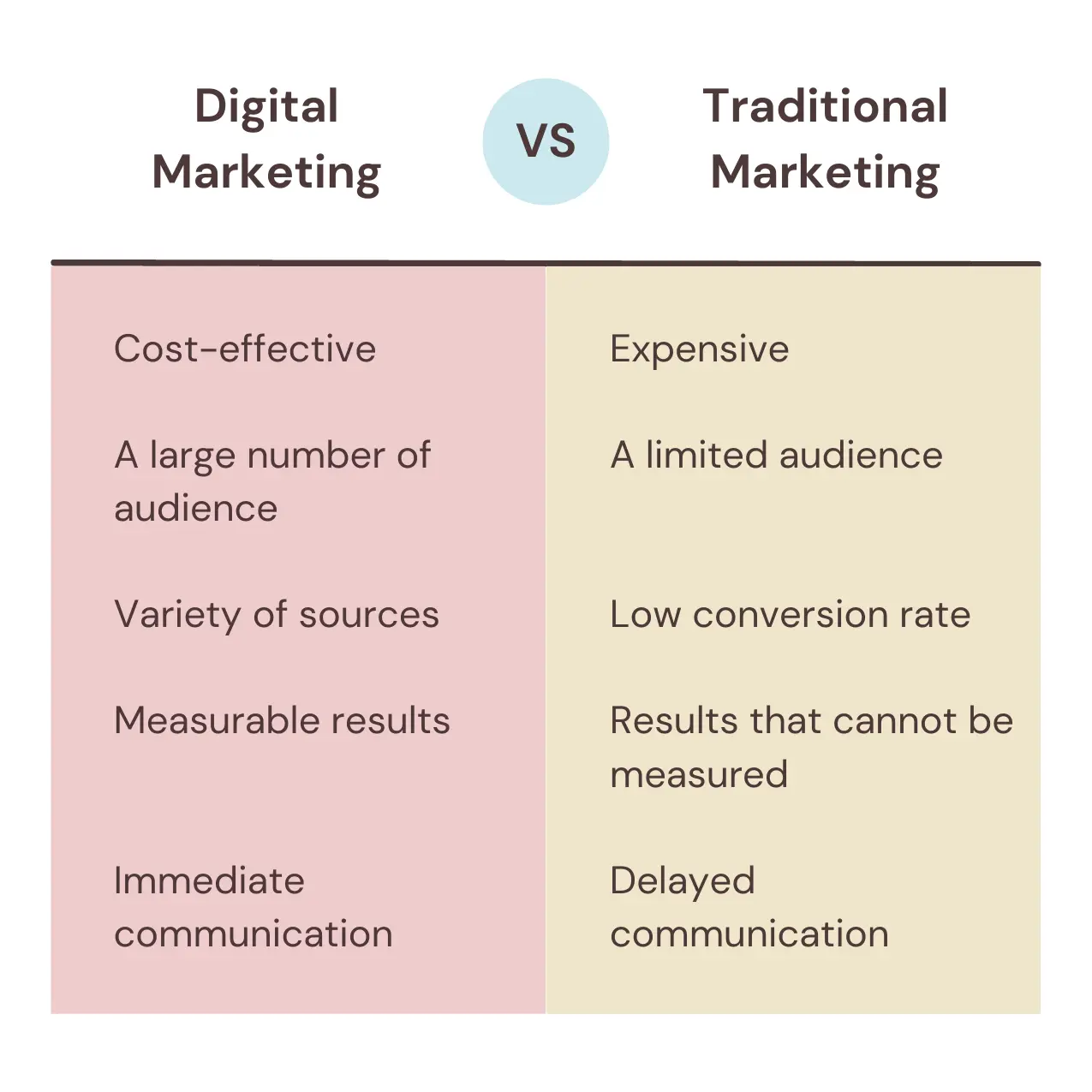
You can start digital marketing with a small budget and measure the return on every dollar you spend, which is much harder with traditional marketing. You can track and analyze the performance of your campaigns in detail to see what's working and what isn't, enabling you to make data-driven decisions.
Customer Engagement
Unlike traditional marketing, digital marketing allows you to engage with your audience directly. Channels like social media and email marketing allow you to interact with your customers, respond to their comments, answer their questions, and build trust and loyalty with your brand.
Brand Awareness
There is no other marketing technique than online marketing that can help boost brand awareness. By having a presence in all networks your potential customers are using, users become more familiar with your brand, increasing the likelihood of becoming customers and later brand ambassadors.
Global Reach
The internet allows you to reach a global audience, tap into new marketing, grow your customer base worldwide, and compete with businesses of all sizes and types.
Why Do Some People Consider Digital Marketing A Scam?
Digital marketing has many advantages but also a bad reputation. This is due to misconceptions that have emerged over the years and the negative experiences of people tricked into thinking that digital marketing is a quick, rich scheme.
Let's see some examples that contribute to this:
Unrealistic Promises
Many agencies or individuals claim they can deliver instant results or guarantee top rankings on search engines. These promises often lead to disappointment when results don't match expectations. Google itself warns that no one can guarantee a #1 ranking on Google.
For example, if you see this on TikTok, you get the impression that there is a magic way to get an insane amount of free traffic from SEO that will lead to more sales.

The expectations raised by this video are far from the truth. Yes, there are legitimate ways to get free traffic from search engines through SEO, but that requires a lot of effort and good knowledge of how search engines work, how algorithms work, how content marketing works, and more.
So, people who fall into this trap and follow whatever unsolicited advice they find on the Internet that is not based on facts and practices proven to work will feel disappointed and believe that digital marketing is indeed a scam.
Lack of Proper Training and Experience
Reading a post on digital marketing does not make you an expert. Learning digital marketing requires training and practice. Some people, instead of putting in the required effort to get educated and try what they've learned in practice to see if it's working or not, they look for shortcuts that do not exist.
I've been practicing digital marketing for over 20 years, and I have seen a lot of companies and individuals making bold promises that every single one has failed.
So, to protect yourself from these scams, get educated on digital marketing best practices. There are many digital marketing courses, certificate programs, and free resources you can take online to learn basic and advanced concepts.
When you know what digital marketing is all about and how it works, you can differentiate between unrealistic advice and what actually works in reality.
Black Hat Techniques
Black hat SEO involves practices that are outside what Google accepts. Search engines have spam policies and guidelines, and violating them can produce short-term results, but eventually, it can be catastrophic for your brand and digital marketing efforts.
Keyword stuffing, cloaking, link spam such as buying links, and scaled content abuse (mass-producing pages with AI or any other method to manipulate rankings) are all named in Google's spam policies. They can lead to Google penalties and should be avoided for long-term success.
Similarly, buying social media followers and using fake comments may inflate your online presence temporarily but fail to engage real users, ultimately harming your brand's credibility.
Unverified Claims
Many individuals talk about their success with digital marketing but fail to provide data to back up their claims. They often use these unverified success stories to sell products or services, misleading people into believing in guaranteed outcomes.
Always look for case studies and verified testimonials when evaluating the effectiveness of a marketing strategy or service. Don't just blindly believe what people say or show. Do your own research in forums and review sites before hiring a company or individual to work on your marketing.
Lack of Transparency
Some marketers do not provide enough information about where the money is spent, what actions were taken, and what the results were. This lack of transparency can make clients feel unsure about the value of their investment. To avoid this, ensure you work with marketers who offer detailed reports and clear explanations of their strategies and outcomes.
Cheap Services
Does it make sense to pay someone a few hundred dollars monthly and expect them to generate thousands of dollars in profit for your company? It does not. Making money with digital marketing is feasible, but hiring someone experienced who will deliver good results costs money.
That does not mean you should overpay for services (because this also happens), but you should try to find the right consultants to get results at a reasonable cost.
Scams Disguised as Digital Marketing
Most of the "digital marketing is a scam" stories you see online are not about digital marketing at all. They are about schemes that use the name because it sounds modern and easy.
These are the ones to watch for:
Ebook and course reselling schemes
You see a video on TikTok or Instagram of someone working from a beach, claiming they make money with "digital marketing". The offer is a course or ebook, often sold with "master resell rights" (MRR) or as a "done for you" digital product, that you can then sell to others.
The catch is that the product mostly teaches you how to sell the same product. The money comes from recruiting the next buyer, not from marketing anything real. That is how a pyramid scheme works, which is why many people call it "the new MLM".
Get-rich-quick ads
Ads promising $10,000 in 30 days with no experience, or a "secret system" that makes money on autopilot, are selling a course, not a result. Real digital marketing income grows slowly as your skills and your client list grow.
Fake marketing jobs
Some job ads for "entry-level marketing" or "brand ambassador" roles are really commission-only sales jobs, often door-to-door or in retail stands. A real marketing job describes marketing tasks (campaigns, content, analytics, ads) and pays a salary or a clear fee.
Shady agencies
Agencies that promise page-one rankings in days, sell thousands of followers, or refuse to explain what they do with your money give the whole industry a bad name. The work they deliver, if any, rarely survives.
If you have seen any of these, you were right to be suspicious. But the scam is the scheme, not the skill.
How to Check a Digital Marketing Course, Job, or Agency
Before you pay for a course, accept a job, or hire an agency, run through the checklist that fits.
A digital marketing course is legit if:
- It teaches skills a business would pay for, such as SEO, ads, email or content, not how to resell the course.
- It shows the full curriculum and who teaches it before you pay.
- It does not promise a specific income.
- It has a clear price and refund policy, with no pressure to upgrade to a "higher tier".
A digital marketing job is legit if:
- The description lists real marketing tasks, not only sales.
- It pays a salary, an hourly rate, or a clear project fee, not commission only.
- It does not ask you to pay for training, a starter kit, or equipment.
A digital marketing agency is legit if:
- It does not guarantee rankings or results by a date.
- It explains its strategy and sends regular reports you can check yourself.
- It can show case studies and clients you can contact.
- Its prices are realistic for the work involved.
The simplest test covers all three: legitimate digital marketing makes money by marketing a real product or service for a real business. If the money comes from recruiting people or selling the dream, walk away.
If you want to learn digital marketing properly, see our guide on how to learn digital marketing, or read whether affiliate marketing is legit if that is the offer in front of you.
The Final Verdict
Digital marketing is legit and a highly effective way to promote a business online. It's the new way of marketing utilizing digital channels to reach a global (or local) audience interested in your offerings.
Finding success with digital marketing campaigns takes time and effort. You cannot build an online empire overnight (or even for a few months). It takes months to see results from most channels, and years to build strong online visibility and turn it into sales and profit.
Some people take advantage of the needs of people and companies and exploit their lack of knowledge, promising quick results with minimal effort. To avoid falling into these traps, it's crucial to educate yourself on digital marketing best practices, set realistic expectations, and work with reputable professionals.
If you want a structured way to learn the real thing, our Digital Marketing Course covers SEO, ads, social media, email and content, with a clear price and a money-back guarantee.
Frequently Asked Questions
Is digital marketing real or fake?
Digital marketing is real. Businesses of every size use search engines, social media, email and online ads to find customers, and they employ people to do it. What is fake are the schemes that use the name to sell ebooks or courses about getting rich quickly.
Is digital marketing a pyramid scheme?
No. Digital marketing is a set of marketing skills used to promote real products and services. Some schemes that call themselves "digital marketing" work like pyramid schemes, because buyers make money mainly by recruiting the next buyer. That is the scheme, not the profession.
Does digital marketing pay?
Yes. Digital marketing is a paid profession with in-house, agency and freelance roles. Pay depends on the role, your experience and where you work. Our guide to digital marketing salaries breaks down what different roles earn.
Can digital marketing be done from home?
Yes. Most digital marketing work happens online, so many jobs and freelance projects are fully remote. See our guide on doing digital marketing from home for how to get started.
How do beginners start digital marketing?
Start by learning the basics of one channel, such as SEO, social media or ads, then practise on your own project or a small business. Our guide on how to get into digital marketing shows the steps without a degree.