

SEO is easy to learn at a basic level but hard to master. Most beginners understand the main ideas within a few weeks, while getting consistent rankings against strong competitors takes months of hands-on practice. All you have to do is be willing to allocate the necessary time and effort to learn the various SEO concepts and apply them on a real website.
If you are just getting started with SEO and wondering what it takes to go from novice to expert, this post is for you. You’ll learn which parts of SEO are easy and which are hard, how long it takes, and the path to follow to make the learning process less complicated than it seems.
I started with SEO more than 20 years ago, and it took me a couple of years to get a fair understanding of what is SEO and how it works.
Fortunately, things have changed, and you don’t have to spend years learning SEO. There are a plethora of online resources you can use to start learning SEO, and why not become an SEO expert in no time!
Is it Hard to Learn SEO if You Don’t Know Anything?
Learning SEO is not hard. It is challenging initially because there is a lot of information to read about search engines and how the optimization process works. But, if you take it step-by-step and follow a structured learning approach, everything will make sense, and the whole process will become easier.
It helps to know which parts of SEO are easy and which take longer.
The easy part: the basics
- Keywords - finding the words and questions people type into search engines.
- On-page SEO - writing helpful content and adding proper titles, headings, and descriptions.
- Links - connecting the pages of your website and understanding why links from other websites matter.
The hard part: mastery and results
- Competition - ranking for popular keywords against websites that have been doing SEO for years.
- Technical issues - finding and fixing crawling, speed, and site structure problems.
- The waiting game - it can take months to see if a change actually worked, so you learn slowly from your own results.
- Constant change - search engines keep changing, so you have to keep learning.
A learning plan will keep your focus on the critical aspects of SEO and help you build your skills and knowledge gradually as you go along.
What’s the SEO learning curve like?
It will be very steep at the beginning because, besides SEO, you’ll have to familiarize yourself with concepts related to search engines and digital marketing.
This is necessary in order to understand the role of SEO in online marketing. Once you pass this phase and start practicing SEO, it will be smoother and easier to manage.
Do I need a computer science or marketing degree to learn SEO?
No, you don’t need a formal education to learn SEO. As you will see below, there are many online courses you can follow to become SEO certified.
Can I learn SEO on my own?
Yes. Plenty of SEO professionals started out self-taught. You can learn the theory from free guides and courses, and the practice from optimizing your own website.
When does SEO learning stop?
SEO learning never stops. Google reported 4,781 launches (changes) to Search in 2023 alone, meaning you must keep enriching your skills and knowledge.
One of the best and fastest ways to learn SEO is to follow a good SEO course. A high-quality course will help you understand SEO without spending endless hours searching for this information from random resources on Google.
Get Started
How Long Does It Take To Learn SEO?
On average, it takes four to six months for a beginner to learn the basics of SEO well enough to apply them with confidence. Mastering SEO takes longer, usually a year or more of practice. The actual time depends on the effort and time you will allocate.
Here is what to expect at each stage:
| Stage | Time | What you can do |
|---|---|---|
| Getting started | First 2 to 4 weeks | Understand how search engines work, the main SEO terms, and the different types of SEO |
| The basics | 1 to 3 months | Do keyword research, optimize pages, and use Google Search Console on your own website |
| Applying it | 4 to 6 months | See the results of your first changes and know which actions move rankings |
| Mastery | 6 to 18+ months | Rank for competitive keywords, fix technical problems, and run SEO campaigns for others |
| Staying current | Ongoing | Follow Google updates and changes in AI search |
Keep in mind that learning the SEO theory will tell you what you should do to make your website SEO-friendly, but it’s how you apply the SEO principles in practice that will make a difference to your rankings and traffic.
During this period, most of your time will be spent practicing SEO and not just reading the theory.
The reason that I gave four to six months as a minimum period is that it takes time for SEO to work, and you may have to wait a couple of months (or more) to see the impact of SEO-related changes on a website.
I’ve mentioned above that one of the best ways to learn SEO as fast as possible is to follow a learning plan, which is exactly what you’ll read below. Here is a diagram outlining the SEO learning process.
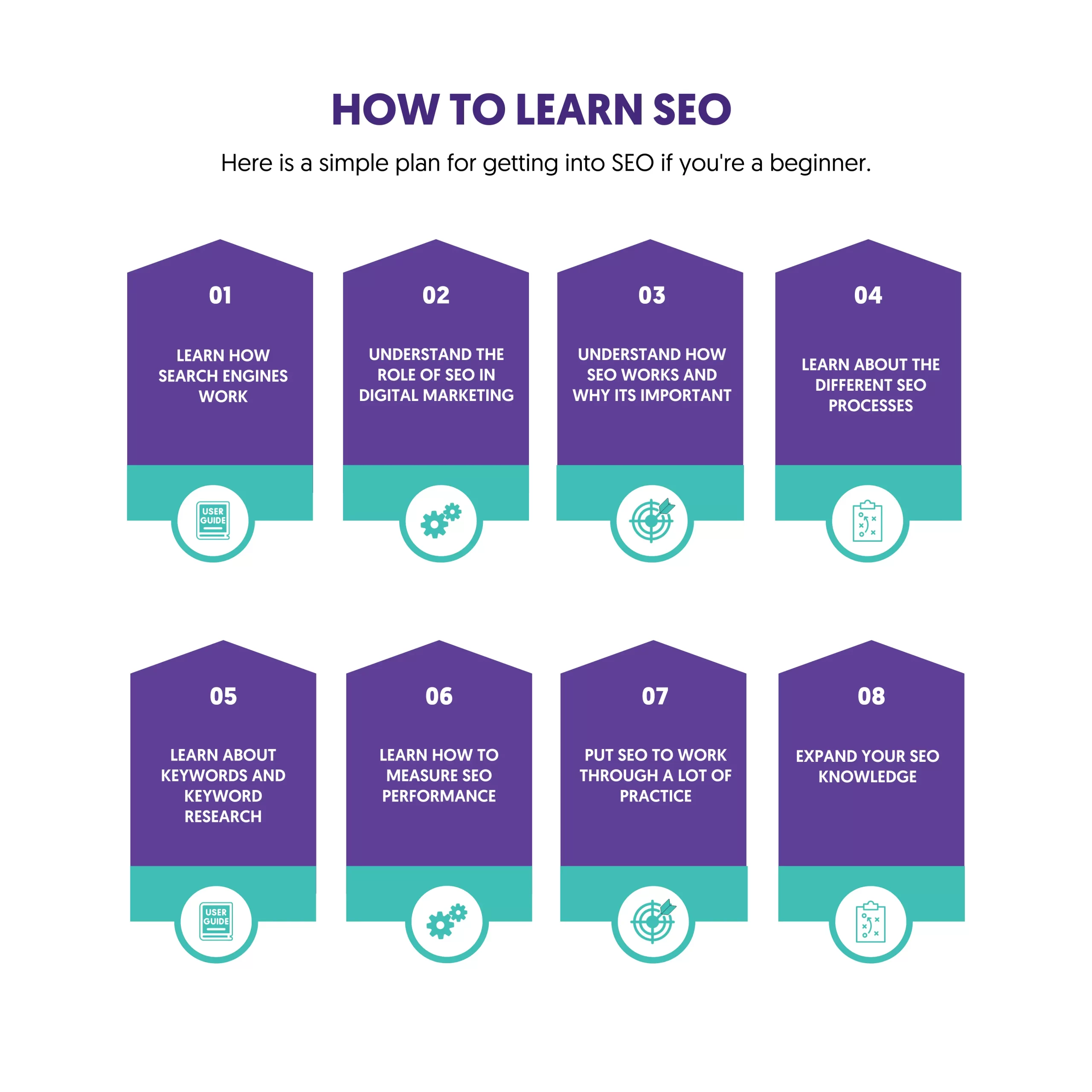
So, if you want to learn how to do SEO on your own, follow these steps:
SEO Learning Plan For Beginners
- Learn How Search Engines Work
- Understand The Role of SEO in Digital Marketing
- Understand What SEO Is and Why It’s Important
- Learn About The Different SEO Processes
- Learn More About Keywords And The Keyword Research Process
- Learn How To Measure SEO Performance
- Put SEO To Work
- Expand Your SEO Knowledge
1. Learn How Search Engines Work
SEO stands for Search Engine Optimization, and since the whole process has to do with how to increase the visibility of a website in search engines, it makes sense to know how search engines work.
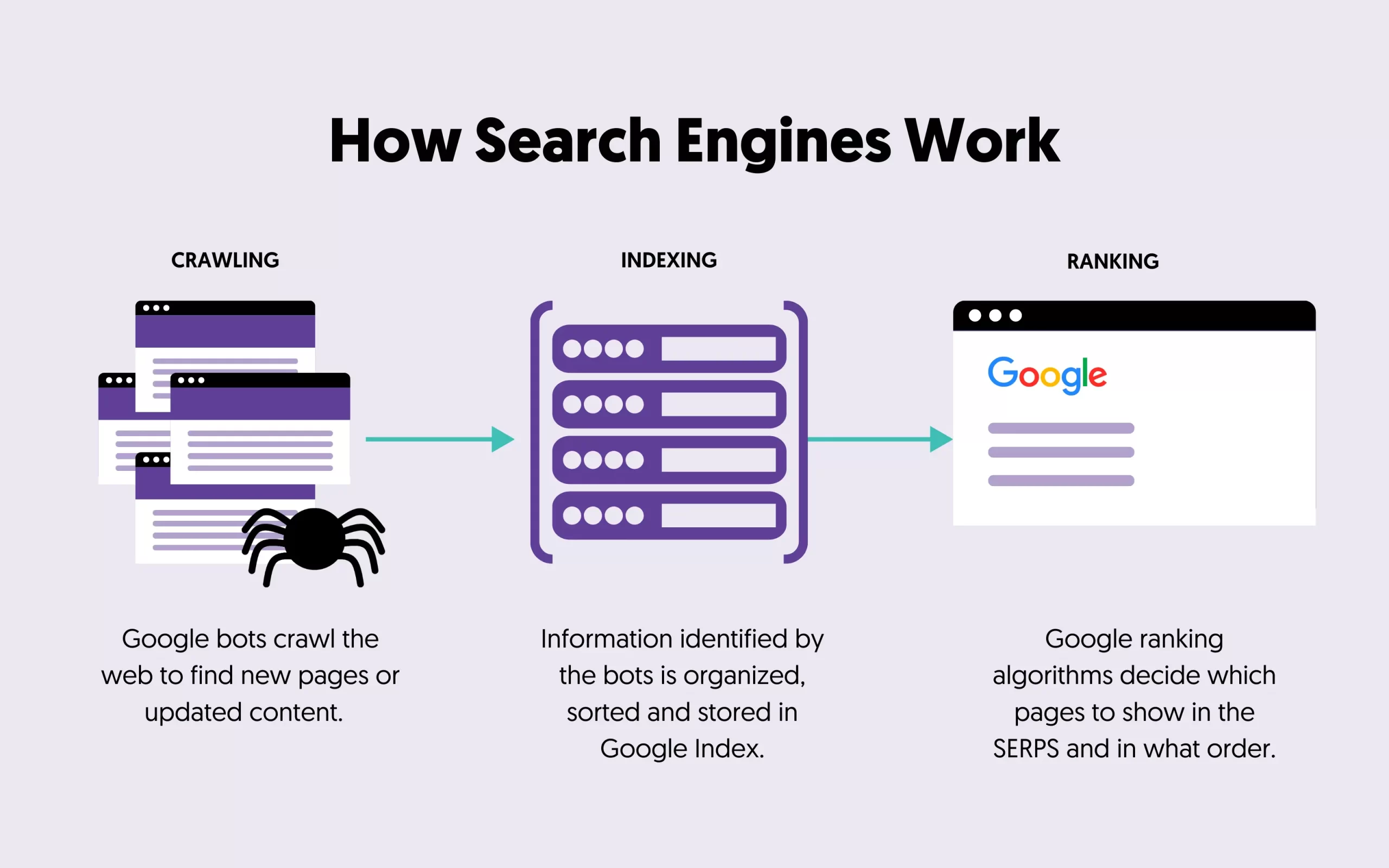
In a nutshell, search engines follow a three-step process: crawling, indexing, and ranking.
- Crawling - during this process, search engine spiders (also known as bots) crawl the web to find new pages and changes made to existing pages.
- Indexing - information gathered from the first stage is organized, sorted, and stored in an index.
- Ranking - when a user types a query in the search box, ranking algorithms decide which pages to show in the SERPs and what order.
From an SEO perspective, it's important to ensure that crawlers can access your content without problems and that you give the right signals to the ranking algorithms so that they can understand what your content is about.
Remember that the whole process is done without human intervention, so it's your responsibility to make the job of search engines as smooth as possible.
A good free starting point is Google’s own SEO Starter Guide, which explains the essentials in plain language, straight from the search engine you are optimizing for.
I highly recommend reading the related guides below and watching the video. They will give you a very good idea of how search engines approach the crawling, indexing, and ranking of websites in their results.
2. Understand The Role of SEO in Digital Marketing
Before getting into the nuts and bolts of SEO, you should have clear in your mind what is the role of SEO in digital marketing.
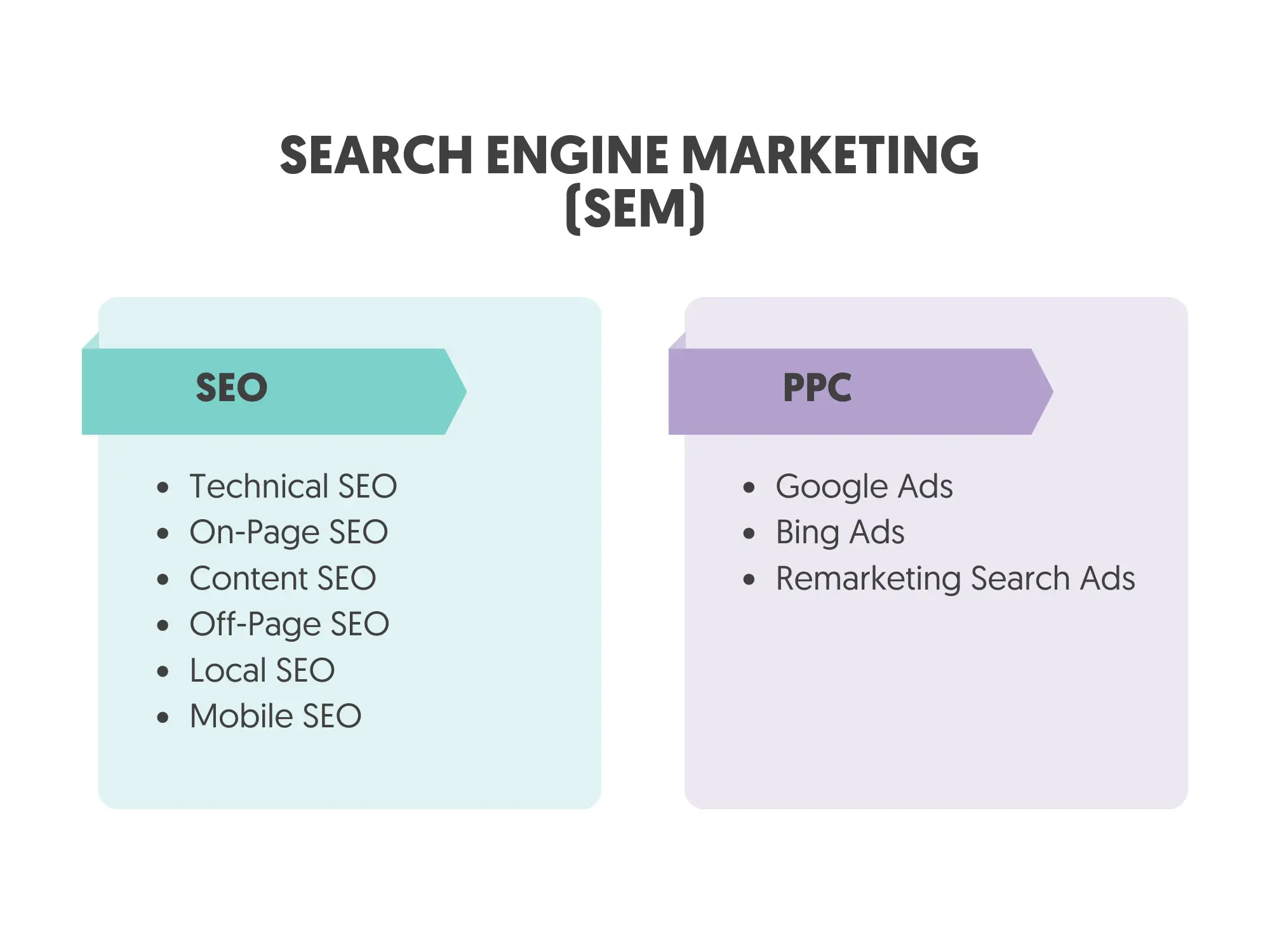
SEO is part of search engine marketing. SEM is the process of getting traffic from search engines either organically (through SEO) or using paid search ads.
SEM is one of the channels available in Digital Marketing. Other channels include Social media marketing, email marketing, content marketing, etc.
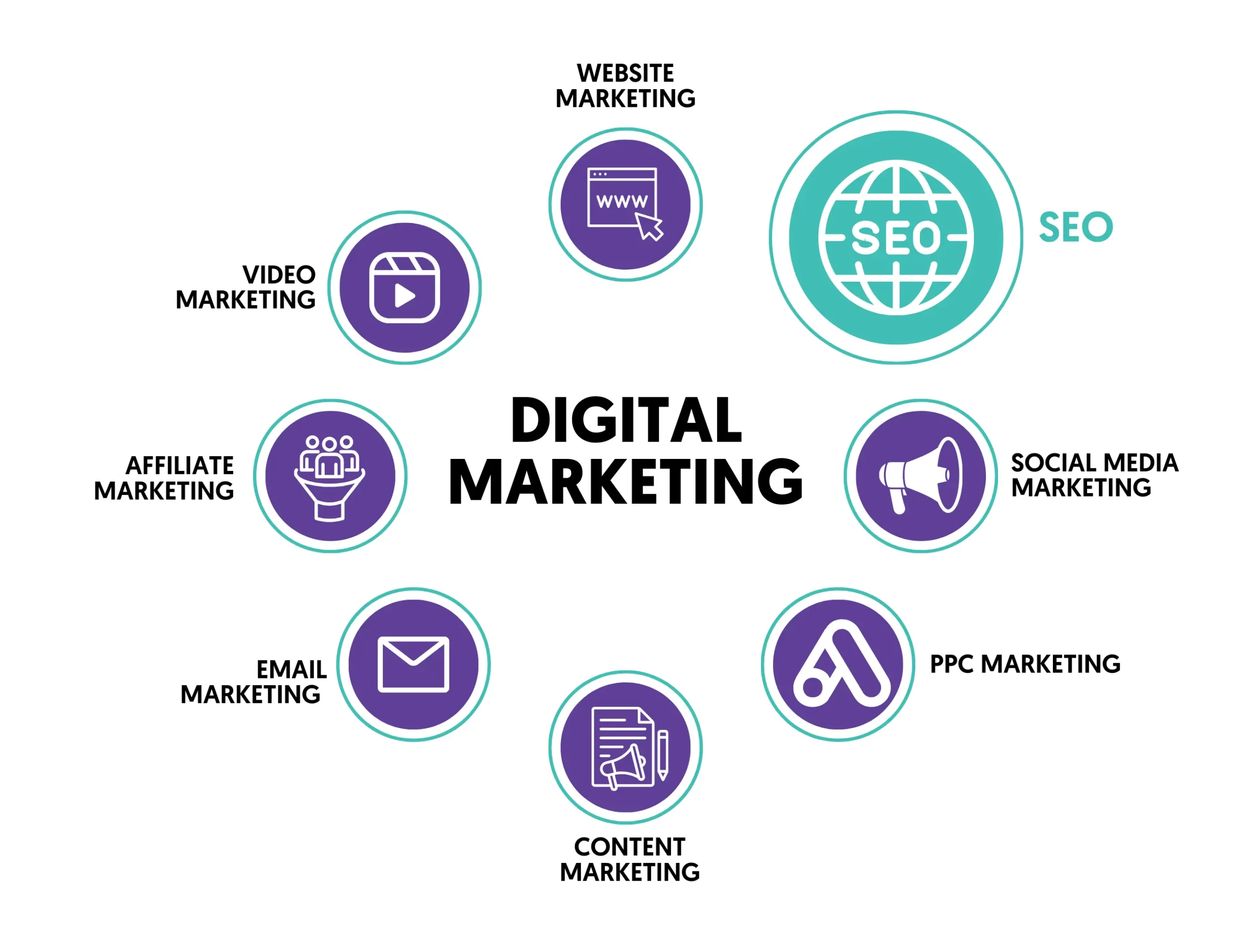
So, SEO is not the same as paid advertising, and it’s not the only component of search engine marketing.
3. Understand What SEO Is and Why It’s Important
The next step is to understand what we mean when discussing search engine optimization and why it’s an important process for any website.
SEO can be defined as a set of rules you can apply on a website so that it appears in the top positions in the search engine result pages (SERPS) for related keywords.
Why is this important?
The majority of search engine traffic goes to the websites that appear in the first 5 positions of the search results.
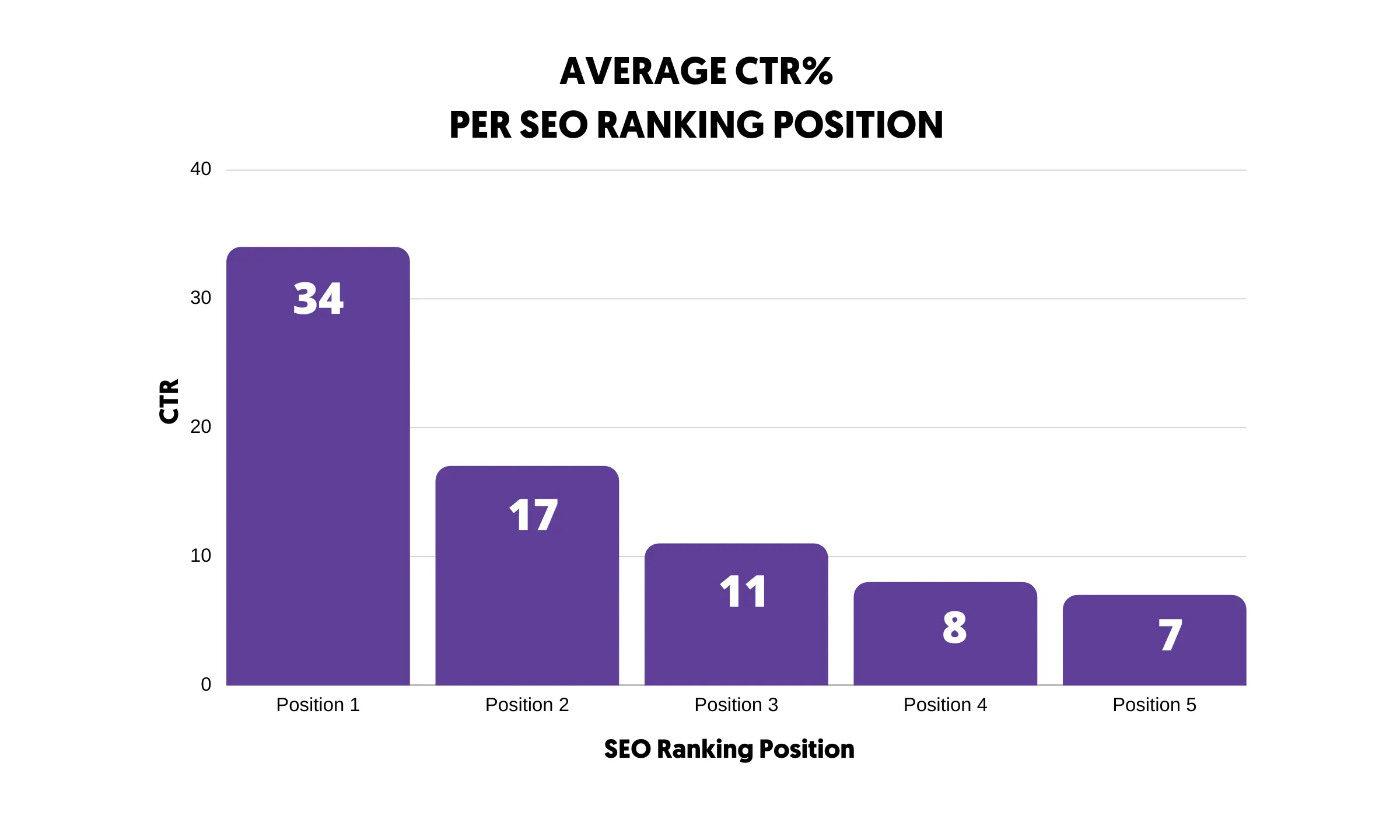
This means that if you want to get traffic from Google and other search engines, your website has to appear in the top positions for the search terms that matter to your business.
4. Learn About The Different SEO Processes
Now that you know what is SEO, the next step is to learn how it works.
Search engines use hundreds of signals to rank pages, and for ease of reference, the work of optimizing a website for them is broken down into a number of sub-processes.
Each sub-process is responsible for a number of SEO rules.

The most important are:
- Technical SEO - the process responsible for the crawling and indexing phase.
- On-Page SEO - the process responsible for optimizing the content of a page so that search engine crawlers can understand it better.
- Content - creating helpful, people-first content that answers what searchers are looking for better than the pages already ranking. Without good content, the other processes have little to work with.
- Off-Page SEO - the process of promoting your website on the Web for the purpose of getting links from other websites. Links in SEO act as ‘votes of trust’ and can positively influence the rankings of a website in the search results.
- Local SEO - the process of optimizing your website for location-aware searches.
5. Learn More About Keywords And The Keyword Research Process
When you get to this point, you should already know that everything in SEO starts with a keyword.
SEO keywords are search phrases users type in a search engine that are important for a particular website.
Once you get past the technical SEO phase, which has to do with infrastructure-related settings, the other SEO phases are strongly related to keywords.
The process to find out which keywords to target in your content is called keyword research.
So, mastering keyword research is an integral part of your SEO learning plan.
6. Learn How To Measure SEO Performance
The next step has to do with measuring SEO performance. This is critical because if you don’t know what to measure and what KPIs to analyze, you won’t know if your SEO campaigns are successful or not.
To measure SEO performance, you need to learn how to use two important tools: Google Search Console and Google Analytics.
The Google Search Console (GSC) will give you insights into how your website is performing on Google. You can see which pages receive traffic from Google and for which keywords.
Google Analytics will tell you what users do once they visit your website. You can find out which pages they visit, how long they engage with a page, and a number of other useful metrics.
7. Put SEO To Work
Last but not least, it’s time to put SEO to work. That’s the only way to verify what you have learned in the above steps.
The best approach for beginners is to choose a topic they’re passionate about and start a blog.
It doesn’t have to be something fancy or too popular, just pick a topic you know well, set up a website, and start optimizing it for search engines.
At this stage, you’ll most probably have to re-visit some of the guides and remind yourself how to do keyword research, how to optimize your page titles, how to check that search bots can access your content and a lot of other things.
To avoid getting lost, it’s best to create an action plan and use checklists to help you keep track of what you have to do at each stage. The guide below will show you exactly how to do this.
8. Expand Your SEO Knowledge
As you have seen in the learning plan above, there are many SEO concepts to master, and many things to learn, and having everything you need to know in one place can save you a lot of time and effort.
An efficient way to expand your SEO knowledge is to enroll in an SEO Course. A good SEO course will teach you the basics of SEO and the more advanced concepts. With relevant real-life examples and easy-to-follow instructions, it can make the learning process easier and faster.
SEO Certifications - This list includes the 10 best SEO certifications you can enroll in today. All courses come with an SEO certification that can prove very useful if you plan to pursue an SEO Career.
SEO Training Courses - A list of free resources that can help you get started with SEO.
Google SEO Courses - Learn SEO with official Google SEO training programs.
Choose Your SEO Learning Path
The plan above works for everyone, but where you put the most effort depends on why you are learning SEO.
For your own website or blog: Focus on keyword research, on-page SEO, and content. Learn by optimizing your own pages and watching the results in Google Search Console. Free guides and courses are enough to get started.
For your business: Add local SEO if you serve customers in a specific area, and learn enough technical SEO to brief a developer. Focus on the keywords your customers use when they are ready to buy.
For a career: You need the full skill set, including technical SEO, reporting, and link building, plus proof that you can get results. A structured program and a certificate will help you get there faster (compare the options in our guide to online SEO training), and a website you ranked yourself is the best portfolio item. Our SEO career guide explains the roles and how to get your first job.
Free resources or a course? Free guides and videos are fine for learning the basics. A course saves time when you want a structured path from beginner to advanced and someone to show you how the pieces fit together.
Is SEO Still Worth Learning With AI?
Yes. AI has changed how search results look, but it has not replaced SEO.
Google now shows AI Overviews and AI Mode for many searches, and people also look for answers in tools like ChatGPT. As a result, some searches that used to send clicks to websites are now answered directly on the results page.
What hasn’t changed is where these answers come from. AI search features still find, read, and cite web pages, and Google says that the best practices for SEO remain relevant for AI Overviews and AI Mode, with no special optimizations needed to appear in them.
So the skills in this learning plan (making a site crawlable, creating helpful content, targeting the right questions, and earning links) are the same skills that get a website mentioned in AI answers. What you need to add is a new way to measure success: besides rankings and clicks, check whether your brand appears in AI answers. Our guide on how to check AI visibility shows you how.
Learn SEO: The Bottom Line
It is possible to learn how to do SEO on your own, you don’t have to be an SEO specialist or expert.
The first thing to do is convince yourself that SEO is not hard. If others can do it, so can you. All it takes is the willingness to learn and time.
If you know nothing, don’t get stressed. The basics take a few months, and with the right approach and regular practice, you can be applying SEO with confidence in less than 6 months.
Enrolling in a good SEO Course is the most effective way to teach yourself SEO.
Free resources are enough to learn the basics, but a good course is a small investment that will save you a lot of time and frustration compared to trying to learn SEO on your own without guidance.